
Regulatory compliance in construction means consistently meeting every applicable law, safety standard, environmental requirement, and permit obligation that governs a project from groundbreaking through closeout. Getting this right protects workers, avoids costly enforcement actions, and keeps projects on schedule. The core framework for U.S. construction projects rests on three pillars: OSHA standards under 29 CFR 1926, EPA environmental obligations, and locally adopted building codes such as the International Building Code (IBC). Effective compliance does not happen through periodic checklists alone. It requires documentation systems, role-specific training, scheduled audits, and processes embedded into daily project workflows.
Key components of a functional construction compliance program include:
- Legal and safety standards: OSHA 29 CFR 1926, IBC, International Residential Code (IRC), and NFPA fire codes
- Environmental protocols: Clean Water Act stormwater permits, Clean Air Act dust controls, and RCRA hazardous waste management
- Permit and licensing requirements: Federal, state, and local approvals obtained before site disturbance
- Documentation: Contemporaneous records of permits, training, inspections, incident reports, and subcontractor certifications
- Training programs: Role-specific instruction refreshed at defined intervals
- Audit and corrective action cycles: Scheduled internal inspections with closed-loop resolution processes
What are the key regulatory requirements for U.S. construction projects?
Construction projects in the United States operate under a layered regulatory structure. Federal agencies set baseline standards, while state and local authorities add jurisdiction-specific requirements that often exceed the federal floor.
OSHA construction standards
OSHA’s 29 CFR 1926 establishes legally enforceable safety requirements across every major construction activity. The most operationally significant provisions include:
- Fall protection at heights over 6 feet, covering guardrails, personal fall arrest systems, and safety nets
- Scaffolding safety under Subpart Q, including load ratings, access, and fall protection
- Hazard communication (HazCom) requiring Safety Data Sheets and chemical labeling
- PPE training documented per worker and task
- Confined space entry procedures with atmospheric testing and rescue plans
OSHA violations in construction carry per-instance penalties that escalate sharply for willful or repeated offenses, making proactive compliance far less expensive than reactive correction.
EPA environmental obligations
The EPA’s construction sector requirements cover stormwater, air quality, and hazardous materials. Projects disturbing one acre or more must obtain a National Pollutant Discharge Elimination System (NPDES) Construction General Permit under the Clean Water Act before breaking ground. Clean Air Act regulations govern fugitive dust, diesel emissions, and demolition-related asbestos. The Resource Conservation and Recovery Act (RCRA) controls hazardous waste generated during renovation and demolition, including asbestos and lead paint removal, both of which require advance notifications and certified contractors.
Building codes and fire standards
Building codes are adopted and enforced by state, local, tribal, and territorial entities. The IBC and IRC serve as the primary model codes in most U.S. jurisdictions, though each jurisdiction may amend them. Fire officials enforce NFPA codes separately, and some projects require fire safety inspections throughout the building’s lifecycle, not just at construction completion. Federal buildings follow additional energy efficiency standards under the Energy Conservation and Production Act (ECPA).
Permits, licensing, and documentation
Every project requires a permit matrix that maps required approvals to project phases. Typical documentation includes:
- Building permits and zoning approvals
- NPDES stormwater permits and Stormwater Pollution Prevention Plans (SWPPPs)
- Subcontractor licenses and insurance certificates
- Asbestos and lead abatement notifications
- Inspection records and certificates of occupancy
Collecting subcontractor certificates at the first payment application and activating environmental permits before any site disturbance are two scheduling milestones that prevent last-minute compliance gaps.
Why does regulatory compliance matter so much in construction?
Non-compliance carries consequences that extend well beyond a single fine. Stop-work orders halt all site activity, triggering liquidated damages, subcontractor idle-time claims, and schedule delays that compound daily. Litigation risk rises sharply after a recordable incident when OSHA citations are on record, because those citations become evidence of known hazards. Insurance carriers also scrutinize compliance histories when underwriting builder’s risk and general liability policies.
Worker safety is the most direct stake. OSHA’s construction standards exist because construction consistently ranks among the highest-risk industries for fatal and serious injuries in the United States. Fall protection, confined space controls, and hazard communication requirements each address hazard categories that have caused documented fatalities. Compliance with these standards is not a bureaucratic exercise; it is the mechanism by which firms prevent those outcomes.
Proactive compliance also produces measurable financial advantages. Projects that maintain clean permit records and pass inspections on the first attempt avoid re-inspection fees, schedule extensions, and the overhead cost of managing enforcement correspondence. Clients and owners increasingly require demonstrated compliance histories before awarding contracts, particularly on public and institutional work.
Pro Tip: Leadership commitment is the single most critical factor in achieving lasting compliance. Senior management must set the organization’s risk tolerance, visibly champion compliance efforts, and allocate resources accordingly. Without that tone from the top, compliance initiatives lose authority in the field and tend to erode under schedule pressure.
What compliance risks and challenges do construction projects face?
Construction projects generate compliance failures through predictable, recurring patterns. Recognizing them early is the first step toward preventing them.
- Fragmented tools and inconsistent documentation: When cost tracking, document management, and safety records live in separate systems, version conflicts arise and audit trails break down. Disparate systems are a primary driver of compliance failures on complex projects.
- Overlapping and frequently changing regulations: Federal, state, and local requirements can conflict or update on different cycles. A project team focused on delivery may miss a mid-project regulatory change that affects permit conditions or safety protocols.
- Insufficient or generic training: Workers assigned to specialized tasks, such as confined space entry or lead abatement, need role-specific instruction, not a general site orientation. Generic training programs leave critical knowledge gaps.
- Poor stakeholder communication: When compliance responsibilities are not clearly assigned across the owner, general contractor, and subcontractors, obligations fall through the gaps. Subcontractors in particular may operate under different assumptions about who is responsible for specific permits or notifications.
- Permit and inspection tracking failures: Missing an inspection window or allowing a permit to lapse can trigger stop-work orders even on otherwise compliant projects. Without a centralized tracking system, these deadlines are easy to miss.
- Typical field violations: The most common OSHA citations in construction involve fall protection deficiencies, inadequate scaffolding, missing hazard communication documentation, and lack of eye and face protection. These violations recur because they involve daily site conditions that change as work progresses.
Best practices to ensure regulatory compliance in construction projects
A compliance checklist for builders is a useful starting point, but sustained compliance requires a system, not a document. The following practices form the operational backbone of a construction compliance program that holds up under audit.
Map regulations to each project before mobilization
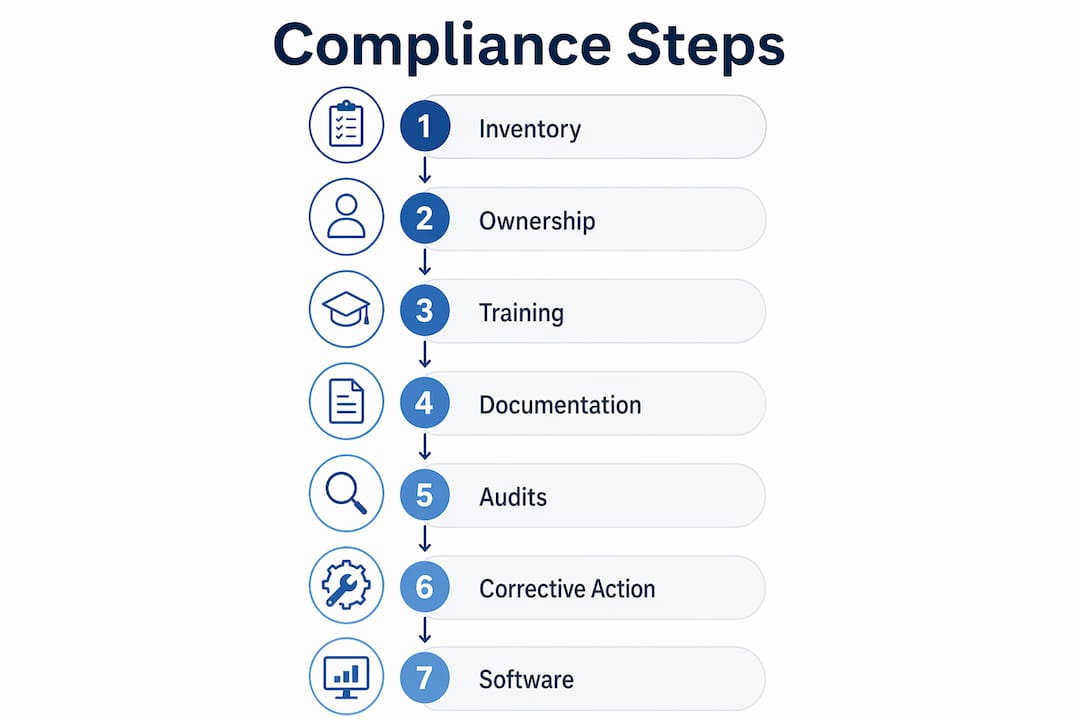
Every project begins with a compliance inventory: a structured review of all applicable federal, state, and local requirements based on project type, location, and scope. This mapping exercise identifies which OSHA subparts apply, which EPA permits are required, and which local amendments to the IBC or NFPA codes are in effect. Completing this before mobilization prevents the reactive scramble that causes permit gaps.
Assign clear compliance ownership
Compliance without named accountability defaults to everyone’s responsibility and no one’s priority. Designate a Compliance Officer or embedded compliance manager for each project. That person owns the permit matrix, the training schedule, the audit calendar, and the corrective action log. On larger projects, assign subpart-specific owners for environmental, safety, and documentation functions.

Implement role-specific, documented training
Training records must document the specific standard covered, the date, the instructor, and each worker’s acknowledgment. Role-specific programs for confined space entry, fall protection, hazardous materials handling, and scaffolding erection are legally required under OSHA and operationally necessary for consistent field performance. Refresh intervals should align with regulatory requirements and project phase changes.
Centralize documentation digitally
Paper binder systems are liabilities during inspections and audits. Digital, centralized documentation that is updated in real time from the field supports audit readiness and provides operational intelligence that paper cannot. Every permit, inspection record, training certificate, incident report, and subcontractor certification belongs in a searchable system accessible to the compliance manager and project leadership.

Pro Tip: Align documentation milestones with project scheduling phases. Collect subcontractor certificates at the first payment application and activate all required environmental permits before any site disturbance begins. Tying compliance tasks to payment and schedule gates is the most reliable way to prevent them from being deferred.
Conduct regular internal audits
Internal audits with standardized checklists reduce OSHA violations by catching problems before regulators do. Schedule audits at defined project milestones, not just at the start and end of a project. Audit scope should cover physical site conditions, documentation currency, permit status, and training record completeness. For audit readiness strategies, the construction compliance audit guide from Tradie Pass provides a practical framework for documentation and workflow preparation.
Build a closed-loop corrective action process
An audit that identifies a deficiency but does not resolve it is worse than no audit, because it creates a documented record of a known problem. Every corrective action must have a named owner, a deadline, and a verification step confirming the issue was resolved before the record is closed. This closed-loop process is what separates firms with sustained compliance from those with recurring violations.
Use integrated compliance software
Integrating compliance workflows into a unified construction ERP or purpose-built compliance platform eliminates the version conflicts and audit failures that fragmented tools produce. The platform should connect permit tracking, inspection scheduling, training records, and incident reporting in a single data environment accessible to field and office teams.
Essential compliance steps, in sequence:
- Complete the regulatory mapping and permit matrix before mobilization
- Assign named compliance ownership roles across the project team
- Activate all required permits before site disturbance
- Deliver and document role-specific training before workers begin assigned tasks
- Integrate permit and inspection deadlines into the project schedule
- Conduct internal audits at defined project milestones
- Log all findings in the corrective action system with owner and deadline
- Verify and close corrective actions before the next audit cycle
- Monitor regulatory updates throughout the project lifecycle
- Maintain all records in a centralized digital system through project closeout
What does current industry research say about lasting compliance?
The most effective construction firms have moved away from treating compliance as a periodic administrative task. System-driven compliance allows companies to scale faster, survive audits more easily, and attract better clients than firms that rely on checklists alone. The distinction is operational: compliance embedded in daily workflows generates contemporaneous documentation automatically, while checklist-based approaches depend on memory and manual effort at the end of a phase.
Leadership’s role in this shift is direct. Senior management that sets explicit risk tolerance, funds compliance infrastructure, and holds project teams accountable creates the conditions for field-level compliance to hold under schedule pressure. Without that organizational commitment, even well-designed compliance programs erode when deadlines tighten.
Digital integration is the enabling mechanism. Fragmented tools cause compliance failures by creating version conflicts and broken audit trails. A unified platform that connects safety records, permit tracking, and documentation management removes those failure points and gives leadership real-time visibility into compliance status across multiple projects.
The closed-loop corrective action process described in the best practices section is the specific differentiator that research identifies between compliant firms and those with recurring violations. Firms that verify resolution before closing a finding accumulate clean audit histories. Those that log findings without following through accumulate repeat citations.
Industry insight: The most effective construction firms treat compliance as a core business strategy integrated with risk management. This approach enables scalability and positions firms to attract enterprise contracts that require demonstrated compliance histories.
How should construction teams handle and report compliance violations?
When a compliance violation or incident occurs on a construction site, the response sequence determines both the legal outcome and the likelihood of recurrence. The first priority is immediate hazard control: stop the activity, secure the area, and prevent further exposure or injury. This step takes precedence over documentation.
Once the immediate hazard is controlled, the incident must be documented in full. OSHA requires employers to record work-related injuries and illnesses on OSHA Form 300 and to report fatalities within 8 hours and hospitalizations, amputations, or eye losses within 24 hours. Environmental incidents involving spills or unpermitted discharges trigger separate EPA and state agency notification requirements, often with shorter reporting windows. Subcontractor compliance violations must be documented and communicated to the general contractor’s compliance manager, who is responsible for ensuring corrective action.
Root cause analysis follows documentation. A violation that recurs is a system failure, not a personnel failure, and the corrective action must address the underlying process gap. The corrective action log should capture the root cause, the assigned owner, the resolution deadline, and the verification method. Closing a finding without verification is the most common reason violations reappear on the next audit.
How do safety management systems integrate with compliance processes?
Safety management systems (SMS) and compliance processes address overlapping obligations, and integrating them eliminates duplication while strengthening both. OSHA’s Injury and Illness Prevention Program (I2P2) framework, which encourages employers to build proactive safety programs, aligns directly with the documentation, training, and audit requirements that compliance programs already require. Running them as separate programs creates redundant recordkeeping and inconsistent field messaging.
The practical integration point is the audit. A combined safety and compliance audit covers physical hazard conditions, PPE compliance, permit currency, training record completeness, and environmental controls in a single site visit. This approach reduces the administrative burden on field supervisors and produces a unified record that satisfies both OSHA inspection requirements and internal compliance reporting. ISO 45001, the international standard for occupational health and safety management systems, provides a structured framework for this integration and is increasingly referenced by owners and insurers as a benchmark for contractor qualification.
For design-phase compliance, integrating safety into engineering design before construction begins reduces the number of field-level compliance issues that arise during execution. Design for Safety principles, which require designers to identify and eliminate foreseeable construction hazards during the design stage, reduce the compliance burden on site teams by removing hazards before they reach the field.
Key Takeaways
Regulatory compliance in construction requires a system-driven approach that embeds documentation, training, audits, and corrective action into daily project workflows rather than treating compliance as a periodic administrative task.
| Point | Details |
|---|---|
| Map regulations before mobilization | Complete a compliance inventory covering OSHA, EPA, and local building codes before breaking ground. |
| Assign named compliance ownership | Every project needs a designated Compliance Officer responsible for permits, training, audits, and corrective actions. |
| Centralize documentation digitally | Real-time digital records support audit readiness; paper binder systems are liabilities during inspections. |
| Use closed-loop corrective actions | Every audit finding needs a named owner, a deadline, and a verified resolution before the record closes. |
| Integrate safety and compliance systems | Combined SMS and compliance audits reduce duplication and produce unified records that satisfy OSHA and internal reporting requirements. |