
Regulatory compliance for architects in Singapore extends well beyond following a set of building code regulations. Many firms discover this the hard way when a submission fails, a disciplinary inquiry surfaces, or a BIM model is rejected at the CORENET X gateway due to incomplete IFC+SG parameter mapping. Singapore’s compliance framework spans statutory registration obligations under the Architects Act 1991, digital submission protocols managed through CORENET X, ethical conduct standards, and continuing professional development requirements. This guide gives architectural firms a structured view of every compliance layer and what each one demands in practice.
Key Takeaways
| Point | Details |
|---|---|
| Architects Act 1991 governs all practice | Registration, practising certificates, corporate licensing, and disciplinary procedures all fall under this Act. |
| CORENET X requires IFC+SG format | BIM submissions must meet strict IFC+SG parameter standards or face rejection and project delays. |
| Validate models before submission | Pre-submission BIM validation using dedicated tools catches parameter errors before they become Written Directions. |
| Ethics and CPD are non-negotiable | Professional conduct obligations and continuing education requirements are part of maintaining active registration. |
| Proactive workflows reduce compliance risk | Staged validation across Design, Construction, and Completion gateways prevents costly resubmissions. |
Regulatory compliance for architects: the statutory framework
Singapore’s architecture profession operates under one of the most structured legal frameworks in Southeast Asia. The Architects Act 1991 is the primary legislation governing the registration, practice standards, corporate licensing, and professional discipline of architects and architectural firms. Understanding this Act is the starting point for any serious approach to architect compliance guidelines.

The Board of Architects (BOA) administers the Act and functions as the regulatory authority responsible for professional oversight. Its scope includes evaluating registration applications, issuing practising certificates, and conducting disciplinary proceedings against registered architects found in breach of professional obligations.
Registration and practising certificates
To practice legally, architects must hold both a valid registration and an annual practising certificate issued by the BOA. Registration requires recognized architectural qualifications, a defined period of practical training, and a professional practice examination. Firms that operate as corporate practices, including limited liability partnerships and companies, must obtain a separate corporate licence.
Key registration obligations under the Act include:
- Maintaining a current practising certificate renewed annually
- Meeting liability insurance requirements for corporate practices
- Appointing a qualified supervising architect for all projects undertaken through a corporate entity
- Complying with BOA governance requirements, including compulsory voting obligations that affect certificate eligibility
Pro Tip: Treat practising certificate renewal as a formal internal milestone. Set a firm-wide calendar reminder at least 60 days before expiry and assign a designated compliance officer to manage the renewal process and the associated documentation.
| Compliance Obligation | Responsible Party | Consequence of Non-Compliance |
|---|---|---|
| Annual practising certificate | Individual registered architect | Loss of authority to practice |
| Corporate licence renewal | Firm principal / director | Firm cannot legally undertake commissions |
| Liability insurance | Corporate practice | Regulatory breach, disciplinary exposure |
| Supervising architect appointment | Firm management | Project approval risk, disciplinary action |
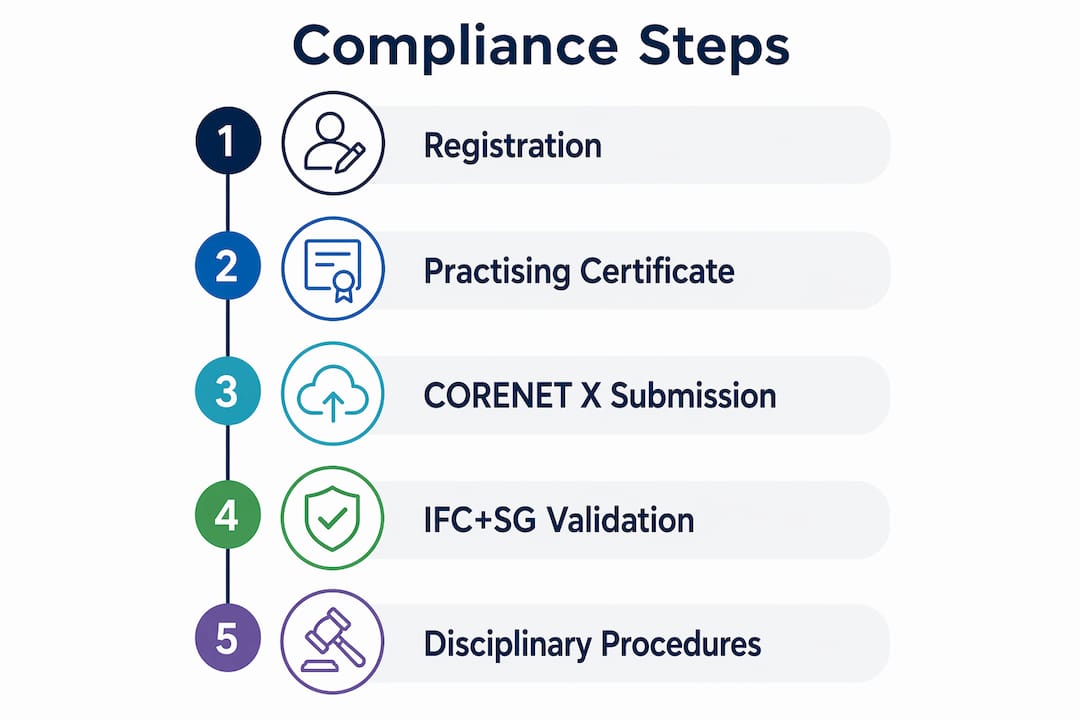
The Act also establishes disciplinary procedures covering complaint investigations, inquiry panels, and a range of penalties including fines, suspension, and cancellation of registration. Non-compliance at the corporate level can affect the licences of both the firm and the individual architects named within it.
CORENET X and IFC+SG submission requirements
Singapore’s CORENET X platform represents a fundamental shift in how design regulations for architects are administered and enforced. Rather than submitting documents sequentially to individual agencies, architects now submit a single coordinated BIM model that is reviewed simultaneously by multiple regulatory agencies including BCA, SCDF, URA, and others.
Multi-agency simultaneous BIM review under CORENET X reduces redundancy and improves certainty before construction approvals are granted. BCA has reported that CORENET X can reduce approval times by up to 20% through this consolidated feedback mechanism.
However, accessing those benefits depends entirely on submitting a model that meets the IFC+SG data schema requirements. This is where most architectural firms encounter their first serious compliance obstacle.
Understanding IFC+SG parameter requirements
IFC+SG is a Singapore-specific extension of the international IFC standard. It defines the exact property sets, parameter names, and classification codes that a BIM model must contain before CORENET X will accept it. Missing or incorrect IFC+SG parameters cause validation failures that trigger rejection and delay the project approval process.
The most common pitfalls architects encounter include:
- Parameter mapping errors: Native BIM software (Revit, ArchiCAD, and others) uses internal parameter names that do not automatically align with IFC+SG classifications. Incorrect native-to-IFC+SG mappings cause loss of critical data during export, even when the geometry is correct.
- Spatial coordination failures: Elements that are geometrically correct but assigned to incorrect spatial zones or building storeys will fail agency-specific checks.
- Classification gaps: Architectural elements without Singapore building classification codes assigned will not be recognized by regulatory review modules.
- Incomplete property sets: Each element type requires a defined set of properties. Missing properties on walls, doors, fire compartments, or structural elements each generate individual errors.
Pro Tip: Treating CORENET X preparation as a formatting exercise misses the complexity of IFC+SG data governance required for compliance. Assign a dedicated BIM manager with specific IFC+SG training to own the data governance process from the design stage, not just before submission.
For firms managing Singapore BIM mandates, the submission workflow spans three regulatory gateways: Design, Construction, and Completion. Each gateway has distinct data requirements. Incremental BIM data enrichment across these gateways helps avoid the scenario where a large volume of compliance gaps are discovered only at submission.
BIM validation tools and project coordination
Knowing that IFC+SG errors exist is straightforward. Catching them before the official submission requires deliberate process integration. This is where dedicated validation tools become a critical component of any firm’s how-to-ensure-compliance approach.
Bimeco Validator is a web-based tool that checks BIM models against CORENET X compliance criteria. It flags missing IFC+SG parameters and property set gaps that would otherwise cause Written Directions and delays. The tool allows corrections to be made inside a browser-based interface, enabling multidisciplinary team members to review and resolve issues without requiring everyone to have a full BIM authoring license.
A structured pre-submission validation workflow typically includes the following steps:
- Export a test IFC+SG file from the BIM authoring tool after completing each design stage. Do not wait until the full model is complete.
- Run the model through a compliance validator to generate an error report. This report should categorize issues by element type, parameter name, and severity.
- Assign error resolution to the responsible discipline. Architectural parameters are fixed by the architect. Structural, M&E, and fire safety parameters must be corrected by the relevant specialist before reintegration.
- Document each validation cycle with version control records. This creates an auditable trail that supports professional accountability requirements under the Architects Act.
- Conduct a final validation run at least five working days before the target submission date. This buffer allows for corrections without compromising the project program.
Incremental model validation is particularly effective because most BIM models submitted to CORENET X contain thousands of IFC+SG parameter errors when first exported. Treating validation as a one-time pre-submission activity creates unnecessary resubmission risk. The firms that maintain the most reliable submission records are those that integrate validation into their standard design stage reviews.
Pro Tip: Set a firm-wide rule that no model proceeds from one CORENET X gateway to the next without a clean or low-error validation report. This protects both the project program and the firm’s professional standing.
Understanding building codes and regulations within Singapore’s construction industry provides additional context for why BIM data quality is directly linked to statutory approval outcomes.
Professional and ethical compliance obligations
An architectural compliance checklist that focuses only on submissions and registrations is incomplete. The Architects Act 1991 and BOA professional conduct requirements impose obligations that sit outside the technical domain but carry equivalent regulatory weight.
The ethical and professional compliance obligations most frequently overlooked by firms include:
- Supervision accountability: The Act mandates that supervising architects take direct professional responsibility for projects undertaken through corporate practices. In multidisciplinary setups, this accountability cannot be delegated to non-registered personnel. Supervision requirements under the Act exist specifically to prevent the dilution of professional oversight in complex organizational structures.
- Continuing professional development (CPD): Registered architects must complete structured CPD activities to maintain their practising certificates. The BOA specifies minimum CPD point requirements annually, covering technical, management, and professional practice topics. Failing to meet CPD requirements is a straightforward but avoidable compliance failure.
- Client and public duties: Ethical conduct obligations extend to honest representation of capabilities, transparent fee structures, conflict of interest disclosure, and protection of public safety in design decisions. These standards are codified in BOA’s professional conduct rules and are actively enforced.
- Compliance culture within firms: Principals and directors bear responsibility for establishing internal processes that make compliance the default behavior, not an afterthought. This means written supervision protocols, documented CPD tracking, and periodic internal compliance audits.
For firms managing multiple projects across disciplines, maintaining a formal architectural compliance checklist that covers registration status, CPD progress, insurance validity, and supervision assignments for each active project is not procedural overhead. It is professional risk management. Architectural planning carried out in compliance with these standards creates a foundation for projects that proceed without regulatory interruption. Firms can reference architectural planning guidance for Singapore developers to understand how planning obligations intersect with statutory compliance at the project level.
A practitioner’s view on compliance integration
I’ve worked alongside architectural firms in Singapore long enough to recognize a pattern that keeps repeating. Compliance is treated as something that happens at the end of a project phase, a checklist to clear before moving forward, rather than a condition that should be continuously maintained from the day a commission is accepted.
What I’ve observed is that the firms with the fewest compliance problems are not the ones with the most elaborate checklists. They are the ones where the principals understand that statutory, ethical, and digital compliance obligations are inseparable parts of the same professional responsibility. An architect cannot maintain an impeccable CORENET X submission record while simultaneously neglecting CPD requirements or mismanaging supervision accountability in a corporate structure.
The shift to CORENET X has exposed a gap in digital literacy that many experienced architects did not anticipate. BIM has been in practice for years, but IFC+SG data governance is a different discipline. I’ve seen firms with genuinely talented designers produce technically excellent models that fail at submission because nobody on the team owned the data quality process.
My position is that embedding PE compliance principles into architectural practice culture is not optional. The regulatory environment in Singapore has made proactive compliance the only realistic strategy for firms that want to protect their registration, their project programs, and their professional reputation.
— Aman
How Aectechnicalsg supports architectural compliance

Aectechnicalsg provides specialized technical advisory services built specifically for the compliance demands Singapore’s regulatory framework places on architectural firms. From design for safety consulting to CORENET X BIM submission support and authority endorsements, the team brings direct experience with BCA, URA, SCDF, and other agency requirements to every project engagement.
Architectural firms that work with Aectechnicalsg gain access to structured pre-submission validation workflows, IFC+SG parameter compliance support, and PE endorsement and authority submission services that reduce resubmission risk and protect project timelines. For firms managing complex multidisciplinary projects or facing first-time CORENET X submissions, this kind of technical backing is the difference between a smooth approval process and preventable delays. Contact Aectechnicalsg to discuss your project compliance requirements and find out how their advisory services fit your firm’s workload.
FAQ
What is the Architects Act 1991 in Singapore?
The Architects Act 1991 is the primary legislation regulating the registration, professional conduct, corporate licensing, and disciplinary procedures for architects in Singapore. It establishes the Board of Architects as the governing authority for the profession.
What does CORENET X require from architects?
CORENET X requires BIM model submissions in IFC+SG format with complete property sets and correct parameter mapping for all architectural elements. Missing or incorrect parameters cause validation failures and delay multi-agency regulatory approvals.
How can architects avoid BIM submission rejections?
Conducting incremental IFC+SG validation across design stages using dedicated tools such as Bimeco Validator catches parameter errors before official submission. Assigning a BIM manager with IFC+SG governance responsibility significantly reduces rejection rates.
What are the continuing education requirements for registered architects in Singapore?
Registered architects must fulfill annual CPD point requirements set by the Board of Architects to maintain their practising certificates. These requirements span technical knowledge, professional practice, and management competencies.
What happens when an architect fails to meet compliance obligations in Singapore?
Non-compliance can trigger disciplinary proceedings under the Architects Act, resulting in penalties that include fines, suspension of the practising certificate, or cancellation of registration. Corporate licences held by the firm may also be affected.