
Design safety is defined as the systematic practice of identifying and eliminating hazards during the design phase of a construction project, before workers or end users are ever exposed to risk. Known formally as Prevention through Design (PtD), this methodology shifts risk management upstream, where changes cost less and carry more impact. Tools like the Design Risk Register and Safety in Design (SiD) Report are the primary instruments for tracking and communicating those risks. In Singapore, where the Building and Construction Authority (BCA) and the Ministry of Manpower (MOM) set rigorous compliance standards, understanding how to ensure design safety is not optional. It is a legal and professional obligation.
What are the essential steps to ensure design safety?
Starting SiD processes in the concept phase increases the ability to influence safe outcomes. That single fact defines the most important rule in design safety: start early, or accept that your options will narrow with every stage that passes.
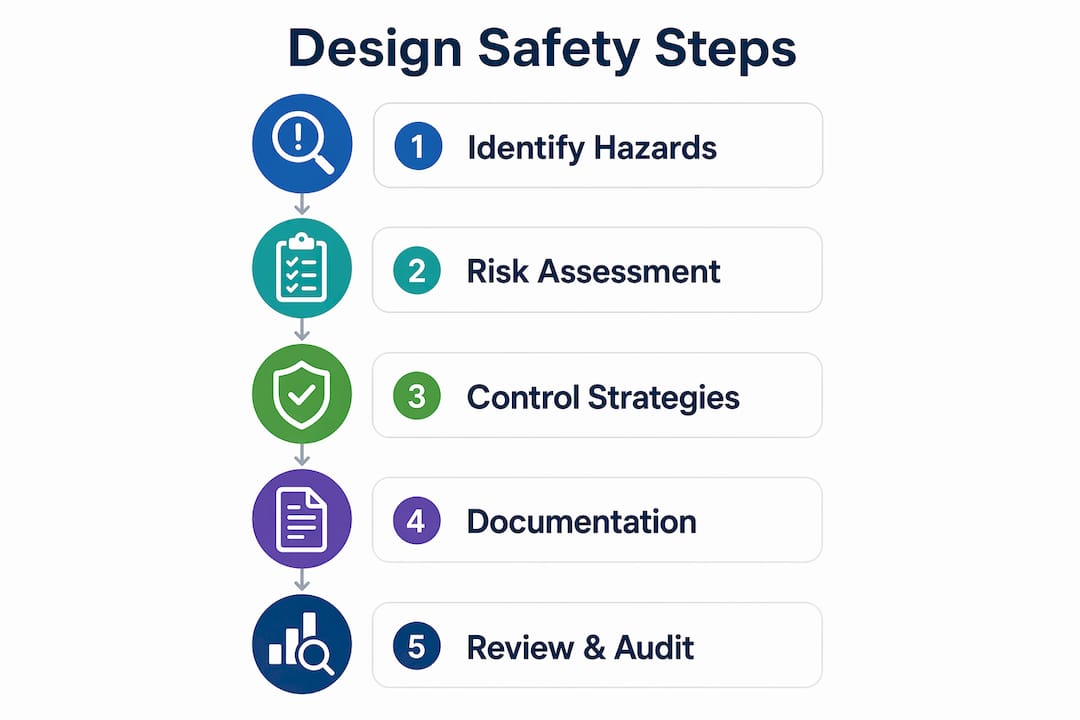
The following steps form the backbone of a compliant and effective design safety process:
-
Conduct hazard identification at concept stage. Use formal techniques such as HAZID (Hazard Identification Study) or CHAIR (Construction Hazard Assessment with Implications Review) to surface risks before design decisions become fixed. Engage structural engineers, M&E consultants, and geotechnical specialists from the outset.
-
Apply the hierarchy of controls in sequence. Elimination comes first, then substitution, then engineering controls, then administrative controls, and finally personal protective equipment (PPE). Require a written engineering alternative for every high-energy task before accepting PPE as a primary control. This discipline prevents teams from defaulting to the easiest answer rather than the safest one.
-
Maintain a Design Risk Register throughout the project lifecycle. The register must log each identified hazard, the controls considered, the controls selected, and the residual risk passed to downstream duty holders. This is not a one-time document. It is a living record updated at every design milestone.
-
Produce a Safety in Design Report. This report communicates residual risks to contractors, facility managers, and operators who will work with the completed structure. It is the primary mechanism for transferring safety knowledge across project phases.
-
Engage a multidisciplinary review team. Include not just designers and engineers but also maintenance staff, facility operators, and safety specialists. Each group sees the project through a different lens, and those perspectives collectively surface hazards that a single discipline will miss.
-
Conduct formal design safety reviews at each project gate. Reviews at concept, schematic, detailed design, and pre-construction stages create structured checkpoints. Each review should produce documented outcomes, not just verbal agreements.
Pro Tip: Schedule your first design safety review within the first two weeks of concept design. Waiting until schematic design is complete eliminates the cheapest and most effective hazard controls.
How do human factors and context realism improve design safety?

Human Capability Realism and Context Realism are two principles that separate effective design safety from box-ticking compliance. Human Capability Realism means designing for how workers actually behave under fatigue, distraction, and time pressure, not how they behave in ideal conditions. Context Realism means accounting for how the physical and operational environment changes over a project’s life.
Most design teams model the competent, alert, well-rested worker. That worker rarely exists on a busy construction site in Singapore’s humid climate at the end of a 10-hour shift. When designs assume ideal human performance, they create latent hazards that only activate under realistic conditions.
Consider the following areas where human factors most frequently drive design failures:
- Non-routine phases. Design safety reviews often miss maintenance and cleaning phases, which are precisely where workers face the highest concentration of unguarded hazards. A rooftop plant room designed for routine operation may require a maintenance technician to lean over an unguarded edge to access a filter housing.
- Access and egress under load. Workers carrying tools or materials behave differently from unencumbered workers. Stairways, ladders, and access hatches must be sized and positioned for realistic task conditions.
- Lighting and visibility changes. A space that is well-lit during construction may be poorly lit during nighttime maintenance. Designs must account for the full range of operational lighting conditions.
- Proximity to unguarded edges. Equipment and walkways should be placed at least 2 meters from unguarded edges where a fall over 3 meters is possible, or guarded with rails where space is constrained.
“Design for safety is not just adherence to rules but embedding human factors and system interactions for lasting risk control.” — Safety.Design, Principles of Safety by Design
Incorporating feedback loops from field teams closes the gap between design assumptions and operational reality. Project managers should establish a formal mechanism for site supervisors to report conditions that deviate from design intent, and those reports should feed back into the Design Risk Register.
What tools and documentation demonstrate design safety compliance?
Designers must maintain two key documents throughout the project lifecycle: the Design Risk Register and the Safety in Design Report. These two instruments form the audit trail that regulators, insurers, and downstream duty holders rely on to verify that hazards were identified and managed.
The table below summarizes the function, owner, and timing of each core design safety document:
| Document | Primary Function | Responsible Party | When Updated |
|---|---|---|---|
| Design Risk Register | Tracks hazards, controls considered, controls selected, and residual risk | Lead Designer / Principal Consultant | At every design milestone |
| Safety in Design Report | Communicates residual risks to contractors and facility managers | Lead Designer | At design completion and handover |
| Safety in Design Checklist | Provides structured prompts for design review consistency | Design Safety Reviewer | At each formal design review |
| HAZID / CHAIR Workshop Record | Documents formal hazard identification sessions and outcomes | Facilitator / Safety Specialist | At concept and schematic stages |
The Safety in Design Checklist deserves particular attention. It standardizes the review process across different team members and project types, reducing the risk that a reviewer’s personal knowledge gaps become project-wide blind spots.
Documentation of rejected controls is as important as documentation of selected ones. Auditors flag design reviews that lack explanations for not choosing Tier 1 controls like elimination or substitution. If your team evaluated elimination and determined it was not practicable, that determination must be written down, with the reasoning stated clearly. Without that record, the decision is legally indefensible.
In Singapore’s regulatory environment, compliance with BCA and MOM requirements depends on the quality of this documentation. A well-maintained Design Risk Register also supports construction compliance submissions to authorities including URA, JTC, and LTA, where design safety evidence may be requested during approval processes.
Pro Tip: Assign a named document controller for the Design Risk Register at project kickoff. Registers that lack a single accountable owner tend to fall out of date by the schematic design stage, which is exactly when they are most needed.
What are the most common mistakes in maintaining design safety?
The most persistent failures in design safety practice are not technical. They are organizational. Teams that understand the principles still make predictable errors when project schedules tighten and budget pressures mount.
-
Treating design safety as a late-stage activity. Teams that begin hazard identification at detailed design stage have already locked in structural configurations, access routes, and plant locations. The cost of change at that point is prohibitive, so hazards get managed with administrative controls and PPE instead of being eliminated.
-
Ignoring maintenance and non-routine operations. Including operators and maintainers in reviews uncovers risks that engineers focused on routine operations consistently miss. A mechanical room designed for efficient installation may require a confined space entry for every filter change. That hazard is preventable at design stage and expensive to manage operationally.
-
Defaulting to PPE without documenting alternatives. Requiring documented engineering alternatives prior to approving administrative controls or PPE for high-risk tasks significantly improves decision quality. Teams that skip this step often discover during audits that they cannot explain why guardrails were not installed or why a hazardous process was not relocated.
-
Poor traceability in the Design Risk Register. A register that lists hazards without linking them to specific design decisions, drawing revisions, or control outcomes provides no audit value. Each entry must be traceable to a specific design element and a specific decision point.
-
Failing to update documentation after design changes. Design changes made after a safety review are a frequent source of unmanaged residual risk. Every design change order should trigger a review of the relevant Design Risk Register entries.
Many jurisdictions now require mandatory design safety frameworks for large construction projects, influenced by frameworks like Australia’s Work Health and Safety Act 2011. Safety strategies have been mandatory for projects valued above AU$3 million in some areas since 1998. Singapore’s own regulatory trajectory follows a similar direction, and project teams that build robust design safety practices now are better positioned for future compliance requirements. Reviewing Singapore’s 2026 building regulations gives project managers a clear picture of where those requirements currently stand.
Key takeaways
Effective design safety requires early hazard identification, rigorous documentation, and multidisciplinary engagement from concept stage through project handover.
| Point | Details |
|---|---|
| Start at concept stage | Apply Prevention through Design principles at project inception to maximize hazard elimination options. |
| Follow the hierarchy of controls | Document written engineering alternatives before accepting PPE or administrative controls for high-risk tasks. |
| Maintain two core documents | Keep the Design Risk Register and Safety in Design Report updated at every design milestone. |
| Include non-routine operations | Engage maintenance staff and operators in design reviews to surface hazards in cleaning and repair phases. |
| Document rejected controls | Record the rationale for not selecting Tier 1 controls to protect audit trails and legal defensibility. |
Why early engagement is the deciding factor in design safety
Working across Singapore construction projects, I have seen the same pattern repeat itself. Teams that treat design safety as a compliance deliverable produce documents. Teams that treat it as a design discipline produce safer buildings. The difference is not budget or expertise. It is timing and culture.
The projects where design safety genuinely works are the ones where the lead designer raises hazard questions in the first project meeting, not the ones where a safety consultant is brought in three weeks before the design freeze. By the time a Safety in Design Report is being drafted, the real decisions have already been made. The report is either confirming good decisions or rationalizing bad ones.
Singapore’s construction sector is moving in the right direction. BCA’s emphasis on Design for Safety (DfS) requirements has pushed more project teams to engage safety specialists earlier. But the gap between formal compliance and genuine risk reduction remains wide. The teams closing that gap are the ones that treat the Design Risk Register as a design tool, not a filing exercise.
My strongest recommendation to project managers is this: make the Design Risk Register a standing agenda item at every design coordination meeting. When the register is reviewed alongside drawings and specifications, it stops being a document and starts being a conversation. That conversation is where real hazard elimination happens.
— Aman
How Aectechnicalsg supports design safety in singapore projects
Aectechnicalsg provides engineering consultancy services specifically structured to support design safety compliance across Singapore’s regulatory environment. From structural and geotechnical engineering to M&E coordination and authority submissions, the team brings the technical depth that design safety reviews require.
For project developers and construction firms navigating BCA, MOM, and URA requirements, Aectechnicalsg offers direct support with Design Risk Register preparation, Safety in Design documentation, and formal hazard identification workshops. The firm’s experience with engineering consultancy for Singapore developers covers the full spectrum of project types, from commercial developments to infrastructure works. Contact Aectechnicalsg to discuss how design safety requirements apply to your specific project and regulatory submission pathway.
FAQ
What is prevention through design (PtD)?
Prevention through Design is the practice of addressing occupational safety and health needs during the design phase of a project to prevent or minimize hazards in construction, operation, and maintenance. It is the formal methodology underpinning design safety practice globally and in Singapore.
When should a design risk register be started?
The Design Risk Register should be initiated at the concept design stage. Starting SiD processes early maximizes the team’s ability to eliminate or substitute hazards before design decisions become fixed and costly to change.
What is the difference between a design risk register and a safety in design report?
The Design Risk Register is a working document that tracks hazards, controls considered, and decisions made throughout the design process. The Safety in Design Report is the formal output that communicates residual risks to contractors, facility managers, and other downstream duty holders at project handover.
Why must rejected controls be documented?
Auditors and regulators identify the absence of rationale for rejecting stronger controls as a critical flaw in design safety reviews. Without written justification for not selecting elimination or substitution, the decision is legally indefensible and fails audit scrutiny.
How does singapore regulate design safety in construction?
Singapore’s design safety requirements are administered primarily through BCA and MOM, with Design for Safety (DfS) obligations applying to qualifying construction projects. These requirements align with international PtD frameworks and mandate formal hazard identification, documentation, and residual risk communication across the project lifecycle.