
The types of LTA civil works specifications fall into five primary categories: design criteria, standard details, materials and workmanship standards, codes of practice, and submission templates. The authoritative documents governing each category are the Civil Design Criteria (CDC), the Standard Details of Road Elements (SDRE), the Materials and Workmanship Specifications for Civil and Structural Works, the Code of Practice on Street Works Proposals relating to Development Works, and the Code of Practice for Works on Public Streets. Every Qualified Person (QP) or Professional Engineer (PE) preparing an LTA submission must reference the current revision of each document before filing.
The core compliance checkpoints are:
- Design criteria: CDC (Civil and Structural Works Revision A3, December 2025) sets mandatory design and detailing requirements for all civil engineering works under LTA’s remit.
- Standard details: The SDRE (March 2025) provides mandatory dimensions and construction details for road elements including kerbs, pavements, guardrails, manholes, signage, and tactile tiles.
- Materials and workmanship: M&W Civil and Structural Works Revision A2 (September 2020) governs concrete grades, reinforcement, aluminum fixings, and workmanship tolerances.
- Codes of practice: The Code of Practice for Works on Public Streets (April 2026) and the Code of Practice on Street Works Proposals (Version 2.0, April 2019) govern permit procedures and technical requirements for street-affecting works.
- Submission templates: LTA’s gateway checklists define mandatory drawings and documents at the Design Gateway (DG), Construction Gateway (CG), and Completion Gateway (TOP/CSC) stages.
The QP or PE is responsible for endorsing all designs, verifying structural and geotechnical assumptions, and confirming that the correct document revision was applied. Always verify the live revision on LTA’s Development and Construction Specifications hub before filing, since interim circulars can supersede printed manuals.
Key Takeaways
LTA civil works submissions require five specification categories, three approval gateways, and version-controlled document references to avoid rejection.
| Point | Details |
|---|---|
| Five specification categories | CDC, SDRE, M&W, Codes of Practice, and submission templates each govern distinct technical parameters. |
| Current document versions | CDC Revision A3 (December 2025), SDRE March 2025, M&W Revision A2, and Code of Practice for Works on Public Streets April 2026 are the active references. |
| Gateway deliverables | DG requires layout and Traffic Plans; CG adds PE-endorsed calculations, DFE schedules, and material finishes; TOP/CSC requires as-constructed drawings and GIS data. |
| Highest rejection risks | Outdated SDRE references, incomplete Traffic Plan color-coding, missing DFE schedules, and non-conforming GIS data are the most frequent causes of rejection. |
| Specialist support | Aectechnicalsg manages DG/CG/TOP submissions, QP endorsements, and inter-agency coordination to reduce RFIs and compress approval timelines. |
Table of Contents
- How LTA organizes its civil-works specification hierarchy
- What each LTA specification type covers, element by element
- What to submit at each approval stage
- Key LTA technical standards and where to find the authoritative text
- What the QP must verify, certify, and coordinate across agencies
- Common compliance pitfalls that cause LTA rejections or delays
- A practical checklist for assembling DG and CG submissions
- “Works on Public Street” vs. “Street Works Proposals relating to Development Works”
- Requirements for developments within Railway Protection and Road Structure Safety Zones
- Forms, checklists, and as-constructed deliverables including GIS data
- When specialist consultancy delivers the most value on LTA submissions
- Aectechnicalsg’s LTA civil-works submission support
- Authoritative LTA documents and official Singapore resources
- Sources
How LTA organizes its civil-works specification hierarchy
LTA’s specification framework follows a clear policy-to-detail hierarchy. At the top sit enabling legislation: the Road Traffic Act, the Street Works Act, and the Building Control Act. Below these, the Civil Design Criteria translates statutory intent into specific design rules for road geometry, structural loading, drainage gradients, and commuter facility dimensions. The SDRE then operationalizes those rules into dimensioned drawings and construction details that QPs adopt directly. The Materials and Workmanship Specifications sit alongside the SDRE, controlling the quality of inputs rather than the geometry of outputs. Codes of Practice govern the procedural and technical requirements for specific work categories, particularly works that affect public streets or arise from development proposals. Submission templates and gateway checklists close the loop by specifying exactly what documentation LTA expects at each approval stage.
Document hierarchy in practice: A QP designing a new access road must apply CDC for road geometry and structural loading, adopt SDRE sheets for kerb profiles and tactile tile layouts, specify materials to M&W standards, follow the relevant Code of Practice for the permit category, and then assemble the DG/CG submission package per LTA’s gateway checklist. Skipping any layer creates a gap that LTA’s reviewers will identify.
This hierarchy maps directly to project stages. DG submissions rely primarily on CDC and SDRE for layout compliance. CG submissions require full structural and materials documentation per M&W and CDC. Street Plan and Traffic Plan submissions draw on the Codes of Practice and SDRE for sign and marking details. TOP/CSC submissions require as-constructed documentation confirming that built conditions match approved plans. Version control is not optional: the CDC Civil and Structural Works Revision A3 (December 2025) supersedes earlier editions, and the Code of Practice for Works on Public Streets was updated in April 2026. Referencing a superseded document at submission is a common and avoidable cause of rejection. For a broader view of how these requirements fit within Singapore’s regulatory framework, the LTA regulations guide provides useful context.
Where LTA requirements overlap with BCA’s building control regime, the QP must satisfy both. Adopting an SDRE standard detail does not discharge structural safety obligations under the Building Control Act; the QP remains personally responsible for verifying that the detail is structurally adequate for the specific site conditions.
What each LTA specification type covers, element by element
The specification categories are not abstract document labels. Each maps to specific physical elements and controls precise technical parameters.
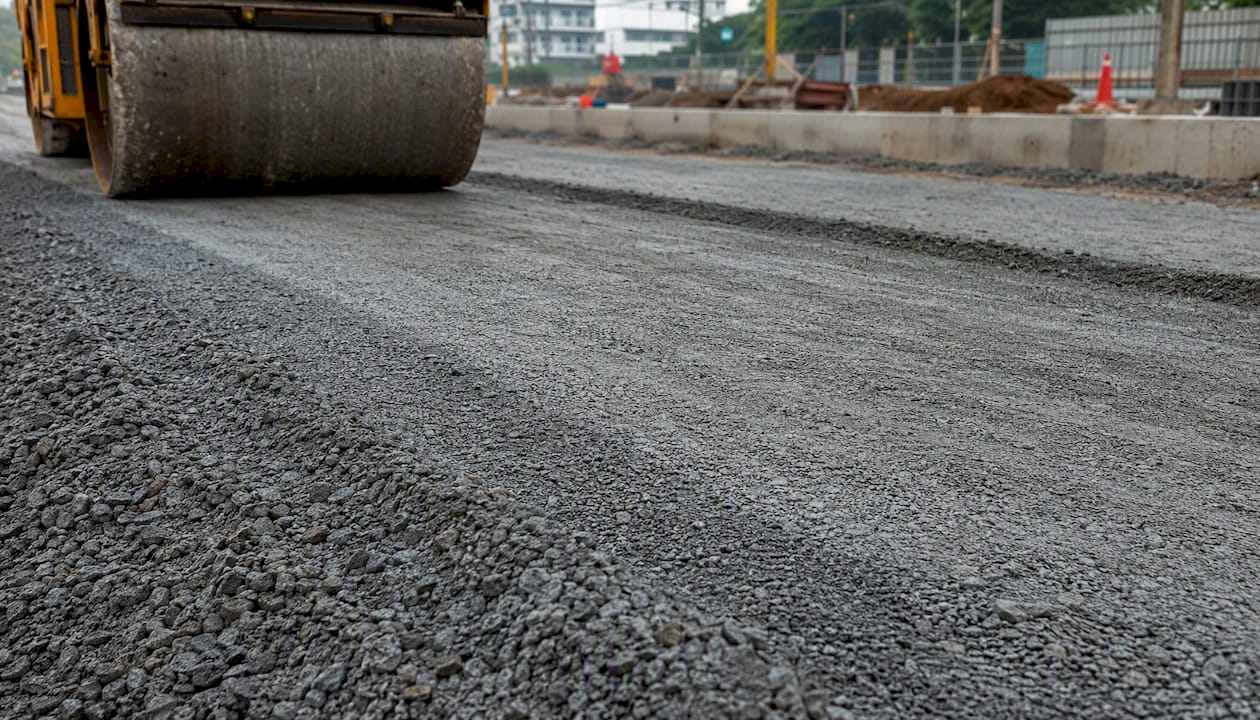
Roads and carriageways: The CDC governs horizontal and vertical alignment, lane widths, sight distances, and superelevation. SDRE provides cross-section details and pavement layer compositions. M&W specifies concrete grades and compaction standards for sub-base and base layers.
Kerbs and footpaths: SDRE sheets define kerb profiles (upstand heights, radii, material grades), footpath widths, and surface finishes. Tactile paving details, including directional and warning tile dimensions and color specifications, are mandatory SDRE references for all pedestrian interfaces.
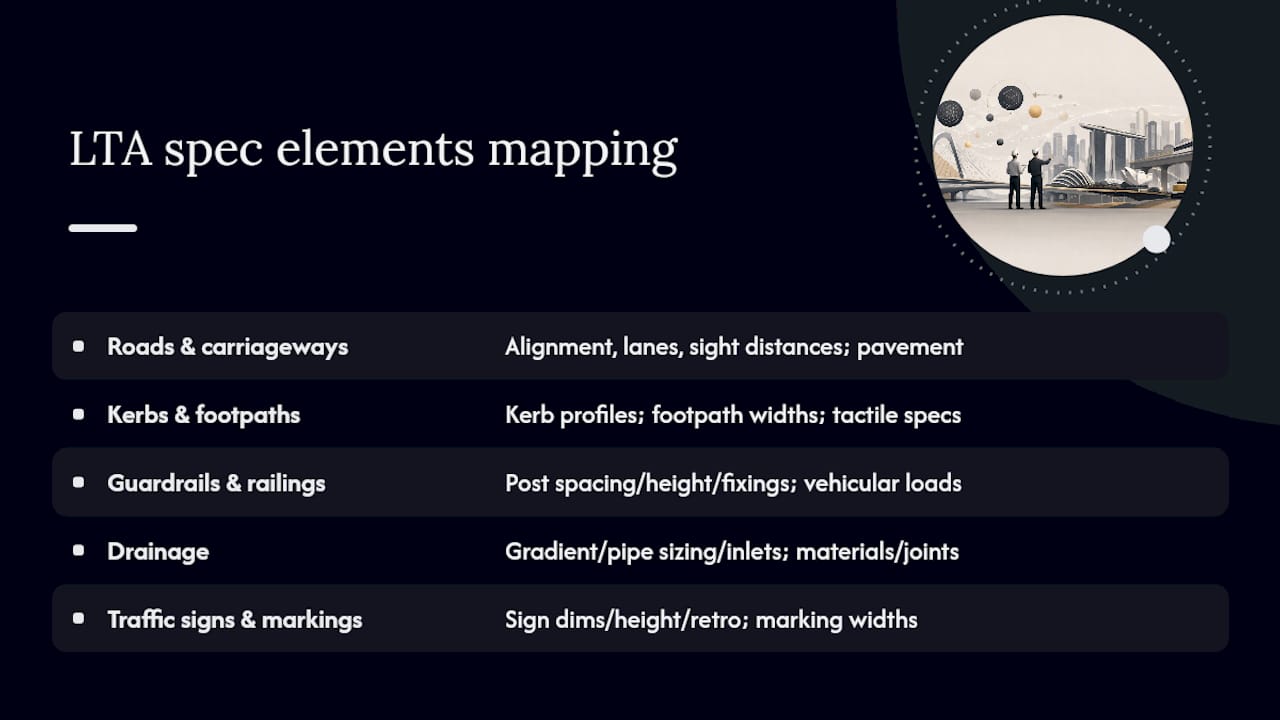
Guardrails and railings: SDRE specifies post spacing, rail height, fixing details, and wind load assumptions for pedestrian guardrails. For vehicular barriers, CDC structural loading criteria apply alongside SDRE dimensional standards.
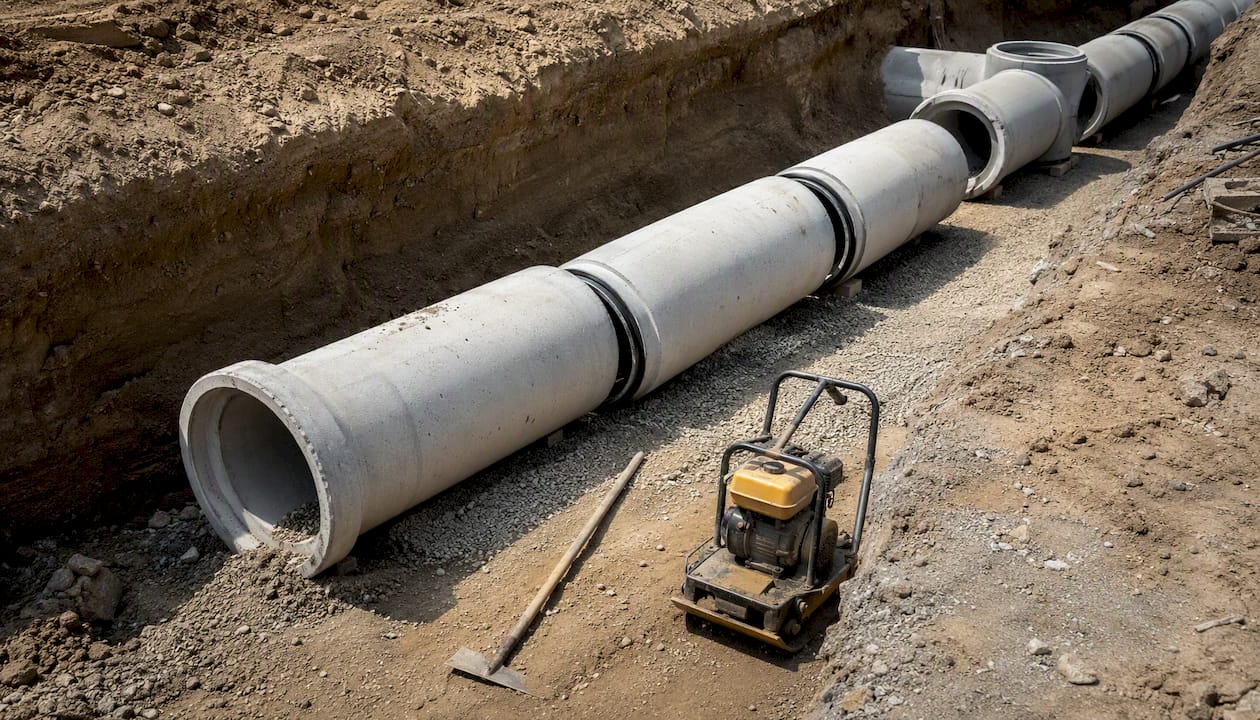
Drainage: CDC sets gradient requirements, pipe sizing methodology, and inlet spacing. M&W governs pipe material grades, joint specifications, and backfill compaction standards.
Manhole covers and frames: SDRE provides standard dimensions, load class designations, and frame-seating details. M&W sets the material and casting standards.
Traffic signs and road markings: SDRE is the primary reference for sign face dimensions, post heights, retroreflectivity classes, and marking widths. Traffic Plans submitted at DG and CG must reference SDRE sign and marking types directly, using the color-coding convention LTA specifies for proposed versus existing elements.
Street furniture and bus stop shelters: Structural inputs for bus stop shelters, including wind load calculations and foundation details, require CDC structural criteria. M&E interfaces (lighting, CCTV, passenger information displays) require coordination with LTA’s M&E specifications.
Slopes and retaining structures: CDC structural and geotechnical chapters govern design assumptions, factor-of-safety requirements, and drainage provisions. Design calculations for major retaining walls and slopes are mandatory CG deliverables and must be signed by a PE.
Underpasses and pedestrian overhead bridges (POBs): These trigger joint site inspections at TOP/CSC. CDC structural chapters set loading criteria; M&W governs concrete grades and waterproofing class. Waterproofing class must be explicitly stated in CG submissions.
Utility works within road reserves: The Code of Practice for Works on Public Streets governs permit procedures, trench reinstatement standards, and traffic management requirements for utility laying and lane closures.
Traffic signal foundations: Foundation design must satisfy CDC structural loading criteria. M&E specifications govern conduit sizing, cable management, and controller housing standards.
For a broader mapping of these elements to civil infrastructure project types in Singapore, practitioners will find the project-type taxonomy useful when scoping which specification categories apply.
What to submit at each approval stage
LTA’s gateway structure is sequential, and each stage has non-negotiable deliverables. Submitting incomplete packages at any stage delays the entire project.
-
Design Gateway (DG): The DG submission establishes the project’s design intent. Required drawings include a site plan (Part B: location and boundary), layout plans showing road geometry and pedestrian routes, topographical plans, and a preliminary Traffic Plan (Part B: existing conditions; Part F: proposed sign and marking layout). Utility coordination plans showing existing services must accompany the layout. CDC and SDRE compliance must be demonstrable at this stage, even if full structural calculations are not yet required. LTA uses the DG to confirm that the proposed layout is fundamentally compliant before detailed design investment proceeds.
-
Construction Gateway (CG): CG is the detailed design submission. The DG/CG submission checklist specifies site plan Parts B and C (construction phasing), supplemental detail sheets, longitudinal sections, cross-sections at regular intervals, floor plans and elevations for commuter structures, and a fully developed Traffic Plan. Design calculations for all major road structures, retaining walls, slopes, and commuter facilities must be submitted and PE-endorsed. A Design for Explainability (DFE) schedule, material finishes schedule, and warranty and maintenance statements are mandatory CG attachments. Waterproofing class for underground structures must be explicitly declared.
-
Street Plan: The Street Plan formalizes the proposed road network geometry. It must show lane widths, turning radii, road reserve boundaries, and pedestrian crossing locations at a scale that allows LTA reviewers to verify SDRE compliance. Color-coding conventions for proposed versus existing elements are mandatory; deviating from LTA’s specified convention is a common cause of rejection.
-
Traffic Plan: The Traffic Plan covers both the permanent sign and marking scheme (Part F) and, where applicable, temporary traffic management during construction. Sign types and marking widths must reference SDRE directly. Lane closure proposals for construction phases must comply with the Code of Practice for Works on Public Streets.
-
Completion Gateway (TOP/CSC): As-constructed drawings must reflect built conditions accurately. GIS deliverables in LTA’s specified format are required for new streets and major commuter structures. Joint site inspections are triggered by new streets, underpasses, and POBs. LTA inspectors verify that built conditions match approved plans and that materials and workmanship meet M&W standards. Incomplete as-constructed GIS submissions are a frequent cause of delayed CSC issuance.
Key LTA technical standards and where to find the authoritative text
The table below identifies each core standard, its scope, and the most recent revision practitioners should reference.
| Standard | Scope | Current Revision |
|---|---|---|
| Civil Design Criteria (CDC) — Civil and Structural Works | Road geometry, structural loading, drainage, commuter facility dimensions | Revision A3, December 2025 |
| Materials and Workmanship Specifications — Civil and Structural Works | Concrete grades, reinforcement, fixings, workmanship tolerances | Revision A2, September 2020 |
| Standard Details of Road Elements (SDRE) | Kerbs, pavements, guardrails, manholes, signage, tactile tiles | Content Page, March 2025 |
| Code of Practice for Works on Public Streets | Permit procedures, utility laying, lane closures, traffic management | April 2026 |
| Code of Practice on Street Works Proposals relating to Development Works | Development layout design, street works submission requirements | Version 2.0, April 2019 |
All five documents are available through LTA’s Transport Infrastructure Design Criteria and Specifications page. The Code of Practice for Works on Public Streets is updated most frequently; the April 2026 edition supersedes the previous version and practitioners who have not downloaded it since early 2026 should do so immediately.
Key points on version control:
- LTA issues interim circulars and technical notices that can supersede specific clauses in published documents before a full revision is released. Check the LTA circulars page alongside the main document downloads.
- The CDC Civil and Structural Works Revision A3 (December 2025) is the current mandatory reference for structural and civil design; earlier revisions are not acceptable for new submissions.
- M&W Revision A2 (September 2020) remains current for civil and structural works; confirm whether discipline-specific M&W chapters (e.g., M&E, architectural) have separate revision dates.
- SDRE sheets are updated individually; the March 2025 content page lists the current sheet numbers and their effective dates.
What the QP must verify, certify, and coordinate across agencies
The QP’s statutory role under LTA’s submission framework is not limited to signing drawings. It carries active verification and coordination obligations that, if neglected, create both professional liability and submission failure.
Statutory and professional responsibilities:
- Endorse all design drawings and calculations submitted to LTA, confirming compliance with CDC, SDRE, and M&W requirements for the specific project conditions.
- Verify that structural and geotechnical design assumptions are appropriate for the site, particularly for retaining walls, slopes, and commuter structures where CDC structural chapters set minimum factors of safety.
- Confirm that SDRE standard details have been adopted where applicable and that any deviation from SDRE is explicitly justified and approved by LTA before submission.
- Sign as the QP/PE of record for all gateway submissions, accepting professional responsibility for the completeness and accuracy of the submission package.
Inter-agency coordination:
Where LTA requirements intersect with other agencies, the QP must document cross-clearances explicitly in the submission. BCA clearance under the Building Control Act is required for structures meeting the relevant thresholds; this clearance does not substitute for LTA approval, and both must be obtained. URA planning approval governs land use and development parameters that constrain road reserve widths and setbacks. PUB coordinates on drainage and stormwater management, particularly where new roads interface with public drains. SCDF requirements apply to underground structures and underpasses. For a detailed breakdown of which agency approvals apply to which civil works categories, the civil engineering authority approval list is a practical reference.
Practical compliance measures:
- Conduct a pre-submission internal QA review against the DG/CG checklist before filing; a single missing deliverable can trigger a formal request for information (RFI) that resets the review clock.
- Maintain a version-control log of all referenced LTA documents, recording the revision date used for each submission. If LTA issues a new revision after DG but before CG, confirm with LTA whether the CG submission must adopt the new version.
- Include warranty and maintenance statements at CG even when the contractor has not yet been appointed; these are mandatory attachments and their absence is a common rejection trigger.
Pro Tip: Pre-consultation with LTA’s Development Control group before DG submission, particularly for projects involving new streets or commuter structures, can resolve ambiguities in CDC interpretation before they become formal RFIs.
Common compliance pitfalls that cause LTA rejections or delays
Most LTA submission rejections are preventable. The following failures appear repeatedly across project types.
- Referencing outdated SDRE or CDC versions: Submitting drawings that reference a superseded SDRE sheet or an earlier CDC revision is the single most common cause of immediate rejection. The March 2025 SDRE content page and CDC Revision A3 (December 2025) are the current baselines.
- Incomplete Traffic Plans: A Traffic Plan that lacks the color-coded sign and marking legend, omits existing conditions in Part B, or fails to reference SDRE sign types by sheet number will be returned for revision. Missing lane-width annotations for proposed configurations are a frequent secondary omission.
- Missing DFE schedules at CG: The Design for Explainability schedule is a mandatory CG attachment. Submitting a CG package without it, or with a DFE that does not cover all major structural elements, results in an RFI.
- Absent or incomplete design calculations: PE-endorsed structural calculations for retaining walls, slopes, and commuter structures are mandatory at CG. Submitting calculations that cover only part of the structural scope, or that are not PE-endorsed, delays approval.
- Incomplete as-constructed GIS data: GIS deliverables that do not conform to LTA’s specified format, or that omit new street centerlines and boundary data, delay CSC issuance. This is particularly common on projects where the GIS preparation is left to the final weeks before TOP.
- Inadequate interface details to existing road or rail assets: Where proposed works connect to existing LTA road or rail infrastructure, the interface details must show how the new works tie into existing levels, drainage, and structural systems. Vague or missing interface details trigger joint review requirements.
- Works within Railway Protection or Road Structure Safety Zones without prior clearance: Commencing design or construction within these zones without LTA’s written clearance is a statutory violation. The Railway Protection Plan must be submitted and approved before any works within the zone proceed.
- Confusing the two Codes of Practice: Applying the Code of Practice for Works on Public Streets to a development-driven street works proposal, or vice versa, results in the submission being processed under the wrong permit flow, causing significant delays.
Joint LTA site inspections are triggered by new streets, underpasses, and POBs. Projects that reach TOP without having coordinated the inspection schedule with LTA face delays in CSC issuance that can affect occupation permit timelines.
A practical checklist for assembling DG and CG submissions
Drawing scales and file contents are specified in LTA’s submission requirements. The table below summarizes the recommended scales by plan type.
The numbered checklist below covers the full submission package for both stages, based on LTA’s DG and CG submission requirements.
- Site Plan Part B (location plan, boundary, existing road network, north point, scale bar) — required at DG and CG.
- Site Plan Part C (construction phasing, temporary access routes, hoarding lines) — required at CG only.
- Layout Plan (proposed road geometry, lane widths, turning radii, pedestrian crossings, road reserve boundaries) — required at DG and CG.
- Topographical Plan (existing levels, spot heights, drainage features, utility locations) — required at DG.
- Longitudinal Sections (road centerline profiles, existing and proposed levels, drainage gradients) — required at DG and CG.
- Cross-Sections (at regular intervals, showing carriageway, footpath, kerb, and drainage details) — required at CG.
- Supplemental Detail Sheets (kerb profiles, tactile tile layouts, guardrail details, manhole frame details, all referencing SDRE sheet numbers) — required at CG.
- Traffic Plan Part B (existing sign and marking inventory, lane configurations) — required at DG and CG.
- Traffic Plan Part F (proposed sign and marking scheme, color-coded per LTA convention, SDRE references) — required at DG and CG.
- Coordinated Utility Plan (all existing and proposed utilities within the road reserve, confirmed with utility owners) — required at DG and CG.
- Design Calculations (PE-endorsed structural calculations for retaining walls, slopes, commuter structures, and major road structures) — required at CG.
- DFE Schedule (Design for Explainability schedule covering all major structural elements) — required at CG.
- Material Finishes Schedule (specifying concrete grades, surface finishes, and coating systems per M&W) — required at CG.
- Warranty and Maintenance Statements (covering structural elements, waterproofing systems, and street furniture) — required at CG.
- As-Constructed Drawings and GIS Data (in LTA’s specified format, covering new streets, drainage, and commuter structures) — required at TOP/CSC.
For GIS deliverables, use LTA’s specified coordinate system and layer naming conventions from the outset of the project. Retrofitting GIS data at TOP from CAD drawings is time-consuming and error-prone.
“Works on Public Street” vs. “Street Works Proposals relating to Development Works”
These two categories are governed by different codes, processed through different permit flows, and carry different technical requirements. Confusing them is one of the most common causes of processing delays in Singapore civil works submissions.
Works on Public Street refers to any physical works carried out on or affecting an existing public street, including utility laying, road resurfacing, drainage works, and lane closures. These works are governed by the Code of Practice for Works on Public Streets (April 2026), which sets permit procedures, traffic management requirements, trench reinstatement standards, and material and workmanship specifications. The permit is issued by LTA under the Street Works Act, and the applicant is typically the utility owner, road authority contractor, or developer’s appointed contractor.
Street Works Proposals relating to Development Works covers the design and construction of new streets, road widening, and road realignment arising from a development project. These proposals are governed by the Code of Practice on Street Works Proposals relating to Development Works (Version 2.0, April 2019) and are submitted by the QP as part of the development approval process. The submission follows the DG/CG/TOP gateway structure and requires full CDC, SDRE, and M&W compliance across the proposed road network.
The practical distinction: if the works are triggered by a development proposal and result in new or modified road infrastructure that will be vested to LTA, the Street Works Proposals code applies. If the works are operational maintenance or utility works on an existing public street, the Works on Public Streets code applies. Many development projects involve both: the new internal road network falls under Street Works Proposals, while the temporary lane closures needed during construction fall under Works on Public Streets.
Requirements for developments within Railway Protection and Road Structure Safety Zones
LTA designates Railway Protection Zones and Road Structure Safety Zones around existing rail infrastructure and major road structures. Any development or construction within these zones requires LTA’s written clearance before design proceeds, and the submission must include a Railway Protection Plan or Road Structure Safety assessment, depending on the zone type.
Within a Railway Protection Zone, the primary concern is the effect of construction activities, particularly excavation, dewatering, and vibration, on the structural integrity and operational safety of the rail system. LTA requires the QP to submit a detailed assessment of the proposed works’ impact on the rail structure, supported by geotechnical and structural analysis. Construction method statements, monitoring plans, and trigger levels for construction-induced movement must be agreed with LTA before works commence. The Building Control Act’s structural safety obligations apply concurrently, and BCA coordination is typically required for works that also involve building structures within the zone.
Within a Road Structure Safety Zone, the concern shifts to the effect of proposed works on existing road structures such as flyovers, underpasses, and major retaining walls. The QP must demonstrate that the proposed works do not compromise the structural capacity or serviceability of the existing road structure. This typically requires a structural assessment of the existing structure under the additional loads or changed ground conditions introduced by the proposed works.
Both zone types require early engagement with LTA. Submitting a DG package for a project within either zone without prior LTA consultation on the zone-specific requirements is a reliable path to rejection and significant redesign. For projects where the building control process intersects with LTA zone requirements, coordinating BCA and LTA submissions in parallel rather than sequentially saves material time.
Forms, checklists, and as-constructed deliverables including GIS data
LTA’s submission framework relies on standardized forms and checklists that define exactly what must be submitted at each stage. The primary forms relevant to civil works submissions are the Street Plan application form, the Traffic Plan template (Parts B and F), and the Railway Protection Plan template for zone-affected projects. These are available through LTA’s Development and Construction Specifications hub.
At TOP/CSC, as-constructed deliverables are not optional. LTA requires:
- As-constructed drawings reflecting all changes from the approved CG drawings, signed and endorsed by the QP.
- GIS data in LTA’s specified format, covering new street centerlines, road reserve boundaries, drainage networks, and commuter structure footprints. The coordinate system and layer naming conventions must match LTA’s GIS submission standards exactly.
- Joint site inspection coordination: For new streets, underpasses, and POBs, the QP must notify LTA to schedule a joint inspection before CSC is issued. The inspection verifies that built conditions match approved plans and that materials and workmanship comply with M&W specifications.
- Maintenance manuals and warranty documents for structural elements, waterproofing systems, and mechanical components of commuter facilities.
GIS data preparation is consistently underestimated in project programs. Projects that begin GIS data compilation only after physical completion routinely face three to six week delays in CSC issuance while data is corrected and resubmitted. Starting GIS compilation at CG stage, using the approved drawings as the base, eliminates most of this delay.
When specialist consultancy delivers the most value on LTA submissions
The case for engaging a specialist on LTA civil works submissions is strongest at three project types: those involving Railway Protection or Road Structure Safety Zones, those requiring new street construction with full DG/CG/TOP gateway management, and those where multiple agencies must sign off concurrently.
Projects near rail infrastructure carry the highest technical risk. A submission that underestimates the geotechnical impact of excavation on an adjacent MRT tunnel can result in LTA halting construction, requiring redesign, and imposing additional monitoring requirements. The cost of a specialist who understands LTA’s zone-specific assessment criteria is a fraction of the cost of a construction stop order.
Complex traffic reconfigurations, particularly those involving major junctions or bus priority routes, require Traffic Plans that satisfy both LTA’s sign and marking standards and the operational requirements of the Land Transport Authority’s traffic management team. Errors in these plans generate RFIs that can delay CG approval by weeks. A specialist who has prepared multiple Traffic Plans to LTA’s color-coding and SDRE-reference standards eliminates that risk.
The practical ROI of a submission-managed approach is clearest on projects with tight TOP timelines. Fewer RFIs at DG and CG translate directly into faster construction commencement. Complete as-constructed GIS submissions at TOP translate into faster CSC issuance. Aectechnicalsg structures its support around document QA at each gateway, version-controlled specification references, and on-site inspection coordination, specifically to compress the time between submission and approval.
Aectechnicalsg’s LTA civil-works submission support
Preparing compliant LTA civil works submissions requires more than familiarity with the CDC and SDRE. It requires version-controlled document management, PE-endorsed calculations, coordinated inter-agency clearances, and GIS deliverables that meet LTA’s exact format requirements, all assembled under tight project timelines.

Aectechnicalsg provides end-to-end LTA submission management covering DG, CG, and TOP/CSC stages, including QP and PE endorsement support, design-for-safety reviews, materials and workmanship compliance checks, and as-constructed GIS preparation. The team coordinates BCA, URA, PUB, and SCDF clearances in parallel with LTA submissions, reducing the multi-agency coordination burden that most project teams underestimate. For projects within Railway Protection or Road Structure Safety Zones, Aectechnicalsg’s structural and geotechnical specialists prepare the zone-specific assessments LTA requires before DG can proceed. Contact Aectechnicalsg directly to discuss your project’s gateway timeline and get a clear picture of what your submission package needs to include.
Authoritative LTA documents and official Singapore resources
Every practitioner working on LTA civil works submissions should have these documents downloaded and version-dated in their project file.
- Development and Construction Specifications and Resources: LTA’s central hub for all specification documents, submission checklists, and gateway guidance. The starting point for any LTA civil works project.
- Transport Infrastructure Design Criteria and Specifications: Lists the CDC, M&W, and discipline-specific specifications with their current revision dates. Check this page before every submission to confirm you are using the current version.
- Standard Details of Road Elements (SDRE), March 2025: The mandatory compliance reference for all road element dimensions and construction details. Individual sheets are updated independently; the content page lists current sheet numbers and effective dates.
- Code of Practice for Works on Public Streets, April 2026: The current edition governing permit procedures, traffic management, and material standards for works affecting public streets. Updated most frequently; always download the latest version.
- Code of Practice on Street Works Proposals relating to Development Works, Version 2.0 (April 2019): Governs new street design and submission requirements for development-driven street works proposals.
- Submission Requirements for DG and CG Stage: The definitive checklist specifying required drawings, document attachments, and drawing scales for DG and CG submissions.
LTA also issues technical circulars and notices that can amend specific clauses in published documents between full revisions. Monitoring the LTA circulars page alongside the main document downloads is the only reliable way to stay current. For practitioners who want a broader orientation to Singapore’s civil engineering project types and how LTA specifications apply across them, that resource provides a useful project-type taxonomy.
Sources
- Development & Construction Specifications and Resources
- Transport Infrastructure Specifications and Design Criteria
- Standard Details of Road Elements (SDRE) – Content Page March 2025
- Code of Practice for Works on Public Streets (Apr 2026)
- Submission requirements for DG and CG stage