
Civil engineering design is frequently reduced to a single question: “Will it hold?” That framing misses most of what the discipline actually demands. Civil engineering design is the engineering work that plans and develops civil infrastructure so it can be safely built and then function in service, covering both public and private sector projects from roads and drainage systems to high-rise foundations. For developers and construction firms operating in Singapore, understanding what civil engineering design truly encompasses is not an academic exercise. It determines compliance outcomes, project timelines, and long-term asset performance.
Table of Contents
- Understanding the core principles of civil engineering design
- Key phases and deliverables in civil engineering design projects
- Singapore standards and regulatory compliance in civil engineering design
- Innovations and best practices: drainage blankets and site investigation for Singapore projects
- Balancing design objectives: safety, serviceability, and economics in practice
- Why civil engineering design must go beyond traditional strength focus in Singapore
- How AEC Technical Advisory supports your civil engineering design needs in Singapore
- Frequently asked questions
Key Takeaways
| Point | Details |
|---|---|
| Civil engineering design scope | It covers safe planning and design of infrastructure like roads, buildings, and water facilities for Singapore projects. |
| Design balance principle | Effective design balances safety, usability, and cost rather than focusing on strength alone. |
| Local codes matter | Singapore Standards and BCA guides are essential for compliant, practical civil engineering design. |
| Site and foundation specifics | Proper site investigations and drainage blanket use optimize foundation safety and efficiency. |
| Expert advisory benefits | Professional consultancy helps navigate standards, boost project success, and streamline compliance. |
Understanding the core principles of civil engineering design
Building on the general definition, it is essential to grasp the key design principles that guide civil engineers in Singapore. These principles are not a checklist. They are a set of competing priorities that must be resolved on every project, often under real cost and schedule pressure.
Structural design aims to achieve safety first, then serviceability, and then economics, balancing multiple objectives rather than optimizing for strength alone. This hierarchy is deliberate. A structure can be strong enough to carry its loads and still fail in service because it deflects excessively, cracks under thermal movement, or corrodes prematurely in Singapore’s humid environment.
The three core civil engineering design principles work as follows:
- Safety: The structure must not collapse or cause harm under anticipated loads, including dead loads, live loads, wind, and seismic effects where applicable. In Singapore, design for safety in engineering is a regulatory obligation, not merely a professional aspiration.
- Serviceability: The structure must perform acceptably for its intended users over its design life. This includes deflection limits, crack width control, vibration thresholds, and durability against corrosion and carbonation.
- Economics: Design decisions must consider material quantities, construction method, labor costs, and long-term maintenance. Overdesigning for strength while ignoring lifecycle costs is a common and expensive mistake.
“Civil/structural design aims to achieve safety first, then serviceability, and then economics, balancing multiple objectives rather than optimizing only strength.” This principle underpins every credible design decision on Singapore construction projects.
Developers who treat these three objectives as equally weighted from day one tend to produce more efficient, approval-ready designs. Those who focus exclusively on structural capacity often encounter expensive revisions when serviceability or budget targets are reviewed.
Key phases and deliverables in civil engineering design projects
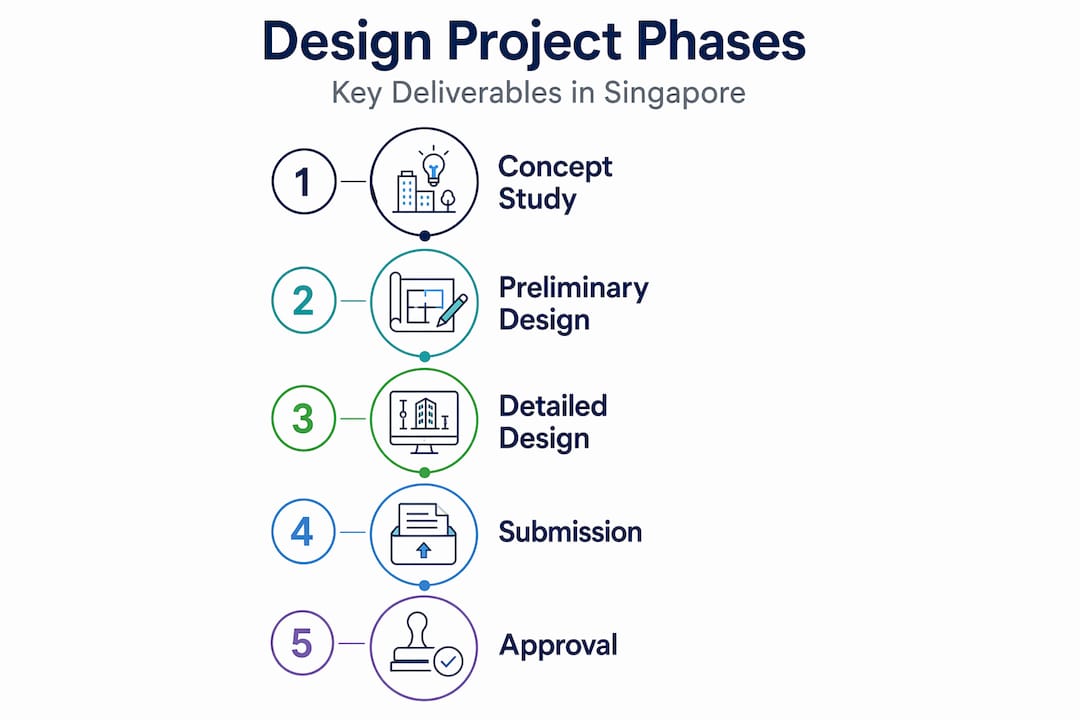
With principles clear, understanding how these translate into project stages brings clarity to the design workflow. Civil engineering projects move through phases including feasibility and site assessment, preliminary design, detailed design, bidding, construction administration, and commissioning. Each phase produces specific deliverables that feed into the next.
-
Feasibility and site assessment: Engineers evaluate ground conditions, existing utilities, surrounding structures, regulatory constraints, and access. The output is a feasibility report that informs go or no-go decisions. In Singapore, this stage often involves engaging geotechnical specialists and reviewing URA planning parameters before any design work begins.
-
Preliminary design: Structural and civil systems are laid out in sufficient detail to support cost estimation and regulatory pre-application meetings. Engineers produce outline drawings, preliminary calculations, and material specifications. This is where developers gain the clearest early picture of project cost and buildability.
-
Detailed design: This phase produces the full set of construction drawings, technical specifications, and engineering calculations required for BCA submission and tender documentation. Every connection detail, reinforcement schedule, and drainage gradient is finalized at this stage. Errors introduced here are expensive to correct during construction.
-
Bidding and procurement: Tender documents derived from the detailed design are issued to contractors. Engineers often assist in evaluating bids and clarifying technical queries, ensuring contractors understand design intent before work begins.
-
Construction administration: The structural engineering process does not end at permit approval. Engineers conduct site inspections, review shop drawings, approve substitutions, and issue instructions when conditions differ from those assumed during design.
-
Commissioning and closeout: As-built drawings are prepared, regulatory submissions are finalized, and the engineer certifies that the completed works conform to the approved design. In Singapore, this step is mandatory for BCA Temporary Occupation Permit and Certificate of Statutory Completion applications.
A practical structural engineering guide will reflect all of these phases as interconnected rather than sequential silos. Problems consistently arise when phases are compressed or when design decisions made in phase one are not documented and carried forward.
Singapore standards and regulatory compliance in civil engineering design
Knowing the workflow phases, we now focus on how local standards govern civil engineering design practice. Singapore does not simply adopt international codes wholesale. BCA reviews international standards, identifies provisions that require local modification, and publishes Singapore Standards and design guides that engineers must use.
Key compliance considerations for civil engineering design in Singapore include:
- BCA-referenced Singapore Standards: Structural designs must follow codes such as SS EN 1992 (Eurocode 2 for concrete) and SS EN 1993 (Eurocode 3 for steel), incorporating Singapore-specific national annexes that modify partial safety factors and material parameters.
- Material-specific design guides: For newer materials, BCA issues targeted circulars. For example, fibre-reinforced concrete structures are now governed by SS 674:2021, ensuring that design engineers apply consistent and safe practices when specifying this material class.
- Submission obligations: Plans for new buildings, additions, and alterations must be submitted through the BCA’s CORENET system. Structural plans require the endorsement of a Qualified Person who is a registered Professional Engineer.
| Regulatory body | Primary design concern | Key reference |
|---|---|---|
| BCA | Structural and fire safety | Singapore Standards, BCA circulars |
| URA | Land use, height, setbacks | Development Control guidelines |
| PUB | Drainage and flood resilience | Code of Practice on Surface Water Drainage |
| LTA | Road and underground infrastructure | LTA Civil Design Criteria |
| NEA | Environmental impact | NEA guidelines and regulations |
Pro Tip: Engage your structural engineer at the pre-application consultation stage with the relevant authority. Early alignment on code interpretation prevents costly redesigns during formal submission review.
The Singapore guide to Eurocode 2 is particularly relevant for reinforced and prestressed concrete structures, which form the majority of Singapore’s building stock. Developers working with a structural engineering consultancy should confirm that their design team is working from the current version of each applicable Singapore Standard, as these are updated periodically.
Innovations and best practices: drainage blankets and site investigation for Singapore projects
Beyond standards, mastering practical site and foundation strategies is key to successful design in Singapore. Two areas that significantly affect foundation design outcomes are drainage blanket systems and site investigation reporting requirements.
Drainage blankets beneath base slabs
Drainage blanket systems beneath base slabs help reduce water uplift pressure, optimizing foundation design while requiring specific site suitability assessments and maintenance plans. When ground conditions allow, a properly designed drainage blanket can reduce or eliminate the need for tension piles, which are expensive to install and can complicate future basement modifications.
Key design and implementation considerations include:
- Site suitability must be confirmed through geotechnical investigation before a drainage blanket solution is specified.
- A detailed maintenance plan must accompany the design, addressing inspection access, drainage outlet maintenance, and contingency responses if the system is compromised.
- Long-term reliability depends on the surrounding ground permeability and the ability to monitor drainage performance over the building’s life.
Site investigation reports
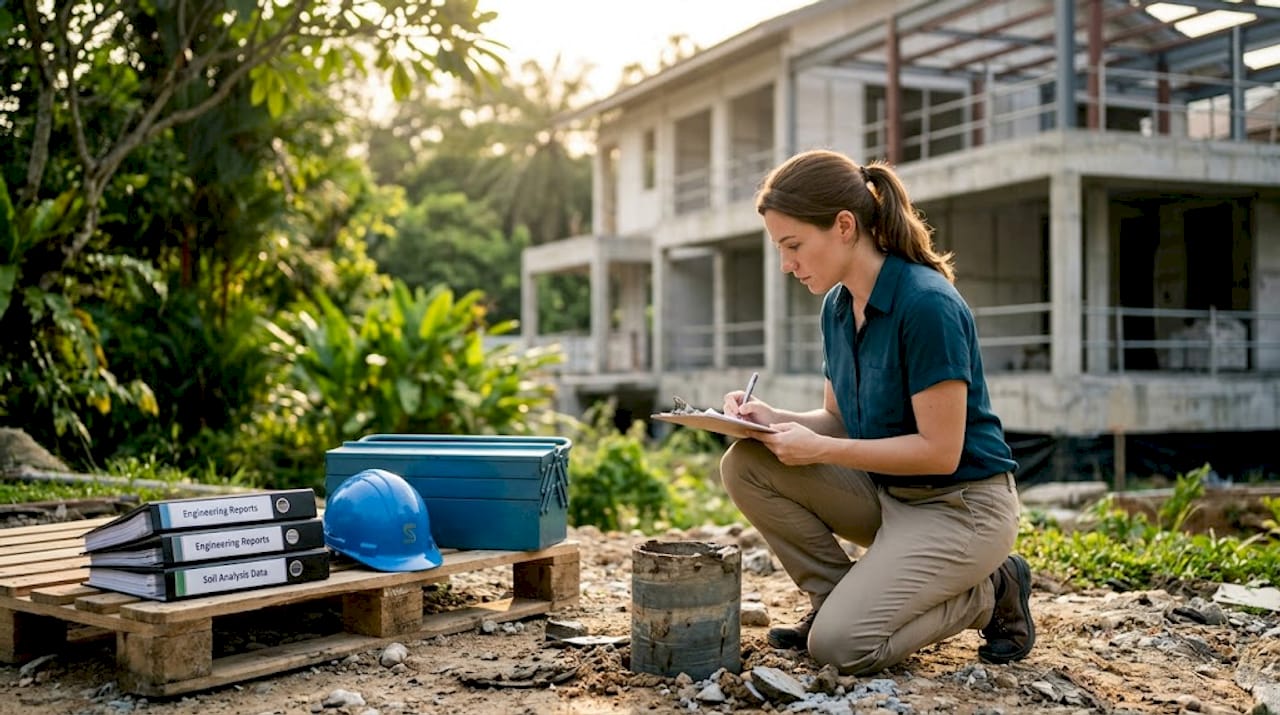
Standardized site investigation reports ensure reliable ground condition assessment essential for safe and economical building works. BCA guidelines specify minimum borehole depths, laboratory testing requirements, and report formats. Developers who commission inadequate site investigations typically face surprises during piling or excavation that drive cost overruns far exceeding the cost of a thorough investigation at the outset.
Pro Tip: Budget for site investigation early and treat it as risk reduction, not an avoidable cost. A single unexpected ground condition during construction can cost ten times more to resolve than a comprehensive investigation upfront.
Understanding civil engineering terminology related to ground investigation, including terms like SPT N-values, undrained shear strength, and consolidation parameters, enables developers to meaningfully review investigation reports and ask the right questions before design decisions are locked in.
Balancing design objectives: safety, serviceability, and economics in practice
Understanding standards and site factors leads us to how design aims are balanced practically in Singapore projects. A correct structural design balances safety, serviceability, and economics rather than optimizing strength alone. In practice, this balance requires deliberate decision-making at multiple points in the design process.
| Design objective | Practical considerations | Common trade-offs |
|---|---|---|
| Safety | Code compliance, load combinations, material factors | Overdesign increases cost but reduces risk |
| Serviceability | Deflection, cracking, durability, vibration | Better performance may require premium materials |
| Economics | Material cost, labor, maintenance, project timeline | Cost savings must not compromise safety or performance |
Factors that influence how this balance is struck on Singapore projects include:
- Material selection: Higher-strength concrete reduces section sizes but increases material cost. The net effect depends on formwork and labor savings.
- Construction method: Top-down construction for deep basements reduces construction time and lateral movement but requires more detailed design coordination.
- Maintenance planning: Specifying durable materials with longer inspection cycles reduces lifecycle costs, which BCA and developers increasingly prioritize under Singapore’s Green Building Masterplan.
Pro Tip: When reviewing design options with your engineer, ask for a comparison of total lifecycle costs, not just initial construction costs. A slightly more expensive material or detail often reduces maintenance expenditure significantly over a 30-to-50-year building life.
The benefits of structural engineering investment become most visible at this balancing stage. Developers who engage experienced engineers early in the design process consistently achieve better outcomes across all three objectives compared to those who treat engineering as a late-stage compliance activity.
Why civil engineering design must go beyond traditional strength focus in Singapore
There is a persistent tendency in construction procurement to evaluate structural engineering quality by a single metric: whether the structure stands. This view is understandable given that collapse is the most visible failure mode. It is also dangerously incomplete.
Civil engineering design aims to balance safety, serviceability, and economics rather than optimize only strength. Overemphasis on strength as the primary design goal produces structures that are technically safe but financially inefficient, difficult to maintain, and often uncomfortable or impractical for users. Singapore’s regulatory environment is increasingly reflecting this reality. BCA’s push for Green Mark certification, PUB’s Sustainable Drainage requirements, and LTA’s infrastructure resilience standards all demand that engineers think beyond whether a structure will stand and instead address how it will perform across its entire operational life.
The value of consultancy expertise in this context is substantial. An experienced consultancy does not simply apply code rules. It applies judgment built from managing trade-offs on comparable projects, understanding how Singapore’s authorities interpret ambiguous code provisions, and anticipating maintenance and operational realities that developers may not foresee. Lifecycle cost analysis, for instance, is rarely mandated by code but is consistently where the most significant financial decisions are made. Consultants who raise these conversations early save developers from committing to designs that are compliant but costly to operate.
Singapore’s evolving standards landscape, including the adoption of second-generation Eurocodes and the BCA’s ongoing circular program, means that what constituted acceptable practice five years ago may not meet current expectations. This is not a context where periodic engagement with a generalist engineer is adequate. Civil engineering design in Singapore demands sustained engagement with specialists who track regulatory changes and apply them with practical judgment.
How AEC Technical Advisory supports your civil engineering design needs in Singapore
Navigating Singapore’s civil engineering design requirements demands more than familiarity with codes. It requires applied judgment, regulatory relationships, and the ability to coordinate across structural, geotechnical, and M&E disciplines from feasibility through closeout.
AEC Technical Advisory provides specialist engineering consultancy services aligned with Singapore’s regulatory framework, covering design for safety obligations, BCA submission management, and geotechnical and structural design advisory. Whether your project requires ground investigation planning, foundation optimization, or full structural design from preliminary through detailed phases, our team applies current Singapore Standards and regulatory requirements to deliver compliant, cost-effective outcomes. Our design and build services integrate design and construction coordination, reducing interface risk and compressing project timelines. To understand how professional engineers contribute to building safety and compliance in Singapore, and how our team can support your next project, contact AEC Technical Advisory for a consultation.
Frequently asked questions
What does civil engineering design encompass in Singapore projects?
Civil engineering design covers infrastructure planning and design for roads, buildings, water supply, and environmental facilities, producing detailed drawings and specifications that ensure safety and full compliance with Singapore’s regulatory standards.
Which standards guide structural engineering design in Singapore?
Structural designs follow Singapore Standards including SS 674:2021 for fibre-reinforced concrete, referenced in BCA circulars, alongside local national annexes that modify international Eurocodes for Singapore’s specific conditions.
How important is site investigation for civil engineering design?
A comprehensive site investigation report is critical for assessing ground conditions safely and economically. Standardized site investigation requirements mandated by BCA guidelines apply to all building works in Singapore.
What are the benefits of using drainage blankets in Singapore foundation design?
Drainage blanket systems beneath base slabs reduce uplift water pressure, potentially eliminating the need for tension piles and significantly reducing foundation costs, provided site conditions are suitable and a maintenance plan is in place.