
Choosing the wrong project approach in Singapore’s construction landscape carries real consequences: regulatory rejections, costly redesigns, and delayed approvals that erode project margins. Singapore’s building codes and regulations govern every major decision, and the city-state’s combination of soft marine clay, reclaimed land, dense urban infrastructure, and aggressive climate resilience targets means that no two civil engineering projects follow identical compliance paths. This guide systematically examines the primary civil engineering project types, the regulatory frameworks controlling each, and the technical factors that should shape your project selection and design strategy from the outset.
Table of Contents
- Evaluating civil engineering project types: Key criteria for Singapore
- Roads, expressways, and pavement projects
- Drainage, stormwater, and flood prevention systems
- Major tunneling, MRT, and foundation works
- Comparison of major civil engineering project types in Singapore
- What most guides miss: Hidden civil engineering decisions in Singapore
- Connect with expert civil engineering consultants for your Singapore project
- Frequently asked questions
Key Takeaways
| Point | Details |
|---|---|
| Project selection drives compliance | Choosing the right civil engineering project type helps ensure regulatory approval and safety in Singapore. |
| Singapore’s terrain needs special solutions | Soft clay, heavy rainfall, and tight land require methods like deep bored piles and innovative drainage. |
| Sustainability is now the default | Stormwater management must use SuDS and ABC Waters frameworks to meet modern standards. |
| Regulation shapes every project | Success depends on early alignment with LTA, PUB, and BCA codes throughout planning and design. |
| Expert advice saves time and cost | Engaging multidisciplinary consultants early can accelerate compliance and optimize project outcomes. |
Evaluating civil engineering project types: Key criteria for Singapore
Before committing to a project approach, developers and construction firms need to understand the regulatory agencies and site factors that will govern the entire design and approval process. Singapore’s heavy civil projects require rigorous public standards compliance, with BCA, LTA, and PUB each holding distinct jurisdictional authority over different project components.
Key regulatory agencies and their roles:
- BCA (Building and Construction Authority): Governs structural safety, qualified person appointments, and building plan approvals for constructed works.
- LTA (Land Transport Authority): Controls road reservations, street works proposals, and underground utility protection zones.
- PUB (Public Utilities Board): Mandates stormwater management, drainage reserve setbacks, and ABC Waters design standards for all developments.
- JTC and URA: Relevant for industrial and land-use planning submissions, especially in reclaimed or restricted zones.
Critical decision factors before selecting a project type:
- Site ground conditions, specifically whether the site contains soft Kallang Formation marine clay, residual soils, or weathered granite
- Project impact radius on adjacent structures, utilities, and transport corridors
- Drainage catchment area and flood vulnerability under intensified rainfall scenarios
- Required integration with existing transport infrastructure, including MRT corridors and bus lanes
Early geotechnical studies reduce compliance risks significantly. Many project delays trace back to geotechnical surprises uncovered mid-construction, when design changes are exponentially more expensive. Understanding the correct types of engineering consultancy needed for your project, whether structural, geotechnical, or drainage-focused, allows you to assemble the right team before submission.
Pro Tip: Always align your road and drainage designs with the latest LTA Standards and Specifications before preparing any street works proposal. Outdated references are among the most common causes of first-round submission rejections.
With this foundation, let’s examine each project type in detail.
Roads, expressways, and pavement projects
Road infrastructure represents one of the most frequent civil engineering project types encountered by Singapore developers, particularly those managing large-scale mixed-use or industrial developments. Roads and pavements in Singapore are built to LTA standards, with flexible and rigid pavement options tailored to local traffic loads and climate conditions.
Flexible vs. rigid pavements: Technical selection criteria
| Pavement Type | Typical Application | Key Advantage | Common Singapore Use Case |
|---|---|---|---|
| Flexible (asphalt) | Arterial and local roads | Easier resurfacing, lower initial cost | Industrial estate access roads |
| Rigid (concrete) | Bus lanes, heavy vehicle routes | High load capacity, durability | Expressway ramps, container port roads |
| Composite | High-traffic urban roads | Combines benefits of both | Trunk roads near MRT interchanges |
Major ongoing projects like the North-South Corridor (NSC) demonstrate how Singapore integrates bus lanes, cycling trunk routes, and pedestrian paths within a single road corridor. This multimodal integration requirement adds design complexity that developers building access roads into large developments must also address when their works connect to state roads.
LTA SDRE (Street and Development Requirements and Evaluation) guidelines specify road reserve widths, kerb standards, drainage channel types, and sight-line requirements for all road works proposals. Compliance with SDRE is mandatory for obtaining street works approval, and submissions must be endorsed by a Qualified Person (QP) registered with LTA.
Arterial road projects in Singapore also require coordination with the Road Opening Permit (ROP) system, underground utility owners, and traffic management plans that minimize disruption to existing vehicle and pedestrian flows. For larger road schemes, Environmental Baseline Studies and Traffic Impact Assessments may also be required by LTA or URA.
Pro Tip: Plan for integration with bus lanes, bikeways, and multimodal transport nodes from the earliest design stage. Retrofitting these elements after road geometry is fixed is costly and often triggers full redesign of intersection layouts.
Beyond roadways, another equally critical sector in Singapore’s urban network is drainage and flood management.
Drainage, stormwater, and flood prevention systems
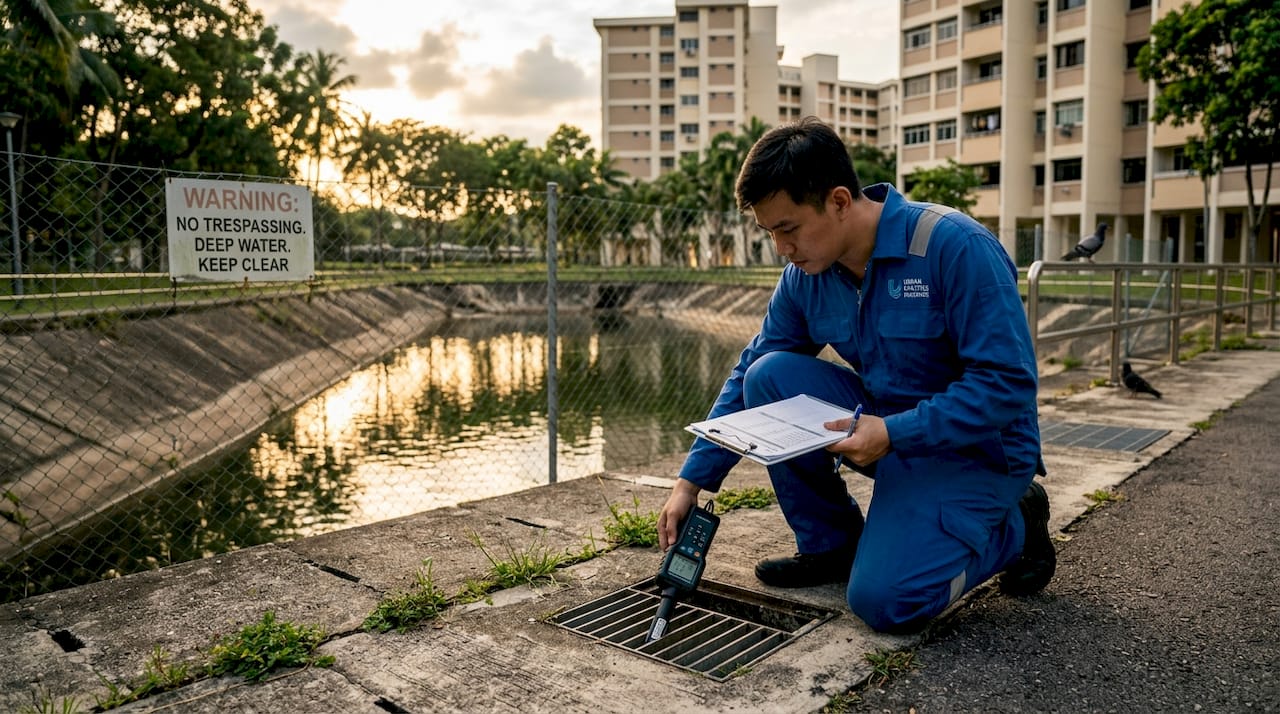
Singapore’s intense rainfall, averaging over 2,400 mm annually, combined with a heavily urbanized catchment, makes drainage engineering one of the most technically demanding civil project categories in the country. Drainage projects frequently utilize U-drains, box culverts, and drop-inlet chambers in line with LTA and PUB requirements, while deep tunnel initiatives like DTSS (Deep Tunnel Sewerage System) exemplify Singapore’s large-scale approach to stormwater and sewage management.
Common drainage project types in Singapore:
- Open U-channel drains: Standard for residential and light industrial developments; designed to PUB hydraulic calculation requirements.
- Box culverts: Used for larger catchments, road crossings, and areas where open channels are not feasible.
- Drop-inlet chambers and sumps: Critical transition structures managing flow velocity between surface and subsurface drainage.
- Retention ponds and detention tanks: Required under ABC Waters guidelines for new developments above a defined site area threshold.
- Deep Tunnel Sewerage System (DTSS): The deep tunnel approach operates 20 to 50 meters below ground, conveying both used water and stormwater to centralized treatment facilities.
Singapore’s ABC Waters and SuDS frameworks promote sustainable drainage and on-site stormwater detention, aligning with the country’s broader climate adaptation strategy. The Source-Pathway-Receptor (SPR) model provides the analytical framework PUB uses to evaluate flood risk, where the source is the rainfall event, the pathway is the drainage network, and the receptor is the vulnerable area or building.
Conventional vs. sustainable drainage: A practical comparison
| Feature | Conventional Drainage | Sustainable Drainage (SuDS/ABC Waters) |
|---|---|---|
| Primary function | Rapid runoff conveyance | Slow, filter, and reuse runoff |
| Land requirement | Minimal | Moderate (bioswales, retention ponds) |
| Maintenance intensity | Low to moderate | Moderate to high |
| Regulatory incentive | Standard compliance | GFA incentives under ABC Waters scheme |
| Flood resilience | Dependent on channel capacity | Enhanced through distributed detention |
Developers working on sites near designated Sustainable Drainage Systems or within ABC Waters designated parks must integrate biophilic drainage elements as a planning condition. Water-sensitive urban design principles are increasingly embedded in URA Master Plan conditions for new precincts.
Infrastructure beneath the surface is equally vital, especially tunnels, MRT lines, and foundations.
Major tunneling, MRT, and foundation works
Underground works represent the highest technical complexity and geotechnical risk among Singapore’s civil engineering project types. MRT and tunnel projects use diaphragm walls and bored tunnel techniques specifically engineered for Singapore’s ground conditions, which include soft Kallang Formation marine clay in coastal and reclaimed areas and hard granite in the central and eastern zones.
Key construction methods used in Singapore underground works:
- Cut-and-cover: Used for shallow MRT stations and utility tunnels where surface disruption is manageable.
- Bored tunneling (TBM): Preferred for MRT running tunnels to minimize surface settlement and protect adjacent structures.
- Diaphragm walls: Serve as both temporary earth retention and permanent structural elements in station boxes.
- Bored piles and caissons: Essential for deep foundations in soft clay areas, managing both structural loads and negative skin friction.
Negative skin friction (downdrag) is a particularly significant issue in Singapore’s reclaimed and coastal areas. When soft marine clay consolidates over time, it exerts downward drag forces on pile shafts, increasing the effective load that the pile must carry. Deep bored piles are specifically designed to anchor below the consolidating layer, bypassing the zone of downdrag and transferring loads to competent bearing strata.
Empoldering is a newer land reclamation technique receiving significant attention. At Tekong Polder, this method has cut sand needs by 50%, a crucial innovation for Singapore given its dependence on sand imports for traditional reclamation. The polder system uses perimeter bunds and internal drainage pumping to manage land below sea level, similar to Dutch practices but adapted for tropical conditions and Singapore’s rising sea level projections.
Statistic: The Tekong Polder project saves approximately 50% of the sand volume that conventional hydraulic fill reclamation would require, representing both significant cost savings and reduced environmental impact.
Pro Tip: Engage specialized geotechnical teams early for projects involving transition zones between soft clay and granite, particularly in areas like Buona Vista, Jurong, and parts of the East Coast. Ground model uncertainties in these zones have historically caused tunnel boring machine (TBM) schedule overruns.
For a quick summary, compare the key features, compliance needs, and technical challenges across these project types.
Comparison of major civil engineering project types in Singapore
Understanding how each project type compares across practical parameters helps developers allocate resources, plan timelines, and prioritize which professional appointments to make first.
| Project Type | Scope | Primary Compliance | Technical Focus | Unique Challenge |
|---|---|---|---|---|
| Roads and pavements | Surface works, traffic management | LTA SDRE, ROP system | Pavement design, drainage integration | Multimodal lane integration |
| Drainage systems | Surface and subsurface hydrology | PUB, LTA SDRE, ABC Waters | Hydraulic calculations, SuDS design | Climate change intensification factors |
| MRT and tunnels | Deep underground, station structures | LTA, BCA, specialized PE | Ground movement, TBM selection | Marine clay and granite transitions |
| Foundation works | Substructure, pile design | BCA, geotechnical PE endorsement | Pile capacity, settlement analysis | Negative skin friction in reclaimed land |
| Land reclamation | Coastal, offshore works | PUB, MEWR, international standards | Empoldering, hydraulic fill design | Sand scarcity, sea level rise |
Singapore’s key infrastructure projects often require PSSCOC contracts (Public Sector Standard Conditions of Contract) and performance-based Eurocode design, which formally assigns responsibility to professional engineers for demonstrating that designs meet defined performance outcomes rather than simply following prescriptive rules.
“Performance-based Eurocode design shifts the burden of proof to the design engineer. This means your QP must be able to demonstrate adequacy through calculation, not just cite a standard. Select your professional engineering services partner based on their Eurocode competency, not just their submission track record.”
When to prioritize each project type:
- Prioritize road and pavement works when developing new industrial, logistics, or mixed-use precincts requiring LTA road reserve dedication.
- Prioritize drainage and SuDS when site areas exceed PUB’s on-site detention requirements or are within flood-vulnerable catchments.
- Prioritize deep foundation and tunneling when developing high-rise structures in reclaimed areas or adjacent to existing MRT corridors.
- Engage a structural engineering specialist early using the structural engineering guide when your project involves complex loading scenarios on variable ground.
Having explored each type and their comparative strengths, let’s consider industry wisdom from field experience.
What most guides miss: Hidden civil engineering decisions in Singapore
Most project guides focus on compliance checklists. The real risk in Singapore civil engineering is not failing a checklist. It is making the correct project type selection without a robust understanding of what the ground will actually do over the design life.
Singapore’s site-specific challenges, including soft marine clay and rapid urbanization, make early geotechnical planning and regulatory dialogue critical for any major civil engineering project. This is not a formality. Projects that invest in early geotechnical investigation consistently outperform those that treat soil investigation as a compliance box to tick post-design.
The second overlooked factor is multidisciplinary integration. Road engineers who design in isolation from drainage engineers routinely produce road profiles that trap water at low points. Tunnel designers who do not engage urban planners early find that their ventilation shaft locations conflict with future URA Master Plan changes. The most successful Singapore infrastructure projects, including DTSS Phase 2 and the TEL MRT line, were built on sustained collaboration between geotechnical, structural, drainage, and transport engineers working concurrently rather than sequentially.
The third issue is regulatory engagement strategy. Many developers treat agency submissions as procedural hurdles. In reality, early pre-application consultations with LTA, PUB, and BCA are among the most cost-effective investments a project team can make. Authorities frequently provide informal guidance that shapes design direction before costly detailed design is completed. Understanding geotechnical analysis steps and presenting credible ground models during pre-application meetings demonstrates technical readiness and typically shortens formal approval timelines.
Pro Tip: Do not treat agency submissions as red tape. The developers who engage LTA and PUB at concept stage, presenting preliminary ground models and drainage strategies, consistently receive more constructive feedback and shorter formal approval cycles than those who submit only at the detailed design stage.
Connect with expert civil engineering consultants for your Singapore project
Navigating the technical and regulatory complexity of Singapore’s civil engineering landscape requires more than internal resources alone. Whether your project involves road submissions to LTA, drainage compliance with PUB, or deep foundation design in challenging ground conditions, having the right advisory team directly shapes approval timelines, design accuracy, and construction cost outcomes.
AECTechnicalSG provides engineering consultancy services tailored specifically for Singapore developers and construction firms, covering the full spectrum from geotechnical and structural engineering to authority submissions and drainage design. The team manages PE endorsement and authority submissions to BCA, LTA, PUB, and other agencies, reducing your administrative burden while ensuring technical compliance. Explore the real value of consultancy for your next Singapore civil engineering project and engage specialists who understand how to move projects from concept to approval efficiently.
Frequently asked questions
What are the most common types of civil engineering projects in Singapore?
Major types include roads, drains, tunnels, deep sewerage systems, and land reclamation works, each governed by distinct regulatory frameworks and technical requirements.
How does Singapore handle flood prevention in civil projects?
Singapore uses U-drains, box culverts, and mandates SuDS and ABC Waters compliance; deep tunnel initiatives and the Source-Pathway-Receptor model are central to its flood prevention strategy.
What is special about land reclamation in Singapore?
Empoldering at Tekong Polder saves 50% of the sand volume required by conventional hydraulic fill methods, while also delivering improved flood resilience through internal drainage management.
What standards do Singapore developers need to follow for civil projects?
Developers must comply with LTA SDRE standards for roads and drains, Eurocode for performance-based structural design, and PUB and ABC Waters guidelines for all stormwater management requirements.
How do geotechnical risks influence project design in Singapore?
Singapore’s soft marine clay and granite transition zones require deep bored pile solutions and early geotechnical investigation to avoid negative skin friction, excessive settlement, and structural failures.