
SCDF fire safety is defined as the full regulatory framework administered by the Singapore Civil Defence Force to govern fire prevention, protection system standards, and emergency response readiness across all buildings in Singapore. The framework draws its authority from the Fire Safety Act 1993 and the Fire Code, two instruments that set binding obligations for construction professionals, building managers, and property developers alike. Understanding SCDF fire safety is not optional for anyone involved in building development or management. Non-compliance carries criminal liability, project delays, and occupancy restrictions. Recent updates, including a shift to a three-year Fire Certificate validity effective 1 april 2026, make it more critical than ever to stay current with SCDF fire safety guidelines.
What are SCDF fire safety works and when is plan approval required?
“Fire safety works” is the formal term under the Fire Safety Act 1993 for any installation, alteration, or extension of fire protection systems, fire-resisting construction, or emergency egress routes within a building. The scope is broader than most developers initially expect. Fire safety works extend beyond equipment to structural elements like fire-resisting walls and emergency exits, all of which fall under SCDF jurisdiction.
Plan approval from SCDF is mandatory before any fire safety works begin. Under the Fire Safety Act 1993, plans must be prepared and submitted by a Qualified Person (QP), typically a licensed Professional Engineer or registered architect with relevant fire safety expertise. The QP bears legal responsibility for the accuracy and completeness of the submission. Engaging an unqualified party to prepare plans is itself a breach of the Act.

Certain minor fire safety works are exempt from plan submission under the Fire Safety (Exemption) Order. These exemptions are narrowly defined and do not cover structural fire compartmentation or primary suppression systems. Developers who assume their works qualify for exemption without formal verification frequently trigger enforcement action.
The consequences of proceeding without approval are severe. Unauthorized alterations to fire safety systems constitute a criminal offense under the Fire Safety Act, exposing responsible parties to fines, mandatory rectification, and project suspension. The following steps summarize the plan approval process:
- Engage a QP to assess whether works require plan submission or qualify for exemption.
- Prepare fire safety plans in accordance with the Fire Code and relevant Singapore Standards.
- Submit plans through SCDF’s e-services portal for review and approval.
- Obtain written approval before commencing any fire safety works on site.
- Notify SCDF upon completion and request inspection before occupancy.
Pro Tip: Engage your QP and fire safety consultant at the schematic design stage, not after construction documents are finalized. Late-stage plan revisions to meet SCDF requirements are among the most common causes of project delays in Singapore.
How to obtain and maintain SCDF Fire Safety Certificates
The Fire Safety Certificate (FSC) is the formal confirmation that a building’s fire protection systems have been installed, inspected, and verified to comply with the approved plans. Occupying a building without a valid FSC is a criminal offense under the Fire Safety Act. The FSC is not a one-time milestone. It requires active maintenance and periodic renewal to remain valid.
Effective 1 april 2026, the Fire Certificate renewal now carries a three-year validity period. This change reduces the administrative frequency of renewals while placing greater responsibility on building owners to maintain systems rigorously between renewal cycles. The longer validity period is not a relaxation of standards. It reflects SCDF’s expectation that licensed contractors and Fire Safety Managers will uphold continuous compliance without annual prompting.
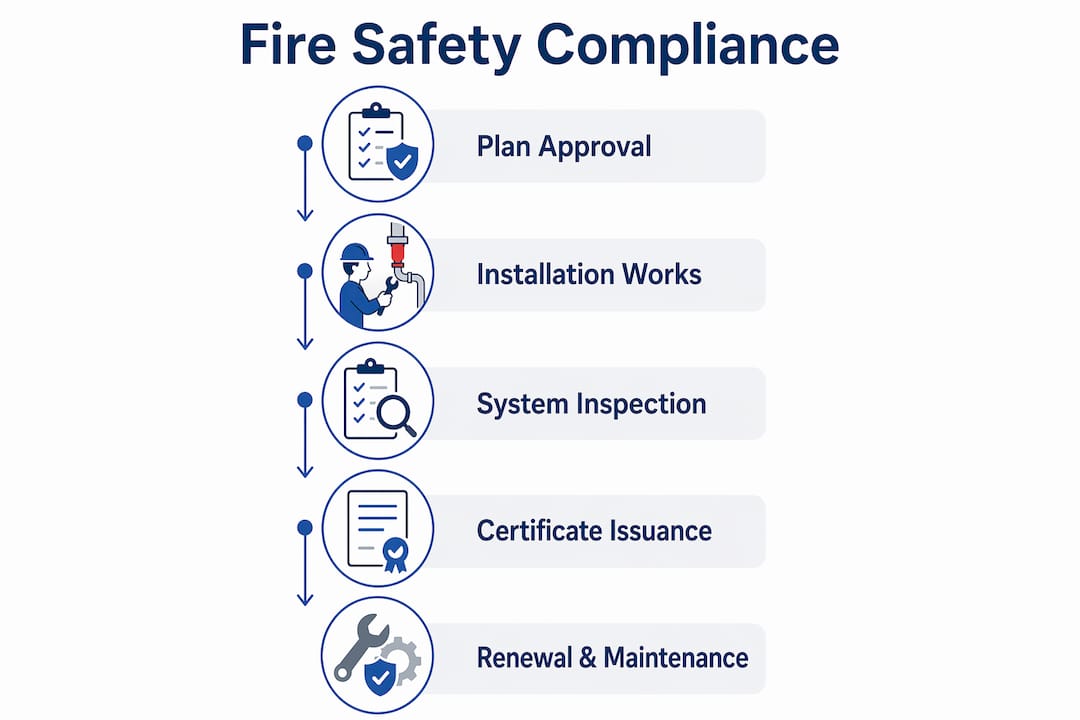
The following table summarizes the key elements of FSC application, maintenance, and renewal:
| Stage | Requirement | Responsible Party | Timeline |
|---|---|---|---|
| Initial application | Submit completed works for SCDF inspection | QP and licensed contractor | Before occupancy |
| FSC issuance | Confirm systems comply with approved plans | SCDF | Upon satisfactory inspection |
| Ongoing maintenance | Maintain and service all fire protection systems | SCDF-licensed contractor | Continuous, per schedule |
| Record keeping | Keep maintenance records on-site for inspection | Building owner or manager | At all times |
| Renewal application | Submit renewal before expiry | Fire Safety Manager or owner | Every 3 years from 1 April 2026 |
Key obligations during the FSC maintenance period include:
- Appointing a certified Fire Safety Manager for all prescribed premises.
- Scheduling maintenance of sprinkler systems, fire alarm panels, hose reels, and suppression systems with SCDF-licensed contractors.
- Keeping maintenance records accessible on-site at all times for SCDF inspection.
- Updating the FSC file whenever system modifications are made and approved.
- Submitting renewal applications before the certificate expires to avoid a lapse in valid certification.
Pro Tip: Set a calendar reminder 6 months before your FSC expiry date. Renewal applications that arrive close to expiry leave no buffer for SCDF queries or documentation gaps.
Key fire safety compliance obligations for building managers and developers
Compliance does not end at FSC issuance. Building managers and developers of prescribed premises carry ongoing legal obligations that run for the life of the building’s occupancy. Occupiers of prescribed premises must appoint certified Fire Safety Managers who are responsible for coordinating all fire safety activities and liaising directly with SCDF.
SCDF conducts periodic inspections and enforcement actions to verify that fire safety standards and system maintenance are upheld. Inspectors check physical systems, maintenance records, evacuation plans, and drill documentation. A building that passes FSC inspection but fails a routine SCDF audit due to poor record keeping faces the same enforcement consequences as one with defective equipment.
Fire evacuation drills are a specific legal requirement, not a best practice. Prescribed premises must conduct fire evacuation drills at least once every six months. Evacuation plans must be displayed prominently and communicated to all occupants. Records of every drill, including date, participants, and outcomes, must be retained as proof of compliance.
The critical compliance tasks for building managers and developers are:
- Appoint a certified Fire Safety Manager and keep appointment records current.
- Conduct fire evacuation drills semiannually and document each exercise.
- Display and update evacuation plans whenever building layouts or occupancy changes.
- Engage SCDF-licensed contractors for all fire protection system maintenance.
- Retain all maintenance and inspection records on-site and accessible.
- Report any fire safety system defects to the licensed contractor immediately and document the remediation.
- Prepare for SCDF inspections by conducting internal audits at least annually.
Pro Tip: Treat SCDF inspections as an opportunity, not a threat. Buildings with organized documentation and proactive maintenance records consistently resolve inspection findings faster and with fewer enforcement notices.
What are the common challenges in SCDF fire safety submissions?
Documentation gaps are the leading cause of plan submission rejections and FSC delays. QPs frequently submit plans that reference outdated Fire Code editions or omit required details on fire compartmentation. SCDF reviewers return these submissions, and each revision cycle adds weeks to the project timeline. Developers who treat fire safety plan preparation as a low-priority task typically pay for that decision in program delays.
Coordination between the architectural, structural, and mechanical and electrical (M&E) teams is a persistent challenge. Fire safety works touch all three disciplines. A change to a floor slab penetration affects fire compartmentation. A revised ceiling layout affects sprinkler coverage. When these teams work in silos, the QP receives conflicting information and the submitted plans reflect it. Early and structured coordination meetings, with fire safety as a standing agenda item, prevent most of these conflicts.
The following practices reduce compliance risk across the project lifecycle:
- Engage a fire safety consultant or SCDF submission specialist at the project inception stage.
- Confirm exemption eligibility in writing before assuming minor works are excluded from plan submission.
- Maintain a single master fire safety register that tracks all systems, maintenance dates, and upcoming renewal deadlines.
- Schedule internal fire safety audits 3 months before any anticipated SCDF inspection or FSC renewal.
- Provide fire safety awareness training to all building management staff, not just the appointed Fire Safety Manager.
SCDF’s regulation covers not just paperwork but ensures effective emergency response readiness around the clock through design compliance. That framing matters. A building that meets every documentation requirement but has a poorly designed egress route still represents a life-safety failure. Compliance and genuine safety are not the same thing, and the best practitioners treat them as inseparable.
Key Takeaways
SCDF fire safety compliance requires plan approval before works begin, a valid Fire Safety Certificate before occupancy, and continuous maintenance and documentation throughout the building’s operational life.
| Point | Details |
|---|---|
| Plan approval is mandatory | All fire safety works require SCDF-approved plans prepared by a Qualified Person before work starts. |
| FSC is required before occupancy | Occupying a building without a valid Fire Safety Certificate is a criminal offense under the Fire Safety Act. |
| Three-year FSC renewal from 2026 | Effective 1 April 2026, Fire Certificate renewals carry a three-year validity, increasing the importance of proactive maintenance. |
| Semiannual drills are a legal requirement | Prescribed premises must conduct fire evacuation drills every six months and retain documentation as proof. |
| Licensed contractors for all maintenance | Fire protection system maintenance must be performed by SCDF-licensed contractors with records kept on-site. |
What I’ve learned from years of SCDF fire safety submissions
The most consistent mistake I see from developers and building managers is treating SCDF fire safety as a box-ticking exercise. They engage the QP late, rush the plan submission, and then scramble when SCDF returns comments. The three-year FSC validity change from 2026 is genuinely positive for the industry. It reduces the annual renewal burden. But I’ve already seen teams interpret it as a reason to defer maintenance planning. That interpretation is wrong and costly.
The buildings that sail through SCDF inspections share one characteristic: their fire safety documentation is as organized as their financial records. Maintenance logs are current. Drill records are filed. The Fire Safety Manager knows the renewal date without checking. That level of discipline does not happen by accident. It requires a system, and that system needs to be built into the building’s operational framework from day one.
My practical advice is this: treat the QP and the fire safety consultant as core project team members, not external vendors you engage at the last moment. Their input at the design stage prevents the kind of late-stage plan revisions that cost real money and time. For building managers, the construction compliance checklist approach works equally well for ongoing fire safety management. Build the checklist, assign ownership, and review it quarterly.
SCDF’s evolving regulations reflect a balanced approach: reduce business burdens while enhancing safety through longer certificate validity combined with strict maintenance enforcement. That balance is achievable, but only for teams that take compliance seriously before an inspector arrives.
— Aman
How Aectechnicalsg supports your SCDF fire safety compliance
Aectechnicalsg provides end-to-end engineering consultancy for SCDF fire safety submissions, from initial plan preparation and QP endorsement through to FSC application and renewal support. The team works directly with developers, building managers, and construction firms across Singapore to manage the full submission lifecycle.
Aectechnicalsg’s SCDF submission services cover fire safety plan endorsement, Professional Engineer (PE) endorsements, and compliance audit support for both new developments and existing buildings undergoing alteration works. For developers managing multiple regulatory submissions simultaneously, Aectechnicalsg also provides engineering consultancy services that coordinate fire safety requirements alongside structural, M&E, and authority submission workflows. Contact Aectechnicalsg to discuss your project’s fire safety compliance requirements before your next submission deadline.
FAQ
What is SCDF fire safety certification?
SCDF fire safety certification refers to the Fire Safety Certificate (FSC), which confirms that a building’s fire protection systems comply with approved plans and the Fire Safety Act 1993. Occupying a building without a valid FSC is a criminal offense.
When is a Qualified Person required for SCDF plan submission?
A Qualified Person, typically a licensed Professional Engineer or registered architect, is required to prepare and submit fire safety works plans to SCDF under the Fire Safety Act 1993. The QP bears legal responsibility for the submission’s accuracy.
How often must fire evacuation drills be conducted?
Prescribed premises must conduct fire evacuation drills at least once every six months. Records of each drill must be retained on-site as documentation of compliance.
What changed with SCDF Fire Certificate renewals in 2026?
Effective 1 april 2026, the Fire Certificate renewal validity period extended to three years, reducing the frequency of renewal applications while maintaining strict maintenance and inspection obligations between renewal cycles.
Who can perform fire protection system maintenance in Singapore?
Only SCDF-licensed contractors are authorized to carry out fire protection system maintenance. Maintenance records must be kept on-site and made available during SCDF inspections.