
Structural engineering failures in Singapore don’t just cost money. They trigger BCA enforcement actions, project suspensions, and reputational damage that can take years to recover from. For project developers and construction firms operating in one of Asia’s most tightly regulated building environments, understanding structural engineering principles and compliance obligations is not optional. This guide provides a precise, practical breakdown of structural engineering concepts, workflows, key codes, and modern innovations, giving your project team the clarity needed to make informed decisions from site assessment through authority submission.
Table of Contents
- What is structural engineering? The foundation of every project
- Structural engineering workflow: From concept to construction
- Key compliance and building codes in Singapore
- Modern innovations and materials in structural engineering
- Why compliance and expertise matter more than ever in Singapore construction
- Partner with Singapore’s leading structural engineering advisors
- Frequently asked questions
Key Takeaways
| Point | Details |
|---|---|
| Critical project role | Structural engineering underpins safe, compliant, and cost-effective building projects. |
| Workflow clarity | Following a structured process ensures timely approvals and avoids regulatory pitfalls in Singapore. |
| Strict local compliance | Staying current with codes and securing PE endorsement is mandatory for all structural works. |
| Leverage innovations | Using modern materials and technologies lifts project quality and efficiency. |
| Expert guidance advantage | Experienced local engineers navigate complexity and add value beyond basic compliance. |
What is structural engineering? The foundation of every project
Structural engineering is the branch of civil engineering focused on designing and analyzing load-bearing systems within buildings and infrastructure. Its primary purpose is to ensure every component of a structure, from foundations and columns to beams and slabs, can safely resist the forces placed upon it throughout its service life. In Singapore’s context, that means accounting for gravity loads, wind pressure, dynamic forces from construction activity, and the long-term effects of a tropical climate on building materials.
Structural engineering ensures buildings are safe, stable, and compliant with regulations at every stage of the project lifecycle. This isn’t merely a design concern. It is a legal obligation. In Singapore, all structural designs for buildings submitted to the Building and Construction Authority (BCA) must be endorsed by a registered Professional Engineer (PE) with the appropriate scope of practice. Failure to secure PE endorsement is grounds for permit rejection and potential demolition orders on unauthorized works.
The structural engineer’s role spans far more than drawing beams on paper:
- Load analysis: Determining dead loads, live loads, wind loads, and seismic considerations for Singapore’s geographic context.
- Material specification: Selecting appropriate grades of concrete, reinforcement steel, structural steel sections, or composite systems for each application.
- Foundation design: Coordinating with geotechnical engineers on pile systems, mat foundations, or shallow spread footings based on soil investigation reports.
- Connection design: Detailing every joint, splice, and anchor to ensure forces transfer reliably through the structure.
- Collaboration and coordination: Working with architects, M&E engineers, and project developers to resolve conflicts between structural systems and other building components.
Understanding structural engineering basics is particularly critical when projects involve mixed-use developments, high-rise towers, or industrial facilities where load paths are complex and coordination demands are high.
“Poor structural decisions made early in a project are rarely corrected cheaply. By the time errors surface during construction or authority review, the cost of redesign, demolition, and schedule disruption frequently exceeds the original engineering fee many times over.”
Singapore’s regulatory standards for structural performance are stringent precisely because of the density of its urban fabric. A structural failure in a closely packed development zone carries risks not only to the immediate building but to neighboring structures, underground MRT tunnels, and public infrastructure.
Structural engineering workflow: From concept to construction
Understanding what structural engineers do is only part of the picture. How they integrate into a Singapore project’s timeline determines whether your program runs smoothly or stalls at critical milestones. Singapore engineering projects must follow strict approval steps for efficiency and compliance, and a well-structured engineering workflow is the mechanism that keeps those steps aligned.
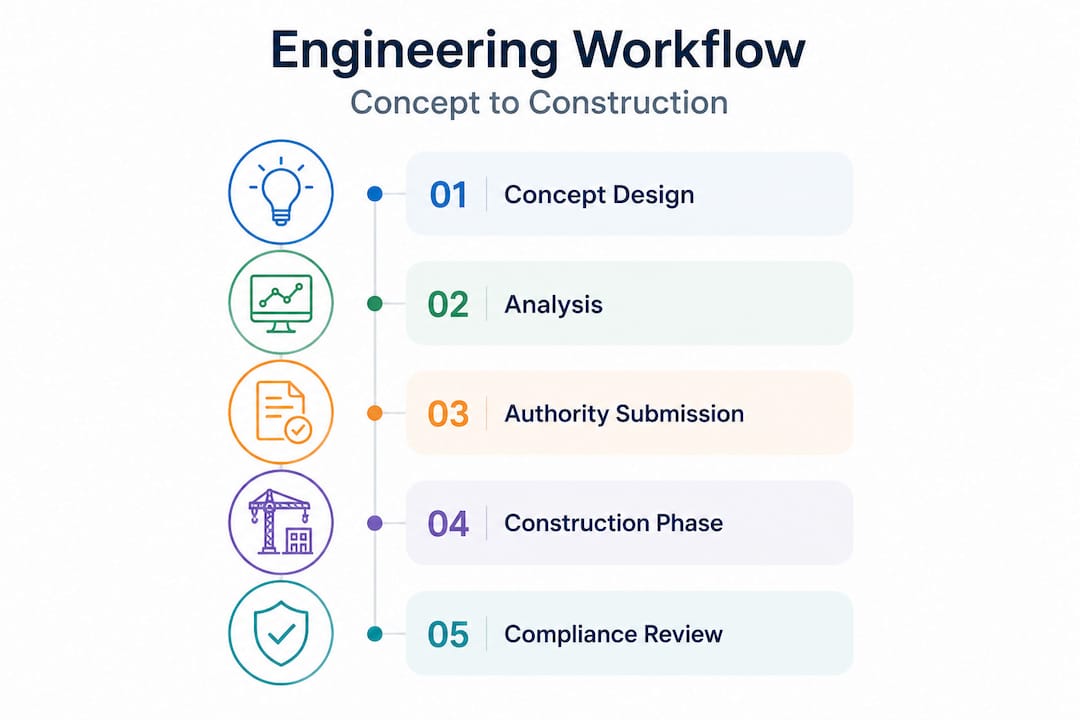
The typical structural engineering process follows these sequential phases:
- Initial consultation and site assessment: The structural engineer reviews the project brief, site constraints, geotechnical investigation data, and any existing structures. This phase establishes the basis of design and identifies potential structural risks.
- Conceptual structural design: Preliminary structural schemes are developed in parallel with the architectural concept. Column grids, floor systems, and foundation strategies are coordinated with the design team.
- Structural analysis and modeling: Using software such as ETABS, SAFE, or SAP2000, engineers perform detailed analysis to verify that the proposed structural systems satisfy code requirements under all applicable load combinations.
- Design development and documentation: Structural drawings, specifications, and calculation reports are produced to a standard suitable for BCA submission and contractor tendering.
- Regulatory submission and authority coordination: The PE-endorsed structural drawings are submitted to BCA and other relevant authorities such as URA, JTC, or LTA depending on the site classification. This phase often involves responding to agency queries.
- Construction support: During construction, the structural engineer reviews shop drawings, attends site inspections, responds to requests for information (RFIs), and endorses structural as-built documents.
| Phase | Key deliverable | Primary authority |
|---|---|---|
| Conceptual design | Structural scheme report | Internal/Architect |
| Structural analysis | Calculation report | BCA review |
| Design development | PE-endorsed drawings | BCA submission |
| Regulatory submission | Approved permit | BCA, URA, JTC |
| Construction support | As-built endorsement | BCA TOP process |
Pro Tip: Engaging the structural engineer before the architectural design is finalized prevents costly rework. Column positions locked into the architecture without structural input frequently conflict with optimal structural spans, forcing expensive redesigns at the submission stage.
Digital tools have transformed the efficiency of structural analysis. CFD modeling uses extend into structural assessment for wind-induced forces on tall or irregularly shaped buildings, particularly relevant for Singapore’s high-rise residential and commercial towers. Similarly, performance-based design approaches, as outlined in detailed fire engineering steps frameworks, allow engineers to demonstrate code compliance through rigorous analysis rather than prescriptive rules alone. These methods provide greater design flexibility and can reduce material quantities while maintaining safety standards.
Key compliance and building codes in Singapore
Regulatory compliance is the defining constraint around which all structural engineering decisions in Singapore are organized. Understanding the applicable codes is not optional knowledge for developers. It is the difference between a project that progresses confidently through authority approval and one that cycles through repeated rejections.
Singapore’s Building Codes and Eurocodes are mandatory for local construction compliance, and the regulatory framework has evolved significantly over recent years. The key instruments governing structural engineering practice include:
| Code/Standard | Scope | Administering Authority |
|---|---|---|
| BCA Approved Document | General building requirements | Building and Construction Authority |
| SS EN 1992 (Eurocode 2) | Concrete structure design | Singapore Standards Council |
| SS EN 1993 (Eurocode 3) | Steel structure design | Singapore Standards Council |
| SS EN 1997 (Eurocode 7) | Geotechnical design | Singapore Standards Council |
| SS EN 1990/1991 | Basis of design and loadings | Singapore Standards Council |
| Singapore Standard CP 65 | Transitional concrete code reference | BCA |
Professional Engineers must validate structural designs for regulatory approval, and the 2024 revision of SS EN 1992-1-1 introduced significant updates that affect how Singapore-registered PEs approach concrete design. Project teams that have not updated their internal design standards to reflect the second-generation Eurocode requirements risk submitting non-compliant documents, which triggers revision cycles that add weeks to approval timelines.
Compliance obligations for developers and construction firms include:
- PE endorsement at every structural submission stage: Structural plans, calculations, and as-built documentation all require PE sign-off. Self-certification by non-registered engineers is not permitted.
- BCA plan approval before construction: No structural works may commence until BCA grants written approval of the structural plans.
- Supervision requirements: Structural works must be supervised by qualified persons. The level of supervision is prescribed based on structure classification and complexity.
- Material compliance: Concrete mixes, reinforcement steel, and structural steelwork must conform to approved standards and be procured from BCA-registered suppliers where applicable.
- Geotechnical reporting: Foundation designs must be supported by site investigation data and endorsed by a PE in geotechnical engineering for structures above prescribed height or load thresholds.
Pro Tip: BCA publishes updates to technical guidelines and clarifications periodically. Developers and their engineering consultants should maintain a process for tracking these changes, as a revision issued mid-project can affect active submissions if not identified early.
The regulatory environment also varies by zone. Industrial facilities on JTC land carry specific structural loading requirements. Structures near LTA infrastructure corridors must satisfy the MRT Protection Zone requirements under the Rapid Transit Systems Act. Projects near watercourses must coordinate with PUB on drainage loading and flood protection requirements.
Modern innovations and materials in structural engineering
Singapore’s construction industry does not operate in isolation from global innovation. Developers and firms that leverage emerging materials and digital engineering methods gain measurable advantages in cost efficiency, construction speed, and long-term structural performance.
Modern construction utilizes FRP, advanced concrete, and digital modeling for both new-build efficiency and the rehabilitation of aging structures. The most impactful innovations currently shaping structural engineering practice in Singapore include:
- Fiber-reinforced polymer (FRP) systems: FRP carbon fiber and glass fiber wrapping systems provide externally bonded strengthening for existing concrete columns and beams. They are particularly valuable for upgrading structures to meet revised loading requirements without demolition, and advanced concrete solutions incorporating FRP compatibility have extended the service life of Singapore high-rises by decades.
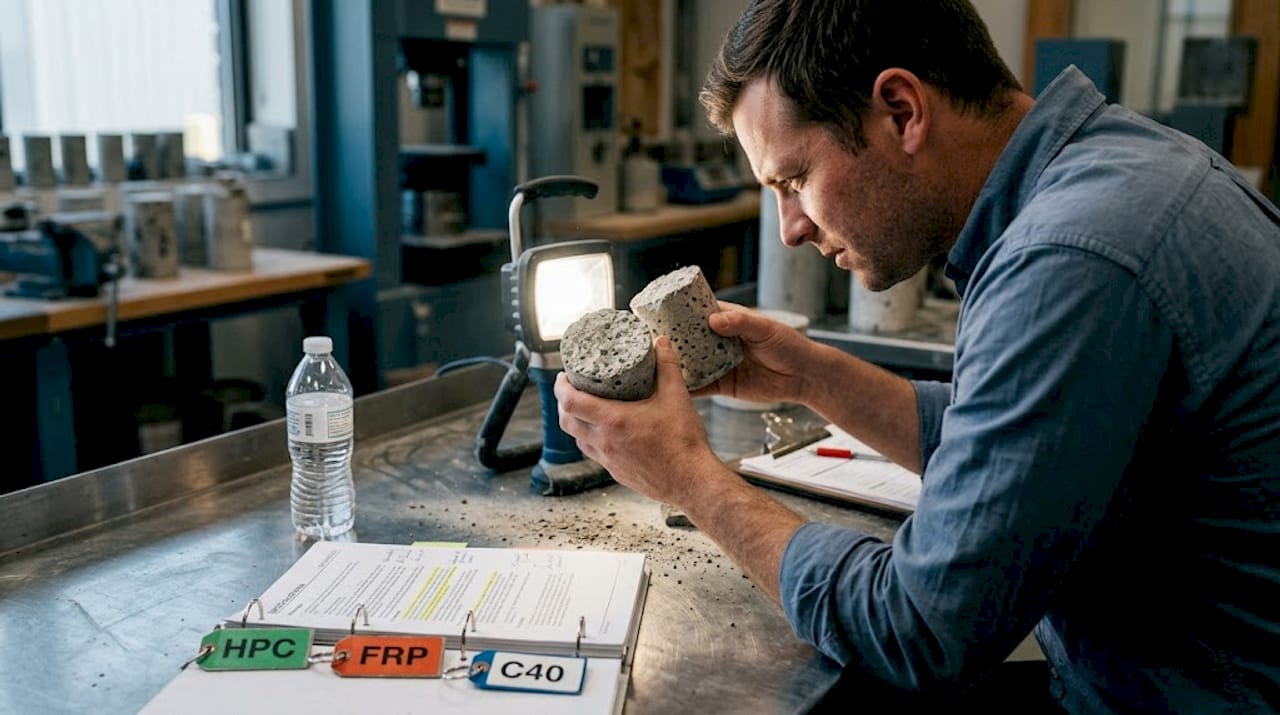
- High-performance concrete (HPC): Modern concrete mixes incorporating supplementary cementitious materials such as silica fume, fly ash, and ground granulated blast-furnace slag (GGBS) achieve compressive strengths exceeding 80 MPa. These mixes reduce column sizes in high-rise construction, freeing valuable floor area and reducing foundation loads simultaneously.
- Cellular and castellated steel beam systems: Cellular beam systems use castellated or circular web openings to reduce structural steel weight while creating integrated zones for M&E service routing. This eliminates the floor depth typically consumed by separately routed ductwork, reducing overall building height while preserving usable ceiling heights.
- Building Information Modeling (BIM): BIM-integrated structural design enables clash detection between structural elements and M&E systems before construction begins. Singapore’s BCA mandates BIM submission for projects above prescribed gross floor area thresholds, making BIM proficiency a compliance requirement rather than an optional workflow enhancement.
- Prefabricated Prefinished Volumetric Construction (PPVC): Singapore’s Construction Industry Transformation Map actively promotes PPVC adoption. Structural engineers must design primary frames to accommodate the dynamic loads from PPVC module installation and the connection detailing required for modular structural assembly.
- Digital twin technology: Real-time structural monitoring systems installed during construction and operational phases feed data into digital twin models, enabling condition-based maintenance and early detection of structural anomalies.
Pro Tip: Early adoption of innovative materials such as HPC or FRP requires coordination with BCA’s technical departments on alternative solution submissions. Engaging your structural consultant before the design is finalized allows adequate time to obtain approval for non-prescriptive material solutions without impacting the project schedule.
The shift toward sustainable construction also intersects with structural material selection. High-performance concrete with GGBS substitution delivers equivalent strength at significantly lower embodied carbon than ordinary Portland cement mixes. For developers targeting Green Mark certification, structural material choices directly influence the sustainability score and should be integrated into the structural design strategy from the outset.
Why compliance and expertise matter more than ever in Singapore construction
There is a tendency in some project teams to treat structural engineering as a commodity service, a PE endorsement secured at the lowest market fee to satisfy BCA submission requirements. This approach is fundamentally short-sighted, and the consequences become apparent not at the quotation stage but during construction, authority review, or years into the building’s operational life.
The regulatory environment in Singapore is evolving faster than many practitioners acknowledge. The second-generation Eurocode rollout, BIM submission requirements, and updated geotechnical standards have all shifted the technical baseline within a compressed timeframe. Engineering firms that have not invested in keeping their teams current are working from outdated assumptions. Developers who hire on price alone carry the risk of those outdated assumptions appearing in their structural submission.
The more consequential issue is that structural engineering expertise is where compliance risk is most concentrated. An architect can revise a facade treatment after authority review. An M&E engineer can adjust duct routing to accommodate a clearance issue. But a structural system that does not meet code requirements demands a fundamental redesign, often requiring demolition of completed work, repeat authority submissions, and schedule disruptions measured in months. The expert consultancy value delivered by experienced structural engineers is precisely their ability to anticipate these conflicts before they materialize in concrete and steel.
Singapore’s urban intensification programs and infrastructure expansion continue to create project environments where structural engineering decisions carry amplified consequences. Proximity to underground utilities, MRT tunnels, and existing high-density developments means that errors in foundation design or temporary works analysis can trigger third-party claims and regulatory enforcement simultaneously. In this environment, the question is not whether to invest in qualified structural engineering expertise. It is whether the investment is made proactively at the design stage or reactively in response to a failure that has already occurred.
Partner with Singapore’s leading structural engineering advisors
Project success in Singapore’s regulatory environment demands more than design intent. It requires a disciplined engineering process, current knowledge of BCA and Eurocode requirements, and the experience to navigate authority coordination with confidence.
AEC Technical Advisory Singapore provides structural engineering consultancy and authority submission services for project developers and construction firms across all project types. From initial structural feasibility through PE-endorsed BCA submission and construction phase support, the team delivers the technical rigor your project requires. Explore the value of expert consultancy on complex Singapore projects, review how design for safety services integrate with the structural engineering process, and contact the team through the structural engineering services page to discuss your project requirements directly. Reliable structural engineering advisory is not an overhead cost. It is a project delivery mechanism.
Frequently asked questions
What is the main role of a structural engineer in a Singapore building project?
A structural engineer ensures that all structures are safe and compliant with Singapore’s codes at every stage, from initial design through construction completion and BCA endorsement of as-built documentation.
Which building codes must Singapore construction firms follow?
All construction firms must follow Singapore’s Building Codes and Eurocodes, including SS EN 1992, SS EN 1993, and SS EN 1997, and must obtain Professional Engineer endorsement for all structural designs submitted to BCA.
What innovations are shaping modern structural engineering?
The most impactful current innovations include advanced concrete technology, FRP and advanced materials for structural strengthening, BIM-integrated design workflows, PPVC systems, and high-efficiency cellular steel beam configurations.
How does early engineering input impact project timelines?
Engaging structural engineers at the earliest design stage helps teams anticipate compliance risks and fast approval process decisions are better supported, reducing the likelihood of costly redesign cycles during authority review.