
Infrastructure development in 2026 is defined as an integrated, lifecycle-centric process that combines regulatory compliance, digital workflows, and strategic policy alignment to deliver sustainable urban systems. This infrastructure development guide 2026 addresses the three forces reshaping how projects get approved, built, and operated: legislative reform, mandatory digitalization, and emerging investment priorities. Urban planners, government officials, and developers who understand these forces will move projects faster and with greater certainty. Aectechnicalsg provides the technical advisory framework that connects these forces to real project outcomes in Singapore and beyond.
How has the infrastructure development guide 2026 changed planning approvals?
Planning reform is the most consequential shift in infrastructure delivery this year. The UK’s Planning and Infrastructure Act 2025 introduced a “golden thread” approach that keeps examination focused on the main issues from application through to final decision. That focus eliminates the procedural sprawl that previously delayed major projects by months or years.
The results are measurable. As of july 3, 2026, 41 major projects had been determined under the reformed system, representing a 95% increase compared to the previous Parliament. That figure confirms that reform is not theoretical. It is producing decisions at nearly double the prior rate.
The reformed process also reduces prescriptiveness in pre-application engagement. Applicants now have more flexibility in how they structure early consultations, which lowers preparation costs and shortens the runway to formal submission. Streamlining is not just about speed. It is about concentrating on relevant planning issues that matter, which improves systemic efficiency and gives developers greater certainty about outcomes.
The table below compares the previous and current planning process features under the reformed framework.
| Feature | Previous process | Current process |
|---|---|---|
| Pre-application engagement | Highly prescriptive, mandatory formats | Flexible, issue-focused consultation |
| Examination scope | Broad, often unfocused | Concentrated on main planning issues |
| Decision timeline | Extended, variable | Faster, with greater predictability |
| Applicant certainty | Low due to procedural variability | Higher due to defined issue threads |
| Resource efficiency | Poor, high duplication | Improved through targeted review |
Pro Tip: Map your project’s main planning issues before pre-application engagement begins. Aligning your submission to the golden thread framework from day one reduces back-and-forth with examining authorities and shortens your overall approval timeline.
New Zealand reinforces this accountability model at the national level. The government is required to respond to the National Infrastructure Plan within 180 days, with the most recent response recorded in june 2026. That statutory deadline forces policy alignment between infrastructure priorities and government action, a model that developers in any jurisdiction can use to benchmark regulatory responsiveness.
What role does digital transformation play in modern infrastructure development?
Digital transformation is no longer optional in 2026 infrastructure planning. Vietnam’s Central Committee policy guidelines for 2026–2030 mandate digital submissions across project stages and hold project leaders personally accountable for practical outcomes. The policy shift moves infrastructure from being “good in writing” to “good in practice,” a distinction that defines whether projects actually deliver value.
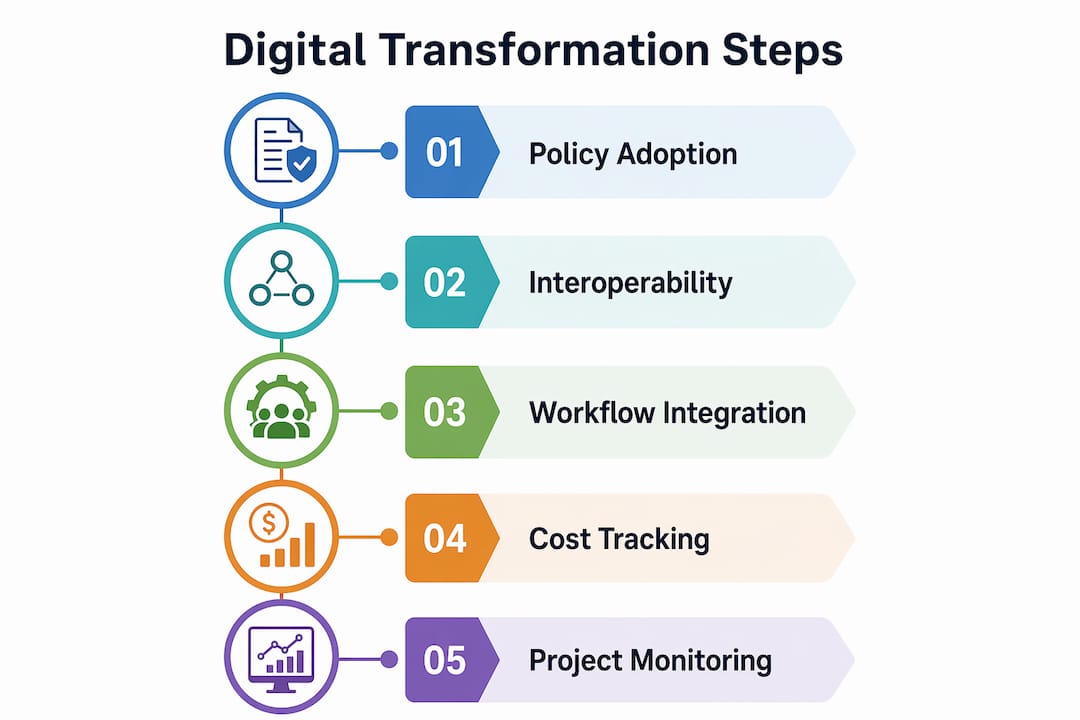
Poor data interoperability between agency systems inflates compliance costs and creates bottlenecks that delay construction starts. Early investment in automated, standardized digital workflows is the most direct way to prevent those costs from compounding across a project’s lifecycle. Singapore’s Building Information Modeling (BIM) mandates demonstrate this principle in practice, requiring structured digital models that feed directly into authority submissions and reduce manual rework.
The core digital capabilities that define compliant 2026 infrastructure projects include:
- Building Information Modeling (BIM): Structured 3D models that integrate design, engineering, and compliance data into a single source of truth for authority submissions. Aectechnicalsg’s guidance on BIM compliance requirements details Singapore-specific mandates.
- Digital twins: Real-time virtual replicas of physical assets that support predictive maintenance and operational performance monitoring across the asset lifecycle.
- Automated submission workflows: Standardized data formats that allow project documentation to move between design teams, consultants, and regulatory bodies without manual reformatting.
- Interoperable data systems: Shared data standards across agencies that eliminate duplication and reduce the compliance overhead that inflates project costs.
Pro Tip: Specify interoperability requirements in your project brief before engaging any engineering consultant. Requiring open data formats such as IFC for BIM models prevents vendor lock-in and keeps your submission pipeline compatible with multiple regulatory portals.
Tracking construction budget categories alongside digital workflow costs gives project managers a clearer picture of where digitalization spending delivers the highest return. Teams that integrate cost tracking with digital submission systems consistently identify savings that offset the upfront investment in interoperable platforms.
What emerging trends are shaping 2026 development strategies?
The most consequential infrastructure investment priorities in 2026 cluster around four areas: grid expansion, transit-oriented development, AI-driven urban systems, and climate resilience. Each carries specific regulatory and technical implications for planners and developers.
The U.S. Department of Energy’s 2026 Draft National Transmission Needs Study identifies congestion hotspots across the national grid and calls for urgent new electric transmission infrastructure driven by load growth from data centers and electrification. The study sought public input through september 7, 2026. That timeline signals that grid infrastructure is entering a period of accelerated permitting and investment, creating downstream demand for engineering consultancy across multiple sectors.
Singapore’s 2026 Economic Strategy Review takes a different but complementary angle. The report positions cities as AI innovation hubs that require smart infrastructure and supply-chain integration, not just data center capacity. Economic resilience now requires cities to be proactive hubs of AI innovation and supply-chain collaboration. That framing has direct implications for how developers design mixed-use and industrial facilities.
| Trend | Primary driver | Impact area |
|---|---|---|
| Grid expansion | Load growth from electrification and data centers | Transmission permitting, utility coordination |
| Transit-oriented development | Urban density and mobility mandates | Site selection, stakeholder engagement |
| AI hub infrastructure | Economic resilience and supply-chain strategy | Mixed-use design, digital connectivity |
| Climate-resilient systems | Socio-economic sustainability plans | Flood mitigation, green building standards |
| Digital twin adoption | Operational efficiency mandates | Asset management, lifecycle performance |
Transit-oriented development (TOD) deserves particular attention. Developers must prioritize projects within 800 meters of transit hubs, and successful TOD projects require comprehensive evidence of compliance, inspection, and verification before construction begins. That documentation burden is significant but manageable with the right pre-construction workflow. Aectechnicalsg’s overview of Singapore civil infrastructure projects covers how these trends translate into specific project types and submission requirements.
What best practices ensure successful infrastructure project delivery in 2026?
Lifecycle integration is the defining best practice for 2026 infrastructure delivery. The Infrastructure Development Handbook presents a lifecycle integration framework that spans concept, engineering, execution, and operations, with sustainability and resilience embedded at every stage. Projects that treat these phases as separate handoffs consistently underperform on cost, schedule, and regulatory compliance.
The following sequence reflects the steps that high-performing project teams use to move from planning to operations without losing momentum:
- Establish a lifecycle brief. Define performance targets, sustainability requirements, and regulatory thresholds before any design work begins. This brief becomes the reference document for every subsequent decision.
- Conduct geotechnical and site investigations early. Ground conditions determine foundation systems, construction methods, and environmental compliance obligations. Delaying this step pushes risk into the construction phase where it costs far more to resolve.
- Align digital workflows with authority submission formats. Map your BIM outputs and documentation standards to the specific portals and formats required by relevant authorities before the design team is mobilized.
- Engage stakeholders at transit nodes and community interfaces. TOD projects in particular require documented public engagement before submission. Authorities expect evidence of consultation, not just notification.
- Build a compliance register and update it continuously. Track every regulatory obligation, inspection milestone, and verification requirement in a single register. Gaps in this register are the most common cause of pre-construction delays.
- Plan asset management from day one. Operational performance targets should be written into design specifications so that the completed asset can be maintained and monitored without retrofitting systems after handover.
Pro Tip: Assign a dedicated compliance manager to maintain the project register from feasibility through construction. Teams that treat compliance tracking as a shared responsibility consistently miss documentation deadlines that delay financing and construction starts.
The infrastructure project workflow guide from Aectechnicalsg provides a structured template for applying these steps across Singapore-specific project types, including the authority submission sequences required by URA, BCA, LTA, and PUB.
Key Takeaways
Successful infrastructure delivery in 2026 requires integrating planning reform compliance, digital interoperability, and lifecycle management from the earliest project stage.
| Point | Details |
|---|---|
| Planning reform delivers speed | The UK’s golden thread approach produced a 95% increase in determined projects, proving that focused examination cuts timelines. |
| Digital mandates are now compliance requirements | Mandatory digital submissions and BIM standards are regulatory baselines, not optional upgrades, in leading jurisdictions. |
| Grid and TOD investment leads spending | U.S. grid expansion and transit-oriented development within 800 meters of transit hubs define where capital is flowing in 2026. |
| Lifecycle integration prevents cost overruns | Projects that embed sustainability and compliance requirements from concept through operations consistently outperform phased approaches. |
| Stakeholder documentation is a financing prerequisite | TOD and major infrastructure projects require verified compliance evidence before construction starts and before financing is secured. |
What I’ve learned about infrastructure planning that most guides won’t tell you
After working through multiple infrastructure submissions across different regulatory environments, the pattern that stands out is this: most project delays are documentation failures, not engineering failures. The technical solutions exist. The compliance registers, the BIM models, the geotechnical reports. What fails is the system for keeping them current and connected to each other.
The shift to mandatory digitalization is genuinely helpful, but only if teams invest in interoperability before they invest in any specific platform. I’ve seen projects where three different consultants used three different BIM formats, and the integration cost at submission stage exceeded what it would have cost to standardize from the start. That is a preventable problem.
The golden thread concept from the UK’s planning reforms resonates because it mirrors what good project management already looks like. Keep the main issues visible from application to decision. Don’t let procedural complexity obscure the core question of whether a project serves its stated purpose. Regulators respond better to submissions that demonstrate clear thinking than to submissions that demonstrate thoroughness for its own sake.
The Singapore Economic Strategy’s framing of cities as AI innovation hubs is worth taking seriously beyond Singapore. Any developer building industrial, mixed-use, or logistics facilities should be asking whether the digital connectivity and supply-chain integration of their project positions it for the next decade of economic activity, not just the next planning cycle.
— Aman
How Aectechnicalsg supports your 2026 infrastructure projects
Aectechnicalsg provides engineering consultancy services specifically designed for the regulatory and technical demands that define 2026 infrastructure delivery in Singapore.

From structural and geotechnical engineering to M&E design and BIM compliance, Aectechnicalsg manages the full submission pipeline across URA, BCA, SCDF, LTA, PUB, and NEA. Developers working on transit-oriented development, grid-adjacent facilities, or mixed-use projects benefit from integrated engineering consultancy services that cover design, authority submissions, and PE endorsement in a single coordinated workflow. For projects requiring detailed regulatory navigation, the 2026 project submission guide outlines the specific documentation and approval sequences required under current Singapore standards.
FAQ
What is the golden thread in infrastructure planning?
The golden thread is a planning methodology that keeps examination focused on the main issues from application through to final decision. It reduces procedural complexity and increases certainty for applicants by eliminating unfocused review processes.
How does BIM support infrastructure project approvals in Singapore?
BIM mandates in Singapore require structured digital models that integrate design and compliance data for direct submission to authorities such as BCA and URA. Projects that meet BIM standards reduce manual rework and submission errors across the approval process.
What is transit-oriented development and why does it matter in 2026?
Transit-oriented development prioritizes projects within 800 meters of transit hubs and requires comprehensive compliance documentation before construction begins. It is a primary driver of urban infrastructure investment and a key criterion for financing eligibility in major markets.
Why does data interoperability affect infrastructure compliance costs?
Incompatible data systems between agencies force project teams to reformat and resubmit documentation manually, which inflates costs and delays approvals. Early adoption of standardized digital formats eliminates this duplication across the project lifecycle.
What does New Zealand’s 180-day response requirement mean for developers?
New Zealand law requires the government to respond to the National Infrastructure Plan within 180 days, creating a statutory accountability mechanism. Developers can use this benchmark to assess regulatory responsiveness and align project timelines with government planning cycles.