
Developers and architects working across Singapore’s built environment face a planning and approval process that demands precision at every stage. This architecture planning guide for Singapore covers the regulatory frameworks, BIM submission standards, and urban design controls that determine whether a project moves forward on schedule or stalls in agency review. From CORENET X mandatory thresholds and IFC+SG data requirements to URA envelope control and HDB Town Design Guide alignment, the guidance here addresses the decisions that carry real project risk. Qualified Persons (QPs), developers, and design teams will find a structured path through Singapore’s multi-agency approval process.
Table of Contents
- Key Takeaways
- Regulatory frameworks for architecture planning in Singapore
- BIM model preparation for CORENET X submissions
- Integrating urban design controls into architectural design
- Submission workflow and approval process
- Troubleshooting common submission failures
- My perspective on integrated planning workflows
- How Aectechnicalsg supports your planning submissions
- FAQ
Key Takeaways
| Point | Details |
|---|---|
| CORENET X changes the critical path | Concurrent seven-agency review shifts coordination earlier, requiring teams to finalize models and data before submission, not after. |
| IFC+SG data completeness drives approvals | Missing parameter mapping, not geometric errors, is the leading cause of gateway rejections in BIM submissions. |
| URA envelope control shapes design early | Height, setback, and massing limits must be integrated from schematic design, not applied as a late-stage check. |
| HDB Town Design Guides reduce redesign risk | Aligning residential projects with town-level design principles early prevents costly plan revisions at authority review. |
| Pre-submission validation is non-negotiable | Systematic QA checks on BIM models before export prevent the majority of submission validation failures. |
Regulatory frameworks for architecture planning in Singapore
Singapore’s planning and development approval process operates through a multi-agency framework that most international developers underestimate on first engagement. At its core, the system requires coordination across the Building and Construction Authority (BCA), Urban Redevelopment Authority (URA), LTA, SCDF, PUB, NParks, and NEA. Each agency holds jurisdiction over a specific set of technical and planning requirements, and no single submission satisfies all of them independently.
CORENET X, launched in 2024, is mandatory for projects exceeding 30,000 m² GFA. It consolidates multi-agency review into a concurrent process that reduces bilateral negotiations between applicants and individual agencies. The result is a reported reduction in approval timelines of up to 20%. For projects below that threshold, the submission pathways differ, but the same compliance standards apply.
The role of the Qualified Person (QP) is central to all plan submissions. A registered architect or engineer acting as QP carries statutory responsibility for ensuring submissions meet BCA and URA requirements. Engaging the QP before schematic design is complete, rather than at documentation stage, is one of the most direct ways to reduce downstream compliance risk.
The table below summarizes key regulatory requirements and their responsible agencies:
| Regulatory Area | Responsible Agency | Key Requirement |
|---|---|---|
| Building plan approval | BCA | QP-certified plans, BIM submission via CORENET X |
| Development control | URA | Envelope control, site coverage, use zoning |
| Fire safety | SCDF | Fire protection layout, means of escape |
| Drainage and sewerage | PUB | Stormwater management, drainage reserves |
| Transport access | LTA | Road access, parking, loading provisions |
| Green cover and ecology | NParks | Greenery replacement, tree conservation |
| Environmental | NEA | Noise, pollution, waste management compliance |
Understanding architectural planning in Singapore as a data-driven, multi-party submission process, rather than a design presentation exercise, changes how teams allocate time and resources from the start.
BIM model preparation for CORENET X submissions
The IFC+SG format is Singapore’s mandatory BIM submission standard. It extends the international IFC schema with Singapore-specific parameters required by agencies for automated compliance checking. Most project teams working in Autodesk Revit or ArchiCAD can export IFC files, but the gap between a geometrically accurate model and a compliant IFC+SG submission is where projects consistently run into problems.

Incorrect parameter mapping is the leading cause of submission failures. BCA provides templates and guidelines that define which properties must be present on which element types. When native BIM parameters are not mapped to the correct IFC+SG property sets during export, the submission fails at gateway review regardless of how accurate the physical model appears.
Key preparation steps include:
- Use BCA-provided IFC+SG templates from the outset of model setup, not as a retrofitting exercise at submission stage.
- Audit parameter completeness by element type before export, checking that spaces, structural elements, and MEP components all carry the required property sets.
- Federate architectural, structural, and M&E models into a single coordinated file to allow concurrent agency review and clash resolution before submission.
- Test IFC exports against BCA validator tools during design development, not only at submission readiness.
- Document the parameter mapping matrix as a project record so that any team member can identify gaps during model updates.
Treating BIM compliance as data model engineering, focused on logical parameter presence rather than visual output, is the mindset shift that separates teams with consistent approval records from those who cycle through resubmissions.
Pro Tip: Embed an IFC+SG parameter export check as a scheduled task in your project BIM Execution Plan. Running it at each design stage gate, not only at submission, catches mapping errors before they accumulate and become difficult to trace.
Integrating urban design controls into architectural design
Singapore’s urban design controls are not guidelines in the advisory sense. They are enforceable planning parameters that define what can physically be built on a given plot. Understanding them at the detail level, from the earliest massing stage, determines whether a design concept remains viable through planning submission.
URA’s 3D envelope control defines height and setback limits for landed residential developments. Two-storey landed homes are typically limited to 12 m, while three-storey homes are capped at 15.5 m. Small protrusions up to 1 m are permitted beyond the envelope in specific circumstances. Attics, mezzanines, and car porch roofs are all regulated, and these elements feed directly into site coverage calculations.
The following sequence outlines how to integrate URA controls into the design workflow:
- Confirm zoning and development baseline. Retrieve the relevant Written Permission conditions and URA outline zoning from eService platforms before commencing design.
- Model the 3D envelope in the BIM authoring tool. Use URA’s published setback and height data to create a spatial constraint model that the architectural design must remain within.
- Apply two-tier site coverage limits. The updated March 2025 two-tier bulk controls distinguish between the sub-control for opaque building mass and the overall limit that includes shading devices and overhangs. Design accordingly.
- Incorporate HDB Town Design Guide requirements for residential town projects. These guides set out vision statements, character areas, and design principles that inform streetscape, building orientation, and communal space treatment. Aligning with Town Design Guides early reduces the risk of late redesign during authority review.
- Check attic and roof form compliance. Attic rules have specific conditions that govern usable floor area calculations. A roof form that reads as an attic during design may be classified as a full storey in regulatory assessment if the geometry does not meet the applicable definition.
Common design errors that cause compliance delays include treating shading devices as uncounted elements without verifying their sub-control impact, and failing to model platform levels and finished floor heights accurately in relation to the envelope datum.
Pro Tip: When designing for URA envelope compliance, build the 3D envelope constraint model in Revit or ArchiCAD before any architectural massing is developed. Designing inside the constraint is faster than revising a massing that exceeds it.
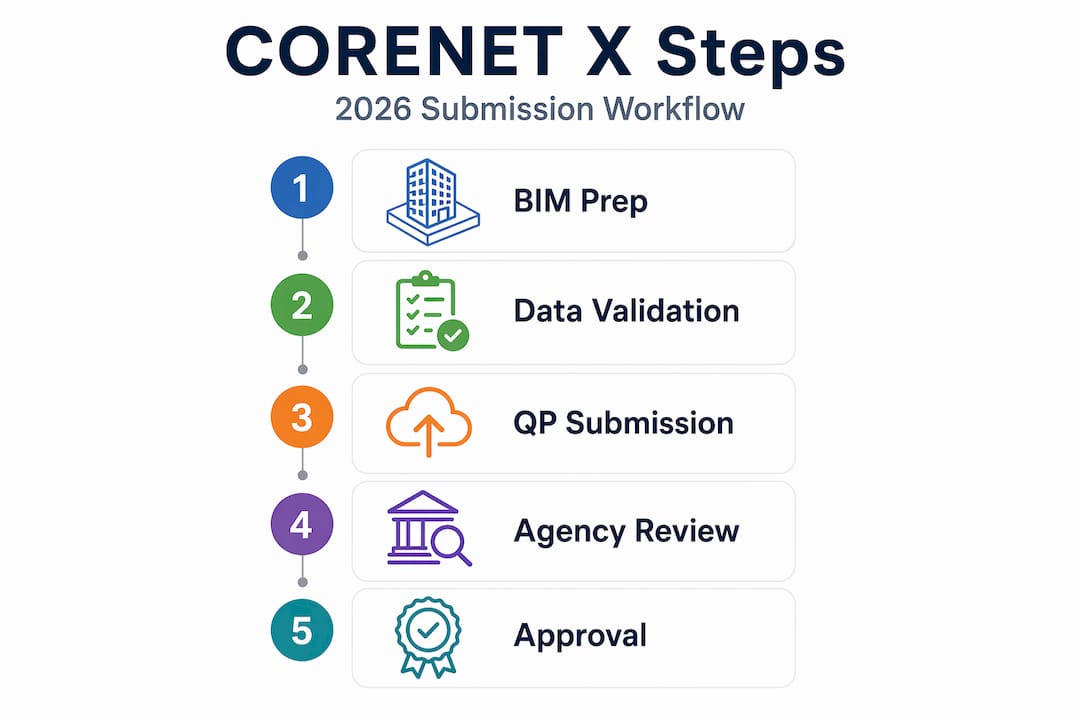
Submission workflow and approval process
A structured, stage-gated workflow is the difference between a project that moves through CORENET X without significant disruption and one that accumulates consolidated agency feedback requiring substantial redesign.
- Engage the QP and multidisciplinary team at project initiation. The QP’s statutory role begins before documentation. Early engagement allows planning controls and authority requirements to shape design decisions rather than constrain completed work.
- Prepare the federated BIM model for integrated submission. Coordinated concurrent agency review under CORENET X requires that architectural, structural, and MEP models are federated and clash-checked before submission. A fragmented submission triggers coordinated feedback across agencies simultaneously, compressing the timeline for response.
- Submit via CORENET X and manage consolidated feedback actively. All seven agencies review concurrently and provide a consolidated response. Assign a single coordination lead to triage, prioritize, and track agency comments against design revisions.
- Plan for a 20-week base timeline for major projects. Building plan approvals for projects above the CORENET X threshold typically require a minimum of 20 weeks from first submission, assuming a complete and compliant submission. Budget contingency time for resubmission cycles if the first submission carries known gaps.
- Close out multi-agency comments before construction mobilization. Conditions attached to approval must be formally discharged before works commence. Track these as a structured register, not as informal correspondence.
The construction approval workflow for Singapore projects above the CORENET X threshold rewards teams that treat submission preparation as a discrete project phase, not an extension of design documentation.
Troubleshooting common submission failures
The most preventable submission failures share a common root cause: model data quality is treated as secondary to geometric accuracy. Missing data properties cause gateway rejection even when the physical model is geometrically correct and fully coordinated. Addressing this requires a pre-submission validation process that runs independently of the visual QA process.
Common causes of validation failures and how to address them:
- Missing IFC+SG parameters on room and space elements. Space objects must carry occupancy classification, area, and fire compartment data. Run a BIM audit specifically targeting space elements before export.
- Coordinate misalignment between federated models. Each discipline model must share a common survey point and project north. Misalignment causes federation failures and spatial analysis errors in agency review tools.
- Inconsistent level datums across disciplines. Structural and MEP models often default to different finished floor level conventions. Align level datums across all models at the start of federation.
- Incomplete fire compartment data. SCDF review tools check fire compartment assignments on wall and floor elements. Missing compartment parameters are a frequent source of SCDF-specific feedback.
Pro Tip: Maintain a pre-submission BIM validation checklist as a living document updated after each project’s agency feedback cycle. Teams that systematically record the specific parameters flagged by agency review tools build an institutional knowledge base that directly reduces resubmission rates on future projects.
For teams navigating complex coordination scenarios, consultancy support in BIM compliance and multi-agency submission management reduces the time QPs and project architects spend on administrative resolution.
My perspective on integrated planning workflows
I’ve worked across enough Singapore development projects to say this plainly: the teams that struggle most with CORENET X are not struggling because of technical complexity. They’re struggling because they carried forward the siloed workflow habits of the pre-CORENET era into a system that was specifically designed to break those habits.
What I’ve observed consistently is that federated BIM submission under CORENET X doesn’t just change the technical process. It shifts accountability earlier. When all seven agencies review your model concurrently, there’s nowhere to hide a design assumption that hasn’t been checked against each agency’s requirements. That exposure is actually useful. It forces the kind of upfront coordination that experienced teams know prevents costly late-stage revisions.
The projects that move through approval with the fewest disruptions share a specific pattern: the QP is engaged before the massing is fixed, the BIM execution plan addresses IFC+SG parameter mapping from day one, and the urban design controls are modeled as spatial constraints before any architectural design is developed inside them.
What I find most significant is the competitive dimension. Developers and firms that adapt their internal processes to treat early federated coordination as a core project phase, not a submission exercise, consistently achieve shorter approval cycles. That translates directly into financing cost reduction and earlier project delivery. Singapore’s regulatory framework rewards preparation. It always has.
— Aman
How Aectechnicalsg supports your planning submissions
Navigating Singapore’s multi-agency architecture planning and approval process is demanding work. Aectechnicalsg provides engineering consultancy, PE endorsement, and authority submission support specifically structured for the complexity of CORENET X projects and URA-regulated developments.

The team at Aectechnicalsg handles BIM compliance preparation, IFC+SG parameter validation, and coordinated submissions across BCA, URA, SCDF, PUB, LTA, NParks, and NEA. Whether your project requires engineering consultancy services for developers or formal PE endorsement and authority submissions under Singapore’s statutory requirements, Aectechnicalsg provides the technical depth and regulatory familiarity to reduce approval timelines and minimize resubmission risk. Reach out to explore how the firm’s services align with your current project requirements.
FAQ
What is CORENET X and when is it mandatory?
CORENET X is Singapore’s digital building plan submission platform that enables concurrent review by seven government agencies including BCA, URA, and SCDF. It is mandatory for projects exceeding 30,000 m² GFA and can reduce approval timelines by up to 20%.
What causes most IFC+SG submission failures?
Missing or incorrectly mapped data parameters are the primary cause of gateway rejection in IFC+SG submissions, not geometric errors. BCA provides parameter templates, and teams should audit property completeness by element type before every export.
How does URA envelope control affect landed home designs?
URA’s 3D envelope control caps two-storey landed homes at 12 m and three-storey homes at 15.5 m, with specific rules governing attics, mezzanines, and car porch roofs. Updated two-tier site coverage limits introduced in March 2025 also regulate the balance between opaque building mass and shading elements.
When should HDB Town Design Guides be consulted?
HDB Town Design Guides should be reviewed at project initiation, before schematic design begins. Early alignment with town-level vision and design principles reduces the risk of plan revisions during authority review and supports place-making objectives.
What role does a Qualified Person play in architecture submissions?
A Qualified Person, typically a registered architect or engineer, holds statutory responsibility for certifying that all building plans meet BCA and URA requirements. Engaging the QP at project initiation, rather than at documentation stage, is the most effective way to prevent compliance gaps from accumulating through the design process.