
Architectural planning is frequently misunderstood as the phase where ideas become drawings. In Singapore’s construction environment, that framing is dangerously incomplete. Every design decision made in the early stages of a project carries regulatory weight, and a single oversight at the planning level can cascade into costly submission rejections, delayed approvals, or mandatory redesigns. For developers and project managers operating under Singapore’s strict building control framework, architectural planning is fundamentally a compliance strategy. This guide breaks down the stages, regulatory touchpoints, and practical considerations that determine whether a project advances smoothly or stalls.
Table of Contents
- Defining architectural planning: More than just design
- Core stages of architectural planning for Singapore projects
- Regulatory compliance: URA, BCA, and approval realities
- Navigating additions and alterations (A&A): Unique Singapore nuances
- A strategic mindset for compliance-ready architectural planning
- Take the next step with compliance-focused support
- Frequently asked questions
Key Takeaways
| Point | Details |
|---|---|
| Start with compliance | Initiate architectural planning with a clear understanding of regulatory and approval requirements for smooth project execution. |
| Follow structured stages | Divide your process into pre-design, schematic, and documentation phases to ensure all compliance checkpoints are met. |
| Know your project type | Understand URA’s distinctions between additions, alterations, and reconstruction to avoid submission setbacks. |
| Get expert input early | Engage qualified professionals and engineers at the beginning to minimize costly delays and redesigns. |
Defining architectural planning: More than just design
Architectural planning is not simply the act of producing floor plans or elevation drawings. For Singapore developers, it represents a structured decision-making process that begins well before any design concept takes shape. It integrates site constraints, regulatory parameters, functional requirements, and approval strategies into a coherent project framework.
Architectural design phases and stages follow a structured early workflow: pre-design and programming, site and context analysis, zoning and functional layout, spatial and circulation decisions, and finally design drawings and documentation. Each of these phases carries distinct obligations in Singapore’s regulatory environment, and skipping or rushing any one of them creates compounding risks downstream.
For developers, the pre-design phase is where the most consequential decisions are made. This is when gross floor area (GFA) limits, plot ratio, building height controls, and setback requirements must all be evaluated against the development brief. Getting these parameters wrong at this stage means that even the most well-executed design will fail URA’s development control review.

The schematic and design development phases translate those early constraints into buildable configurations. Here, decisions about structural systems, building envelope, and M&E coordination begin to intersect with architectural intent. This is also where compliance considerations from project start become operationally significant, because design changes after this phase are expensive and time-consuming.
The core activities in architectural planning include:
- Pre-design: Site analysis, regulatory constraints review, development brief alignment
- Schematic design: Concept massing, GFA computation, zoning compliance checks
- Design development: Detailed layouts, structural coordination, M&E integration
- Construction documentation: Drawings for authority submission, specifications, schedules
- Contract administration: Oversight of construction against approved drawings
Understanding how Singapore building codes impact each of these phases is essential for developers who want to avoid rework and approval delays.
“Architectural planning in Singapore is not a creative exercise that compliance follows. Compliance is the architecture.”
Pro Tip: Engage a Qualified Person (QP) at the pre-design stage, not after schematic design is complete. Early compliance thinking reduces the probability of major rework by addressing regulatory constraints before they become embedded in the design.
Core stages of architectural planning for Singapore projects
With a working definition established, let’s step through how those concepts play out in Singapore’s architectural planning process. The staged workflow of pre-design, schematic design, and documentation maps directly onto Singapore’s regulatory submission sequence, and understanding that alignment is what separates well-managed projects from those that encounter repeated approval cycles.
The following numbered sequence outlines how architectural planning stages correspond to Singapore’s project approval process:
-
Pre-design and programming: The developer defines the project brief, desired use, and target GFA. The QP reviews URA’s Master Plan zoning, development control parameters, and any specific area guidelines. Site surveys and geotechnical assessments are commissioned.
-
Schematic design and preliminary approval: The architect prepares concept massing and layout drawings. A Provisional Permission (PP) application is submitted to URA for developments requiring planning approval. This stage establishes the approved use, plot ratio, and building envelope.
-
Design development: Detailed architectural drawings are developed in coordination with structural and M&E engineers. BCA plan submissions are prepared. Fire safety layouts for SCDF review are integrated.
-
Written Permission (WP) and plan approval: Full architectural plans, structural plans, and supporting documentation are submitted to URA for Written Permission and to BCA for plan approval. The approval process steps at this stage are sequential and interdependent.
-
Construction documentation: Approved plans are translated into detailed construction drawings, specifications, and schedules. BCA submission requirements for structural plans must be satisfied before construction can commence.
-
Construction and supervision: The QP supervises construction against approved plans. Any deviations require amendment submissions and re-approval before implementation.
The following table summarizes the key activities and compliance checkpoints at each stage:
| Stage | Key activities | Compliance checkpoint |
|---|---|---|
| Pre-design | Site analysis, brief development, regulatory review | URA Master Plan zoning, DC parameters |
| Schematic design | Concept massing, GFA computation | Provisional Permission (PP) from URA |
| Design development | Detailed layouts, structural/M&E coordination | BCA plan submission preparation |
| Written Permission | Full plan submission to URA and BCA | Written Permission (WP), plan approval |
| Construction documentation | Detailed drawings and specifications | Approved plan compliance verification |
| Construction | Site supervision, progress inspections | QP supervision, amendment submissions |
This structured approach ensures that each regulatory milestone is addressed in sequence, reducing the risk of approval rejection at advanced project stages.
Regulatory compliance: URA, BCA, and approval realities
With the overall process mapped out, it becomes clear that regulatory compliance threads through every stage. For Singapore developers, understanding precisely where URA and BCA requirements intersect with the design process is critical to managing project timelines and budgets.
URA development control parameters and BCA plan submission requirements together define what can be designed, what must be submitted, and when approvals must be secured. These two regulatory bodies operate on different but overlapping tracks. URA governs land use, building form, and development intensity. BCA governs structural safety, building control compliance, and construction standards.
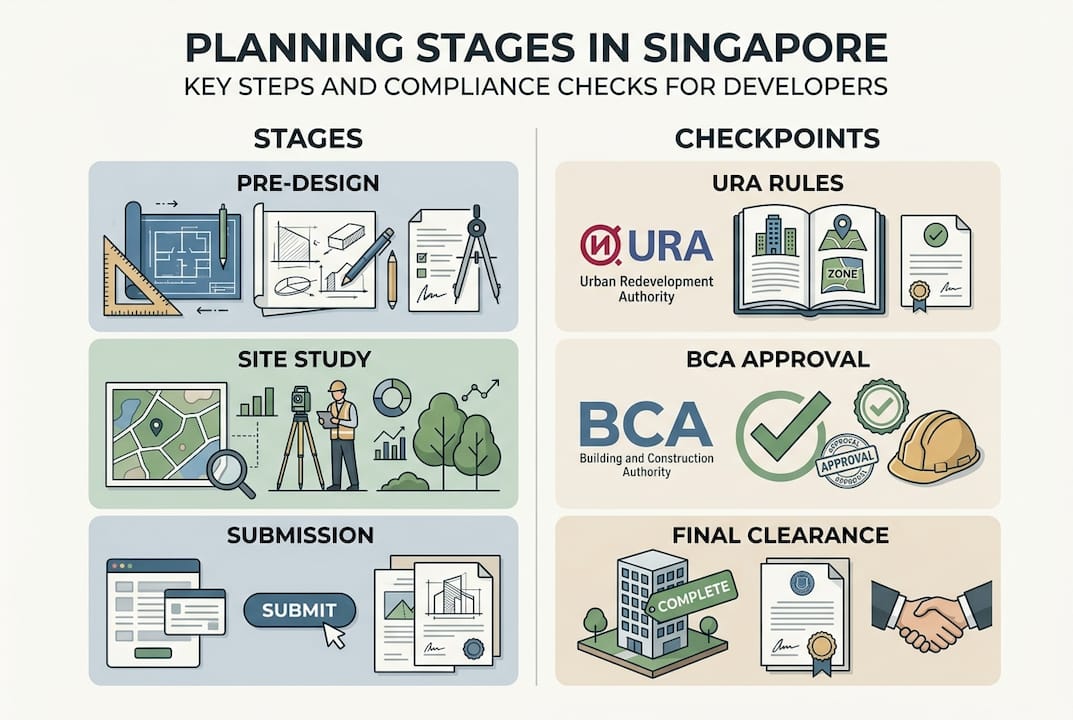
The following table compares design ambition against the compliance obligations developers must address:
| Design consideration | URA compliance obligation | BCA compliance obligation |
|---|---|---|
| Building height | Height controls per DC guidelines | Structural adequacy for proposed height |
| GFA and plot ratio | Must not exceed DC parameters | Structural plans must reflect approved GFA |
| Building use | Permitted use per Master Plan zoning | Occupancy load and structural design |
| Facade and envelope | Setback, site coverage requirements | Cladding and structural attachment compliance |
| Additions to existing buildings | A&A vs. reconstruction classification | PE endorsement and structural plan submission |
Common compliance risks that developers encounter include:
- Exceeding permissible GFA without securing planning permission for the additional area
- Submitting structural plans that do not align with URA’s approved architectural drawings
- Overlooking specific area guidelines such as those for conservation areas or special control zones
- Failing to account for SCDF fire safety requirements during the design development phase
- Proceeding to construction before all plan approvals are obtained from BCA
The role of professional engineers in compliance is not merely technical. Engineers serve as the bridge between architectural intent and regulatory acceptability, particularly in the structural and M&E domains.
Non-compliance at any stage is not a minor administrative issue. Projects that proceed without proper approvals face stop-work orders, mandatory demolition of non-compliant structures, and significant financial penalties. The cost of rectification work after construction is typically several times higher than the cost of proper compliance planning at the outset.
Pro Tip: Build URA and BCA submission milestones directly into the project master program. Treat regulatory approval deadlines with the same urgency as construction milestones, because delays in submissions translate directly into delays in project completion.
Navigating additions and alterations (A&A): Unique Singapore nuances
An important but often misunderstood area for developers is how additions and alterations are governed. The distinction between A&A and reconstruction carries significant regulatory consequences, and misclassifying a project can result in incorrect submissions, approval rejections, and project delays.
URA distinguishes qualifying A&A criteria from reconstruction, and also addresses the retention of non-conforming structures with specific conditions, including Professional Engineer (PE) certification and the retention of at least a portion of the existing floor plate. These distinctions are not merely definitional. They determine which approval pathway applies, what submissions are required, and what design freedoms are available to the developer.
In general terms, a project qualifies as A&A when the additional GFA does not exceed 50% of the existing approved GFA and a significant portion of the existing structure is retained. When the additional GFA exceeds this threshold or the existing structure is substantially demolished, the project is reclassified as reconstruction and must comply with current development control parameters in full, including any updated height controls, setback requirements, and design guidelines.
The following checklist outlines the sequential steps for A&A compliance in Singapore:
- Verify the existing approved GFA against URA’s records to establish the baseline for the 50% threshold calculation.
- Assess the extent of proposed works to determine whether they qualify as A&A or reconstruction under URA’s guidelines.
- Engage a QP and PE early to confirm the structural feasibility of retaining the existing structure while accommodating the proposed additions.
- Obtain PE certification for the retained structural elements, confirming their adequacy to support the new additions.
- Submit the A&A application to URA with full architectural and structural drawings, PE endorsement, and supporting documentation.
- Secure BCA plan approval for the structural works associated with the additions.
- Obtain all necessary permits before commencing any physical works on site.
Mistakes that developers commonly make in A&A projects include exceeding the GFA threshold without realizing the project has been reclassified as reconstruction, failing to obtain PE endorsement for renovation works before proceeding with structural alterations, and retaining non-conforming structures without the required PE certification.
“The A&A pathway offers developers significant flexibility, but only when the qualifying criteria are met and documented correctly from the outset.”
Another edge case that developers must be aware of involves non-conforming structures, which are existing buildings that do not comply with current development control parameters. URA permits the retention of such structures under A&A provisions, but only with PE certification confirming structural adequacy and compliance with specific retention conditions. Attempting to expand or alter a non-conforming structure without meeting these conditions will result in URA requiring full compliance with current parameters, which can fundamentally alter the project scope and economics.
A strategic mindset for compliance-ready architectural planning
Most developers approach architectural planning as a technical requirement to be managed. The more accurate framing is that architectural planning is a strategic instrument. The decisions made in the first few weeks of a project determine the approval feasibility, submission timeline, and cost exposure of everything that follows.
Initial planning decisions determine downstream approval feasibility and the effort and timing of submissions. This means that a developer who invests in thorough pre-design regulatory analysis is not spending more time on planning. That developer is compressing the total project timeline by eliminating the approval delays that result from non-compliant designs reaching the submission stage.
The uncomfortable reality is that most project delays are not caused by design complexity or construction challenges. They are caused by compliance gaps that were introduced at the planning stage and only discovered during the approval process. By the time a submission is rejected, the project team has already invested significant resources in a design that must be revised.
Developers who consistently achieve smooth approvals share a common practice: they treat regulatory foresight as a core planning competency, not an afterthought. They engage QPs and engineers before the design brief is finalized, they map submission milestones into the project program from day one, and they use digital compliance strategies such as BIM-based coordination to identify regulatory conflicts before they reach the submission stage.
The strategic lesson is straightforward. Compliance is not a constraint on good architectural planning. It is the foundation that makes good architectural planning possible in Singapore’s regulatory environment.
Take the next step with compliance-focused support
Navigating Singapore’s architectural planning requirements demands more than technical knowledge. It requires a coordinated approach that aligns design intent with regulatory obligations from the earliest project stage.
AECTechnicalSG provides specialized support across PE endorsement and authority submissions to URA, BCA, SCDF, and other Singapore authorities. Whether your project involves new development, A&A works, or complex mixed-use developments, early engagement with an experienced consultancy reduces approval risk and accelerates your project timeline. The team also delivers professional civil engineering solutions that integrate structural, geotechnical, and M&E expertise into a single coordinated service. Reach out to discuss your project requirements and build a compliance-ready planning strategy from the start.
Frequently asked questions
What are the main stages of the architectural planning process in Singapore?
The staged workflow typically involves pre-design, schematic and design development, and construction documentation, with regulatory compliance milestones embedded at each phase, including URA planning permission and BCA plan approval.
How do URA and BCA influence architectural planning?
URA parameters and BCA submissions shape both what can be designed and when approvals must be secured, with URA governing land use and building form while BCA governs structural safety and building control compliance.
What qualifies as A&A versus reconstruction in Singapore?
Under URA’s A&A threshold, a project generally qualifies as A&A when the additional GFA does not exceed 50% of the existing approved GFA and a meaningful portion of the existing structure is retained; exceeding this threshold typically triggers reclassification as reconstruction.
Why do projects get delayed at the approval stage?
Non-compliance with BCA and URA requirements is the primary driver of approval delays, most often because regulatory constraints were not fully evaluated during the pre-design and schematic stages, resulting in submissions that require revision and resubmission.