
Architectural consultancy is routinely misunderstood as a service that simply produces building drawings. In Singapore’s highly regulated construction environment, that perception carries real risk. Architectural services in Singapore encompass design, planning, regulatory compliance, and full project coordination, all governed by strict legal frameworks that determine whether your project gets approved or stalls. For project developers and construction firms operating here, the stakes are clear: engage qualified consultants early, or absorb preventable costs, delays, and regulatory setbacks later. This article breaks down exactly what architectural consultancy includes, which services matter most, how compliance is managed, and when expert engagement delivers the strongest return.
Table of Contents
- What is architectural consultancy in Singapore?
- Key services and project stages covered by consultancies
- Navigating regulatory compliance and quality benchmarks
- Assessing value: Cost, risk, and when to engage consultancy services
- A fresh perspective: What most developers miss about architectural consultancy
- Connect with expert consultancy for your Singapore project
- Frequently asked questions
Key Takeaways
| Point | Details |
|---|---|
| Consultancy is regulated | Only registered architects or licensed firms can provide consultancy services for gain in Singapore. |
| Full project lifecycle support | Consultants cover every phase from design through authority submissions to construction handover. |
| Crucial for compliance | Consultancies ensure your project meets all required building codes, regulations, and quality benchmarks. |
| Delivers risk reduction | Early engagement with architectural consultants helps avoid costly mistakes, rework, and approval delays. |
| Value depends on project needs | For complex or regulatory-heavy projects, consultancy is essential; for simple works, it can be optional. |
What is architectural consultancy in Singapore?
Architectural consultancy in Singapore refers to the professional supply of expert services in building design, spatial planning, regulatory compliance, and project coordination by registered architects or licensed architectural firms. It is not a general advisory function. It is a legally defined and tightly regulated practice.
The governing legislation is the Architects Act 1991, which specifies who may supply architectural services for reward in Singapore. Under this Act, only individuals registered with the Board of Architects (BOA) or firms holding a valid license may provide these services commercially. This legal gatekeeping exists because architectural work directly affects public safety, structural integrity, and the built environment’s long-term performance.
What does the scope of architectural consultancy actually cover?
The range of work is broader than many developers assume. At minimum, a full architectural consultancy engagement includes the following service categories:
- Building design and planning: From massing studies and spatial layouts to detailed floor plans and section drawings across all building types
- Façade and envelope design: A specialist domain within architecture that governs cladding, glazing, and skin performance, which you can explore further under façade design scope
- Authority submission management: Preparation and lodgment of plans and documents through the CORENET e-Submit system to BCA, URA, SCDF, and other relevant authorities
- Regulatory compliance coordination: Ensuring design solutions conform to applicable codes throughout the project lifecycle
- Project coordination: Managing the interface between the client, contractors, professional engineers, and specialist subconsultants
Consultancy work spans both the private and public sectors. Whether the project is a commercial mixed-use development, an industrial facility under JTC jurisdiction, or a healthcare infrastructure project, the requirement for registered architectural oversight applies equally. This is where architectural consultancy intersects significantly with broader civil engineering services, as the two disciplines must work in close alignment on most medium to large projects.

Why the legal framework matters for your project
The Architects Act is not background information. It has direct operational consequences. If architectural services are supplied for reward by an unlicensed party, the work has no standing with the authorities, submissions will be rejected, and the project faces immediate legal exposure. For developers appointing consultants, verifying BOA registration status is a compliance obligation, not an optional due diligence step.
| Feature | Licensed architectural consultant | Unlicensed service provider |
|---|---|---|
| CORENET submission rights | Yes | No |
| BOA registered | Yes | No |
| Qualified Person (QP) status | Eligible | Ineligible |
| Legally valid for BCA/URA | Yes | No |
| Liability and indemnity coverage | Required | Not mandated |
The table above clarifies why source verification is non-negotiable. An architectural consultancy that cannot demonstrate BOA registration should not be appointed for any work requiring authority submissions.
Key services and project stages covered by consultancies
Understanding the service lifecycle helps developers allocate budget correctly, set realistic timelines, and define clear deliverables at each engagement stage. The Singapore Institute of Architects (SIA) has formalized this through the SIA Value Articulation Framework (VAF), which benchmarks services, resource input, and fee levels against specific project stages.
A full-scope engagement typically progresses through the following numbered stages:
- Project initiation and feasibility study: The consultant assesses site constraints, zoning allowances under the URA Master Plan, gross floor area (GFA) potential, and preliminary regulatory barriers before design begins.
- Schematic and concept design: Early massing, spatial organization, and design intent are established. This stage sets the architectural character and begins to test regulatory constraints against client aspirations.
- Design development: The schematic is refined into coordinated drawings. Structural systems, M&E integration, and specialist inputs are incorporated. This is where compliance with building codes in Singapore is actively tested against the design.
- Detailed design and documentation: Full construction drawings, specifications, and schedules are produced. These documents form the basis for tender and construction.
- Authority submission via CORENET: The consultant, acting as Qualified Person (QP), prepares and lodges all mandatory submissions to BCA, URA, SCDF, and other relevant authorities. Approval must be secured before construction can commence.
- Construction administration and site supervision: The consultant monitors construction against approved drawings, issues site instructions, and manages variations. This is a legal requirement under the Building Control Act.
- Project completion and handover: Includes the preparation of the Certificate of Statutory Completion (CSC) application, as-built documentation, and coordination of final authority inspections.
Pro Tip: Do not treat authority submission as a standalone service. Consultants who are involved from feasibility onward produce submissions that reflect the design intent accurately, reduce clarification requests from BCA and URA, and achieve approval cycles significantly faster than those brought in mid-project.
Each stage carries distinct regulatory and technical demands. The structural design process must be coordinated with architectural documentation at stages 3 through 5 to avoid conflicts that trigger resubmission. Getting this coordination right early is one of the clearest indicators of a high-performing consultancy.
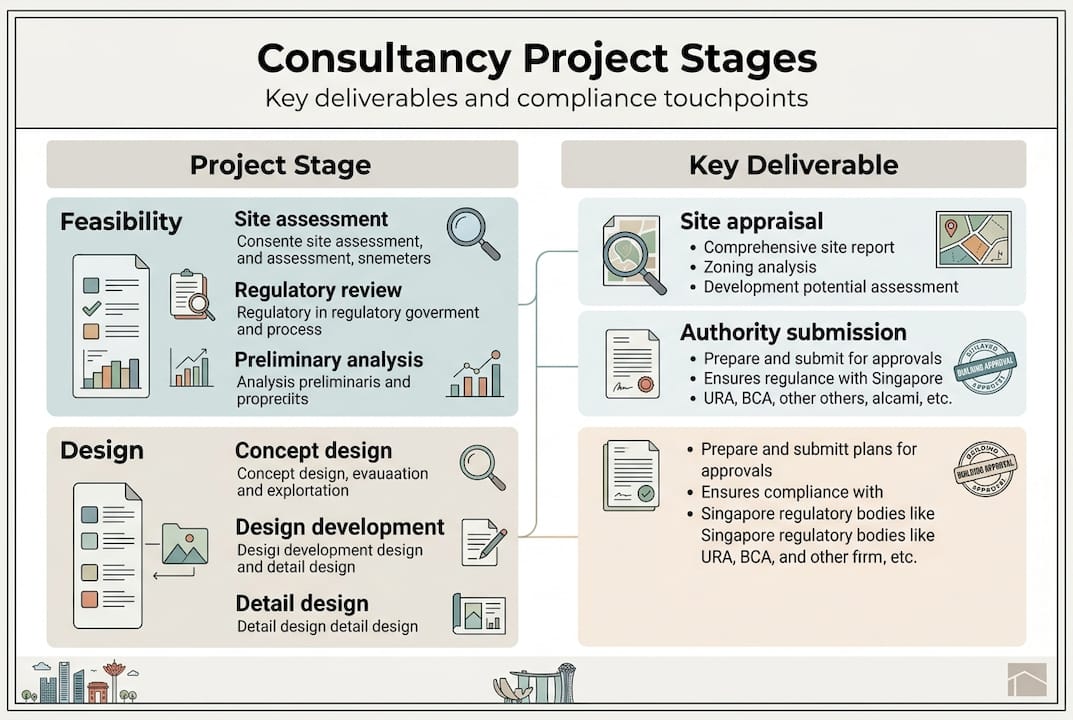
| Project stage | Key deliverables | Primary regulatory touchpoint |
|---|---|---|
| Feasibility | Site appraisal, GFA analysis | URA Master Plan, zoning checks |
| Schematic design | Concept drawings, design brief | Preliminary URA feedback |
| Design development | Coordinated design drawings | BCA building plan checks |
| Detailed design | Construction documents, specs | Fire safety, accessibility codes |
| Authority submission | CORENET lodgment, QP declarations | BCA, URA, SCDF approvals |
| Construction admin | Site supervision, variation orders | Building Control Act compliance |
| Completion | CSC application, as-built docs | Final BCA/SCDF inspection |
Navigating regulatory compliance and quality benchmarks
Singapore’s regulatory system for the built environment is among the most rigorous in the Asia-Pacific region. Architectural consultants serve as the primary navigator through this system, managing submissions and coordinating documentation across multiple authorities simultaneously.
The core regulatory bodies and frameworks that consultants must address include:
- Building and Construction Authority (BCA): Governs structural safety, building control, and the issuance of permits to carry out structural works (PCSO) and permits to carry out building works (PCBW)
- Urban Redevelopment Authority (URA): Controls land use, planning permission, gross plot ratio (GPR), building height, and setback requirements
- Singapore Civil Defence Force (SCDF): Reviews and approves fire safety plans, including means of escape, fire compartmentation, and suppression systems
- Code on Accessibility: Mandates barrier-free access provisions across commercial, residential, and public buildings
- Green Mark scheme: BCA’s green building rating system, which may be a mandatory requirement depending on project size and type
Regulatory compliance also extends to quality assessment through ConQUAS (Construction Quality Assessment System), where architectural works represent a significant weighted component of the overall score. Projects must meet minimum ConQUAS scores to obtain their Certificate of Statutory Completion.
Non-compliance at any stage can trigger project halts, costly redesigns, or formal enforcement action. The cost of a regulatory rejection compounds rapidly when construction has already commenced.
This is precisely where early consultant involvement becomes a strategic financial decision, not just a procedural one. Consultants who join a project at feasibility stage can steer the design away from non-compliant configurations before they become embedded in the construction documents. Retrofitting compliance into an advanced design is consistently more expensive than designing for compliance from the start.
Professional engineers (PEs) work alongside architectural consultants during the compliance process. Their endorsements are required for structural, geotechnical, and M&E elements of the submission package. The consultant coordinates all these professional inputs into a cohesive submission set.
Design for safety (DfS) is another mandatory compliance stream. Under the Workplace Safety and Health (Design for Safety) Regulations 2011, projects above a defined cost threshold require a DfS register to be maintained throughout design and construction. Architectural consultants contribute directly to this process.
Pro Tip: When evaluating consultancy proposals, ask specifically how the firm manages multi-authority submissions in parallel. Firms with established workflows for simultaneous BCA, URA, and SCDF coordination reduce overall approval timelines substantially compared to sequential submission approaches.
Assessing value: Cost, risk, and when to engage consultancy services
Fee levels for architectural consultancy have long been a point of tension in Singapore’s built environment sector. The SIA VAF benchmarks established through a 2025 pilot study indicate that industry-standard fees are approximately three times lower than what a full-scope engagement actually warrants, given the complexity, liability, and labor involved. This gap explains why many consultancies operate with compressed margins and why scope underdelivery is a recurring issue in the sector.
For project developers and construction firms, this has a direct implication. Engaging a consultancy on the basis of the lowest submitted fee often means reduced scope, junior resourcing, or compressed delivery timelines. The short-term saving is outweighed by the downstream risks.
When architectural consultancy is essential
Consultancy is essential for the following project types and scenarios:
- Any project requiring full building plan approval from BCA
- Projects with URA planning permission requirements, including changes of use, development applications, or plot ratio optimization
- New construction of commercial, industrial, institutional, or large residential developments
- Projects subject to Green Mark requirements or specialized accessibility compliance
- Additions and alterations (A&A) works that affect structural elements or increase GFA
- Projects where the QP role must be fulfilled by a registered architect under the Building Control Act
When it may be considered optional
For very minor internal renovation works that do not affect structural elements, do not trigger planning permission, and fall below the building plan submission threshold, formal architectural consultancy may not be a statutory requirement. However, even in these cases, technical input from a qualified practitioner reduces risk.
The factors to weigh when assessing whether to engage include: project scale, regulatory complexity, design ambition, stakeholder expectations, and the legal thresholds under the Building Control Act. Projects integrating Singapore BIM mandates also benefit significantly from consultants with established BIM workflows, as BCA’s BIM submission requirements impose technical standards that many project teams are not equipped to meet independently.
| Project characteristic | Consultancy necessity | Risk of proceeding without |
|---|---|---|
| Requires BCA building plan approval | Mandatory | Submission invalid, no permit issued |
| URA development application needed | Mandatory | Planning permission not granted |
| A&A affecting structure | Strongly advised | Non-compliance, safety liability |
| Green Mark targeted | Strongly advised | Score shortfalls, certification failure |
| Minor internal non-structural works | Optional | Lower, but design risk remains |
Pro Tip: Early-stage engagement, specifically before schematic design begins, consistently produces the best outcomes. Consultants brought in after design is substantially complete have limited ability to optimize for compliance, cost, or regulatory approval speed.
A fresh perspective: What most developers miss about architectural consultancy
Most developers treat architectural consultancy as a compliance formality. They engage a firm to produce the drawings, file the submissions, and collect the approvals. The work is viewed as a linear, transactional process. That perspective consistently leads to underperforming outcomes.
The real function of an architectural consultant is to act as the strategic bridge between a client’s commercial ambitions and the hard boundaries imposed by Singapore’s regulatory landscape. That is a fundamentally different role from a compliance processor. A well-engaged consultant identifies GFA optimization opportunities that a developer’s internal team would miss. They spot early-stage design decisions that would create fire safety conflicts or accessibility shortfalls months before a submission reaches SCDF.
The SIA VAF initiative reflects an industry-wide recognition that this value has been chronically underpriced and underutilized. The sector’s push to formalize fee benchmarks is not just about consultant income. It signals that the strategic input consultants provide deserves recognition in how projects are structured from day one.
Developers who treat consultancy fees as a cost to minimize are, in effect, removing a risk management layer from a project where the cost of errors is orders of magnitude higher than the consultancy fee itself. Understanding building code realities from the outset, through qualified eyes, is one of the most reliable ways to protect project timelines and returns.
Connect with expert consultancy for your Singapore project
Navigating Singapore’s authority submission landscape requires more than general construction knowledge. It requires specialists who understand precisely what BCA, URA, SCDF, and other agencies expect from a compliant submission package.
AECTechnicalSG provides authority submission services covering PE endorsements, engineering documentation, and full architectural coordination for projects across all sectors. The team also delivers design for safety expertise integrated into the design and documentation process, ensuring DfS compliance does not become a last-minute issue. For project developers and construction firms seeking qualified, Singapore-based consultancy support, AECTechnicalSG offers the technical depth and regulatory experience your project requires from feasibility through to handover.
Frequently asked questions
Do I need an architectural consultant for every construction project in Singapore?
Consultants are required for most building projects where authority submissions or regulatory compliance is necessary, but for very simple or minor non-structural works they may not be a statutory requirement. The threshold depends on the scope of works and whether a building plan submission is triggered under the Building Control Act.
What regulations do architectural consultancies help with in Singapore?
They manage compliance with BCA building codes, URA planning controls, SCDF fire safety requirements, the Code on Accessibility, Green Mark standards, and ConQUAS quality benchmarks across the project lifecycle. Each regulatory stream has distinct submission requirements and approval timelines that experienced consultants are equipped to navigate.
How are architectural consultancy fees determined in Singapore?
Fees are typically calculated as a percentage of the total construction cost, adjusted for project complexity and scope, with SIA VAF benchmarks advocating for higher, scope-reflective rates than current industry norms. More complex projects with multi-authority submissions and specialist coordination requirements attract higher fee levels.
How does an architectural consultant coordinate with other specialists?
Consultants act as the central coordination point, liaising with professional engineers, M&E subconsultants, and contractors to ensure design intent, regulatory compliance, and construction quality are maintained from the first submission through to final handover. QP coordination is a formal part of this role under Singapore’s building control framework.