
Structural engineering is frequently reduced to a single idea: making buildings strong enough to stand. That assumption costs project owners time, money, and approval cycles. Structural engineering is a civil engineering discipline focused on analyzing, designing, and verifying load-bearing structures so they remain safe and serviceable under intended and sometimes unplanned loads. In Singapore’s tightly regulated construction environment, where BCA, URA, and other authorities scrutinize every submission, understanding what structural engineering actually covers is not optional. It is foundational to getting a project approved, built correctly, and performing as intended.
Table of Contents
- The fundamentals: What does structural engineering really involve?
- Essential workflow: From concept to regulatory submission in Singapore
- Key concepts: Beyond strength—serviceability, deformation, and connection detailing
- Why structural engineering is essential for project compliance and safety in Singapore
- The real challenge most owners underestimate
- Expert support for compliant structural engineering in Singapore
- Frequently asked questions
Key Takeaways
| Point | Details |
|---|---|
| More than just strength | Structural engineering ensures both safety and serviceability—not just that buildings stand up, but that they work as intended. |
| Stepwise design workflow | From load analysis to code submission, following a structured process is crucial for Singapore project approval. |
| Compliance reduces risk | Expert structural engineering is essential to prevent costly rework, rejections, and safety issues during Singapore construction. |
| Serviceability matters | Ignoring deformation, drift, and detailing can cause failure even when strength calculations pass. |
| Expert support available | Professional guidance streamlines compliance and ensures long-term performance for your Singapore project. |
The fundamentals: What does structural engineering really involve?
Structural engineering sits within the broader civil engineering discipline, but it carries a very specific mandate: ensure that every load-bearing element of a structure performs predictably across its entire service life. This goes well beyond calculating whether a beam can carry a given weight.
The core responsibilities of a structural engineer on a Singapore project typically include:
- Load analysis: Identifying all loads acting on a structure, including dead loads, live loads, wind loads, seismic considerations, and construction-phase loads.
- Structural modeling: Building analytical or digital models that represent how forces travel through a structure’s members and connections.
- Force analysis: Applying statics, equilibrium, and compatibility concepts to determine internal forces and responses to those loads.
- Member and connection design: Selecting appropriate sections, materials, and connection configurations to resist the calculated forces.
- Serviceability checks: Verifying that deflections, vibrations, and lateral drift remain within acceptable limits under working loads.
- Code compliance verification: Ensuring all design decisions align with Singapore Standard codes, BCA-approved documents, and any project-specific authority requirements.
What surprises many project developers is how much of a structural engineer’s work is governed by serviceability rather than ultimate strength. A concrete slab may be strong enough by every calculation, yet still fail serviceability requirements if it deflects too much under occupancy loads, causing finishes to crack or partitions to rack. Getting into fast-tracking structural design without resolving these early-stage questions almost always results in costly design revisions later.
“Good structural design is not the absence of failure modes—it is the systematic management of every load path, connection, and deformation limit, not just the obvious ones.”
Connection detailing deserves special attention. In structural engineering with concrete and steel alike, the junctions between members govern constructability, durability, and often the governing load case. A well-proportioned member paired with a poorly detailed connection will underperform in the field, sometimes in ways that are difficult and expensive to remedy post-construction.
When projects incorporate specialized systems, such as renewable energy design integration or non-conventional framing, the structural engineer must also coordinate loading assumptions with architectural and M&E inputs. The structural solution does not exist in isolation. For projects involving complex framing geometries or non-standard spans, advanced structural solutions using cellular and castellated beams have grown in relevance because they manage weight while accommodating integrated service routes.

Pro Tip: Request that your structural engineer provide a load path summary diagram at the concept stage. This single document exposes coordination gaps between disciplines early, before they become submission problems.
Essential workflow: From concept to regulatory submission in Singapore
Understanding the responsibilities of a structural engineer is one thing. Seeing how those responsibilities translate into a real project workflow is another. In Singapore, the sequence matters because each phase produces documentation or outputs that either support or block the next milestone, including authority submissions.
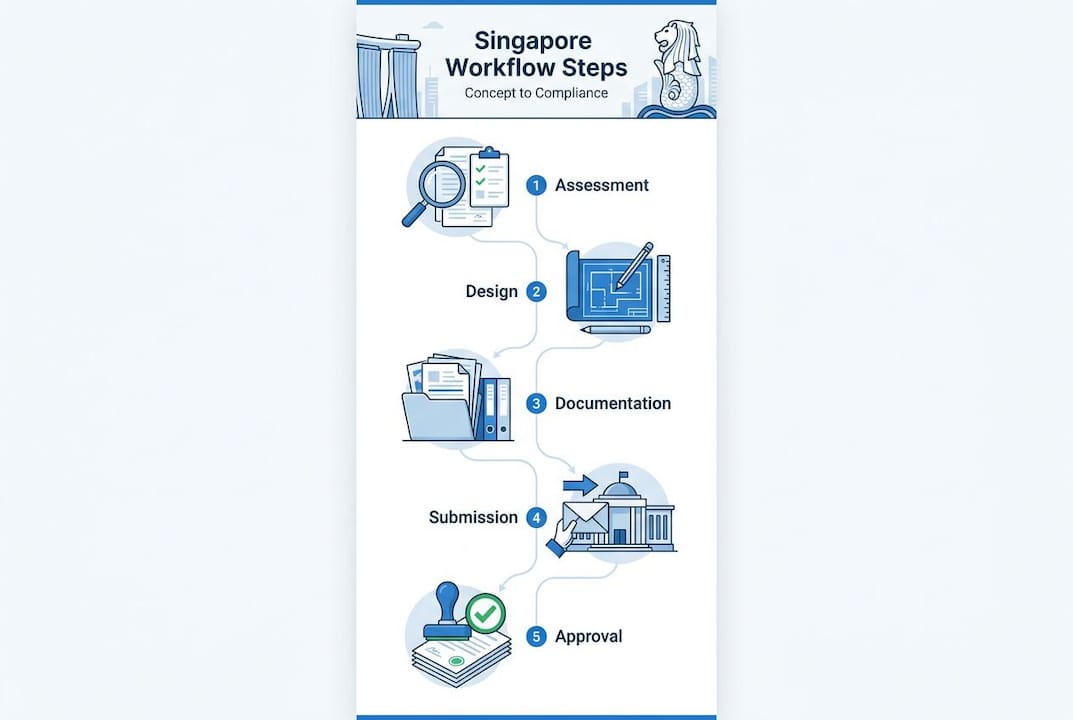
The core workflow commonly progresses through load determination, structural modeling, force analysis, member and connection design, serviceability checks, and ultimately code-compliant documentation for authority submission. Here is how that translates in practice:
- Preliminary structural assessment: Review architectural intent, establish structural system options, and identify critical constraints including foundation conditions and material availability.
- Load determination: Calculate all applicable load combinations per Singapore Standard codes and project-specific requirements.
- Structural modeling and analysis: Develop the analytical model, run load cases, and extract governing internal forces for each member and connection.
- Detailed design: Size all structural members and design all connections, ensuring both strength and serviceability criteria are satisfied simultaneously.
- Serviceability verification: Check deflections, inter-story drift under wind load, and vibration responses for sensitive occupancies such as laboratories or gymnasiums.
- Drawing production and calculation documentation: Prepare structural drawings and calculation packages to the standard required for Professional Engineer (PE) endorsement.
- PE endorsement and authority submission: The endorsed drawings and calculations are submitted to BCA or the relevant authority. In Singapore, no structural submission is valid without a PE stamp from a registered civil or structural engineer.
- Response to authority queries: Address technical clarifications raised during the review cycle. Incomplete documentation is the leading cause of extended review times.
| Workflow phase | Key output | Common bottleneck |
|---|---|---|
| Preliminary assessment | Structural system report | Misalignment with architectural brief |
| Load determination | Load schedule | Late changes to occupancy classification |
| Structural modeling | Analysis model and results | Software compatibility with peer reviewer |
| Detailed design | Design calculations | Serviceability governs over strength, requiring redesign |
| Drawing production | Endorsed structural drawings | Coordination errors with architectural or M&E sets |
| Authority submission | BCA or URA submission package | Missing PE endorsement or incomplete calculations |
Developers who are unfamiliar with design for safety protocols often underestimate how documentation-intensive the Singapore submission process is. BCA requires calculations to follow a traceable format, and any gap between the drawings and the calculations will generate a query that pauses the approval clock.
Pro Tip: Build a submission readiness checklist that maps each BCA requirement to a specific calculation reference and drawing number. This pre-submission audit consistently reduces query cycles.
Key concepts: Beyond strength—serviceability, deformation, and connection detailing
The most consequential misconception in structural engineering is that a design is complete once all strength checks are satisfied. In practice, serviceability, deformation, and connection detailing can govern performance and approval outcomes even when every strength check passes.
The distinction between these three criteria is worth understanding clearly:
| Design criterion | What it checks | Example of failure |
|---|---|---|
| Strength | Ultimate resistance to load without collapse | Beam fractures under overload |
| Serviceability | Performance under working loads over service life | Excessive deflection cracking ceiling finishes |
| Constructability | Ability to build the designed solution as specified | Connection too congested to install bolts |
Deformation limits are set by code, but they are also influenced by the sensitivity of connected elements. A floor supporting precision equipment has much tighter deflection limits than a warehouse floor, even if both carry similar loads. Drift limits for lateral load cases, which measure how much a building sways under wind, are equally important. A structure that meets strength requirements under wind load may still experience unacceptable inter-story drift that compromises partition walls, curtain wall systems, and occupant comfort.
Vibration is an area where deformation and adaptability challenges become especially relevant in modern Singapore projects. Long-span composite floors in commercial buildings, pedestrian bridges, and gymnasium slabs all require dynamic analysis to verify that natural frequencies do not coincide with human-induced loading frequencies. A floor that passes static serviceability checks can still fail a dynamic acceptance criterion.
Connection detailing is where structural intent meets buildability. Engineers who use advanced FEM validation for complex steel connections understand that connection behavior under load is often non-linear and dependent on fabrication tolerances that are not captured in simplified hand calculations. Over-relying on handbook tables for connection design, without verifying behavior at the local level, introduces risk that only surfaces during erection or, worse, during service.
“The structural design that looks elegant on paper is only as good as the connection that transfers the force across two pieces of steel or concrete, fabricated and installed by workers under site conditions.”
For developers using BIM workflows, Tekla Structures for structural steel design has become a critical tool for aligning design intent with fabrication and construction sequences, reducing the gap between what is designed and what is built.
The practical pitfalls of prioritizing strength alone include:
- Visible cracking in finishes caused by deflection that technically met serviceability limits but was not coordinated with partition system tolerances.
- Vibration complaints from occupants in long-span floors that passed static checks but failed dynamic criteria.
- Failed authority submissions where serviceability calculations were absent or inconsistent with drawing annotations.
- Costly post-construction remedial works to stiffen connections that were geometrically adequate but lacked the rotational stiffness assumed in the analytical model.
Why structural engineering is essential for project compliance and safety in Singapore
Singapore’s construction regulatory framework is among the most rigorous in the region. Every structural submission to BCA must demonstrate not only that a design is safe but that it is safe according to a specific, documented, code-compliant methodology. Structural engineering is the discipline that produces, verifies, and endorses that demonstration.
The role of the structural engineer in Singapore’s regulatory process extends across several dimensions:
- Legal accountability: PE-endorsed structural drawings carry legal weight. The endorsing engineer assumes professional liability for the accuracy and adequacy of the design.
- Authority submission compliance: BCA requires structural calculations and drawings that are traceable, complete, and code-referenced. Submissions that do not meet these standards face queries, resubmissions, and timeline penalties.
- Safety case documentation: For buildings with unusual geometry, heavy loads, or deviations from prescriptive code requirements, engineers must prepare formal safety case reports that justify the design approach.
- Ongoing compliance monitoring: For additions and alterations projects in Singapore, structural engineers are often required to assess and certify existing structural adequacy before new works can be approved.
Project developers who invest in modern engineering strategies early in the design process consistently achieve faster approvals. The reason is straightforward: well-coordinated structural documentation reduces the number of authority queries, and fewer queries mean shorter review cycles.
Key compliance risks to manage on every Singapore project:
- Incomplete load combinations that do not account for construction-phase loads or future loading scenarios.
- Structural drawings that are inconsistent with architectural plans, triggering coordination queries from BCA.
- Missing or inadequately referenced code clauses in calculation packages.
- Failure to address foundation design in the structural submission where ground conditions require special treatment.
- Absence of a clearly documented structural system description in the submission cover letter.
According to industry data, structural resubmissions caused by incomplete documentation can add four to eight weeks to a project’s approval timeline. For commercial developments where financing is tied to permit milestones, this delay translates directly into project cost overruns.
Pro Tip: Engage your structural engineer at the schematic design stage, not after architectural drawings are finalized. Early structural input prevents the kind of late-stage design conflicts that generate submission queries and require costly coordination revisions.
The real challenge most owners underestimate
The construction industry in Singapore has largely accepted that structural engineering is necessary. What remains underappreciated is the precision required across what many owners dismiss as secondary checks: serviceability, vibration, and connection detailing. These are not administrative formalities. They are the points where well-intentioned designs most often fail in the field.
A scenario that plays out more frequently than it should involves a developer who has obtained a PE-endorsed structural submission and believes the structural engineering work is complete. Construction proceeds, and during the defects inspection phase, cracking appears in partition walls on upper floors. Investigation reveals that inter-story drift under wind load, while within the code limit, was at the upper boundary of that limit and was not coordinated with the deflection capacity of the lightweight partition system specified by the architect. No individual party made an error. But the absence of cross-discipline coordination produced a building that required expensive remediation before handover.
This is precisely where advanced FEM validation methods and integrated BIM workflows provide value that cannot be achieved through conventional calculation packages alone. They expose interaction effects between structural behavior and architectural components before construction, not after.
The structural engineer’s role is not finished at PE endorsement. It continues through shop drawing review, site inspection, and response to construction-phase variations. Owners who treat structural engineering as a submission task rather than a project-long function consistently encounter surprises that could have been anticipated and resolved at much lower cost.
Expert support for compliant structural engineering in Singapore
Navigating Singapore’s structural engineering and authority submission requirements demands more than design competence. It requires precise coordination across disciplines, thorough documentation, and a working understanding of BCA, URA, and other authority expectations.
AECTechnicalSG provides engineering consultancy services covering the full scope of structural engineering for Singapore developers and project owners, from concept assessment through regulatory submissions. The firm’s PE endorsement services are structured to meet BCA submission standards with documentation that minimizes query cycles and supports timeline certainty. For developers seeking a clearer understanding of Singapore’s building code requirements, the firm’s consultancy approach ensures that every design decision is code-referenced and defensible before submission. Reach out to AECTechnicalSG to discuss your project’s structural requirements and obtain a consultancy assessment.
Frequently asked questions
What is the main difference between structural engineering and civil engineering?
Structural engineering is a specialized branch that focuses on the stability and serviceability of individual structures, while civil engineering covers broader infrastructure design, urban development, and public works. As noted in the Structural Engineering Overview, structural engineering is specifically concerned with analyzing, designing, and verifying load-bearing structures.
Why is serviceability important in structural engineering?
Serviceability ensures that a building remains usable, comfortable, and durable across its intended service life, not merely safe from collapse under extreme loads. Deformation, vibration, and drift can govern design outcomes even when all strength checks are satisfied.
How does structural engineering help with project compliance in Singapore?
It produces the endorsed calculations, drawings, and documentation that BCA and other authorities require to verify that a design meets all applicable safety and performance codes. Code compliance is a core workflow output, not a post-design afterthought, and its quality directly affects submission approval timelines.
What are key mistakes to avoid in structural engineering for Singapore projects?
The most consequential mistakes include neglecting serviceability checks, under-detailing connections, failing to coordinate structural assumptions with architectural and M&E inputs, and submitting incomplete calculation packages. Serviceability and connection detailing frequently govern real-world performance and represent the areas where documentation gaps most often trigger authority queries and project delays.