
Professional engineers in Singapore carry obligations that extend well beyond producing structural calculations or signing off on design drawings. Under the framework administered by the Professional Engineers Board (PEB), a registered PE takes on statutory duties that make them responsible for project-wide legal compliance, including an active duty to report contraventions of written law. For project developers and construction firms, understanding this framework is not optional. It is a fundamental part of responsible project governance, and failing to recognize the full scope of PE involvement can create serious regulatory and legal exposure at any stage of a project’s lifecycle.
Table of Contents
- How professional engineers are regulated in Singapore
- Legal and ethical duties under Singapore law
- Why compliance involves more than technical review
- Choosing and engaging professional engineering services
- Why treating PE engagement as governance boosts project success
- Expert technical advisory for Singapore construction projects
- Frequently asked questions
Key Takeaways
| Point | Details |
|---|---|
| PEB sets the regulatory framework | The Professional Engineers Board maintains registers and licenses providers, acting as Singapore’s engineering regulator. |
| Legal duties extend beyond design | Professional engineers are responsible for due diligence and reporting compliance issues, not just technical review. |
| Compliance is an ongoing process | Engaging a PE means monitoring legal and ethical obligations throughout a project’s lifecycle. |
| Proper engagement prevents risks | Choosing a registered PE and licensed provider ensures project success and avoids regulatory penalties. |
| Treat PE services as governance | Early and proactive PE involvement improves compliance, safety, and operational reliability for construction projects. |
How professional engineers are regulated in Singapore
The PE regulatory framework in Singapore operates through a structured system that separates individual registration from corporate licensing, each carrying distinct obligations.
The Professional Engineers Board serves as the primary regulatory authority. PEB functions include keeping and maintaining a register of professional engineers, practitioners, and licensed corporations, processing registration applications including examinations, and licensing corporations that supply professional engineering services. This means the PEB is not simply an administrative registry. It actively oversees who may practice and who may supply engineering services at both the individual and corporate level.
A critical distinction that developers often overlook is the difference between an individually registered PE and a licensed engineering corporation. Both are regulated separately, and both must satisfy PEB’s requirements. An individual PE holds personal registration and bears personal accountability for work endorsed under their seal. A corporation or partnership supplying professional engineering services must also be independently licensed by the PEB before it can legally offer those services in the market.
Key distinctions between PE registration and corporate licensing:
| Factor | Individual PE | Licensed engineering corporation |
|---|---|---|
| Regulated by | PEB (individual register) | PEB (corporate license) |
| Accountability | Personal, statutory | Corporate and compliance-based |
| Requirement | Passed PE exams, registered | Licensed under PEB framework |
| Scope | Endorses specific works | Supplies engineering services broadly |
| Verification | PEB register | PEB licensed corporations list |
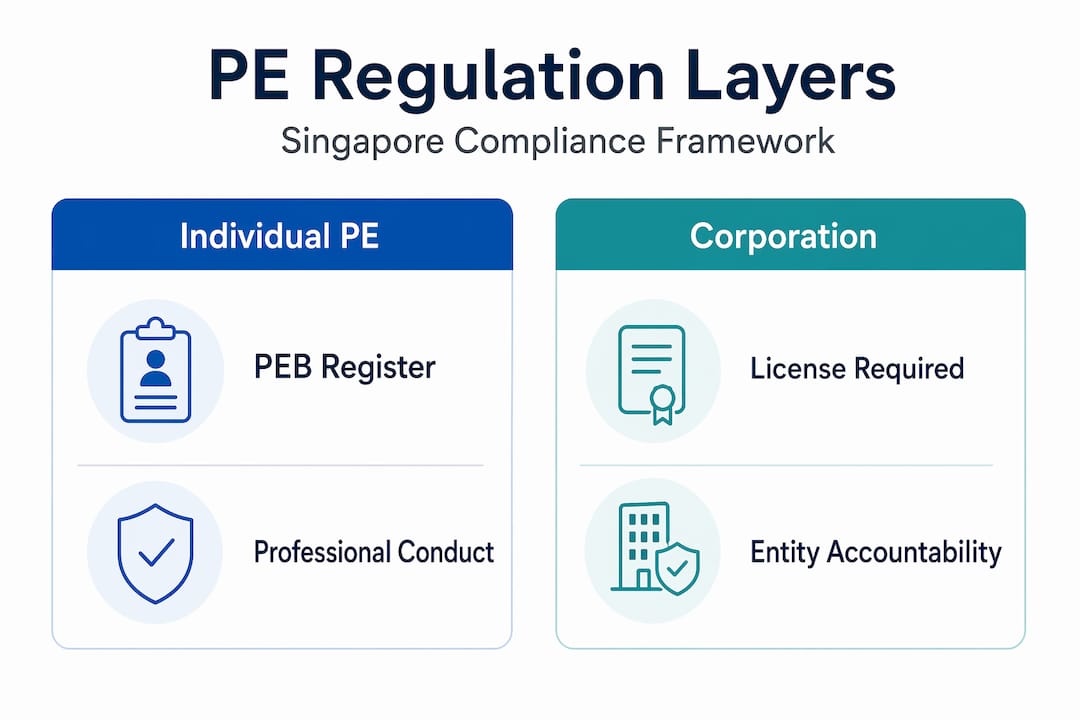
For developers, both layers matter. Engaging an individual PE without confirming that their employing entity holds the correct PE endorsement for renovations or structural work can expose the project to regulatory gaps. A licensed corporation that employs registered PEs provides a verifiable, compliant service structure.
The PEB’s remit also includes establishing and maintaining standards of professional conduct and ethics, hearing disputes relating to professional conduct, and taking disciplinary action where warranted. This places ethical accountability squarely within the regulatory structure, not merely within professional tradition.
Legal and ethical duties under Singapore law
Once the regulatory structure is understood, the specific statutory obligations become the practical focus for any project team. When PE endorsement is required is one question. What the PE must do once engaged is an equally important, and often underappreciated, consideration.

Under Singapore’s subsidiary legislation, the Professional Engineers Rules impose specific duties on registered engineers. These include exercising ongoing due diligence during the project, not merely at the design or approval stage, and reporting to relevant authorities any contraventions or failures to comply with written law that come to the PE’s knowledge in the course of the project.
This “watchdog” duty is significant. It transforms the PE from a technical reviewer into an active compliance participant who bears responsibility for what they know and fail to act on. The duty applies across project stages: from design development and authority submission through construction supervision and project completion.
The key legal and ethical duties of a PE in Singapore projects include the following:
- Exercising due diligence in all technical and regulatory aspects of the work endorsed.
- Reporting contraventions of written law to the appropriate authority when discovered during the project.
- Adhering to the standards of professional conduct established and enforced by the PEB.
- Maintaining accuracy and completeness in all plans, calculations, and submissions.
- Cooperating with any PEB investigation or disciplinary process if a complaint is made.
The PEB sets standards for professional conduct and ethics, and it has the authority to hear and determine disputes arising from ethical or professional conduct concerns. Disciplinary outcomes can include suspension or removal from the register, which constitutes a serious consequence for both the individual engineer and any project that relied on their endorsement.
“A PE’s legal responsibility does not end with the submission of drawings. It continues for as long as the project remains within the PE’s scope of engagement, and the duty to report legal contraventions is active, not passive.”
Pro Tip: When drafting service agreements with a PE or engineering firm, include explicit clauses that define the scope of the PE’s due diligence responsibilities and reporting obligations. This protects the developer and creates a clear record of accountability.
The M&E compliance guide for Singapore buildings offers further insight into how these reporting and advisory duties apply across different engineering disciplines, including mechanical and electrical systems that must meet statutory standards independently of structural works.
Why compliance involves more than technical review
A common and costly misconception among project developers is that hiring a PE is primarily a documentation exercise: get the drawings stamped, get the authority submission filed, and move on. Singapore’s regulatory framework does not support that interpretation.
The Professional Engineers Rules impose an ongoing watchdog duty tied to the PE’s knowledge during the project lifecycle, not only when producing drawings or calculations. This means that compliance risk is continuous and contextual, not limited to discrete document-production milestones.
Why compliance is broader than technical review:
| Compliance area | Developer’s common assumption | Actual regulatory requirement |
|---|---|---|
| Drawing submission | PE signs, job done | PE must continue due diligence through construction |
| Authority approvals | Submitted = compliant | PE remains responsible for accuracy of submissions |
| Construction phase | Contractor’s problem | PE monitors for legal contraventions |
| Variations and changes | Approved verbally | PE endorsement required for material design changes |
| Project closure | Completion cert filed | PE responsible for accuracy of as-built records |
The operational implication is direct. For construction and infrastructure developers, engaging a PE should be treated as part of governance for regulatory compliance because PEB’s functions explicitly cover registration, licensing, ethical standards, and dispute resolution.
This means your project governance structure should define when the PE must be consulted, how construction variations are routed for PE review, and what reporting channels exist if a contravention is identified on site. Without these governance mechanisms, a project team may not recognize when a PE’s watchdog duty has been triggered, creating regulatory exposure that could affect project timelines, occupancy permits, or legal standing.
Common pitfalls developers and contractors face:
- Engaging a PE only for authority submissions and excluding them from construction-phase oversight.
- Failing to verify that the PE’s employing firm holds a valid PEB corporate license.
- Treating PE endorsement as a rubber stamp rather than a substantive review process.
- Not establishing a formal process for the PE to report or escalate regulatory concerns.
- Making design variations during construction without PE-reviewed documentation.
The structural engineering guide for Singapore developers addresses several of these governance gaps in practical terms, particularly for residential and commercial projects where design variations are common during the construction phase.
Pro Tip: Structure your project management workflow to include mandatory PE consultation checkpoints at design freeze, construction kickoff, and any variation order above a defined threshold. This reduces the risk of undocumented changes that may trigger compliance issues during inspection or at project completion.
Understanding key civil engineering terms relevant to your project type also enables more effective collaboration with your PE. The more precisely you can communicate project parameters, the more efficiently the PE can fulfill their advisory and compliance role.
Choosing and engaging professional engineering services
With the regulatory framework and compliance scope established, the practical task becomes selecting the right engineering services and structuring the engagement correctly. The following approach provides a reliable starting point.
Checklist for engaging professional engineering services in Singapore:
- Verify that the individual PE is registered with the PEB using the official register on the PEB website.
- Confirm that the engineering firm or corporation holds a current PEB license to supply professional engineering services.
- Clarify the PE’s specific discipline registration (civil, structural, mechanical, electrical, etc.) and ensure it matches your project’s requirements.
- Confirm that the PE’s scope of engagement covers both design and construction-phase advisory, not only document submission.
- Establish a formal reporting structure for the PE to escalate any regulatory concerns.
Steps for verifying and formalizing engagement:
- Access the PEB register at the official PEB website to confirm individual PE registration status.
- Check the licensed corporations list to verify the engineering firm’s current license.
- Review the PE’s prior project references for work of similar scope and regulatory complexity.
- Draft a service agreement that explicitly defines the due diligence and reporting scope consistent with the Professional Engineers Rules.
- Build in project-stage review meetings that include the PE, the project manager, and the main contractor.
- Confirm submission responsibilities and the authority channels (BCA, URA, LTA, PUB, etc.) covered under the engagement.
The PEB’s remit includes setting professional standards, investigating complaints, and determining disciplinary actions. This means you have a regulatory channel to raise concerns about PE conduct if issues arise during a project. Knowing this process exists and understanding how to use it is part of responsible developer governance.
For complex or multi-disciplinary projects, it is often appropriate to engage specialist PEs for different scopes: structural, civil, mechanical, electrical, and geotechnical. Each must be independently registered and their firms separately licensed. The design for safety advisory framework in Singapore also requires specific design inputs that a general PE may not be qualified to provide without additional credentials or experience.
Pro Tip: Before signing any engineering services contract, request documentary confirmation of both the individual PE’s registration number and the firm’s PEB license reference. Maintain these on file with your project governance records, as they may be required during regulatory inspections or project audits.
Why treating PE engagement as governance boosts project success
There is a persistent tendency in the Singapore construction sector to treat PE engagement as a compliance formality: something that must be arranged because the authorities require it, not because it adds genuine project value. This view is strategically shortsighted and operationally risky.
The regulatory framework governing professional engineers in Singapore, particularly the watchdog and reporting duties embedded in the Professional Engineers Rules, creates a structure where the PE’s knowledge becomes a legal asset or a legal liability depending on how the engagement is managed. A PE who identifies a potential contravention early and raises it formally protects the project. A PE who is excluded from construction-phase decisions cannot fulfill that function, and the developer may bear the downstream consequences.
From a project delivery perspective, the most consistently successful outcomes we observe come from projects where the PE is embedded in the governance structure from the design stage, not brought in to endorse completed work. Early PE involvement means that regulatory constraints are factored into design decisions before they are locked in, which reduces costly rework and submission rejections.
The value of consultancy in Singapore construction is often framed in terms of cost savings on rework and submission acceleration. Those are real benefits, but they are secondary to the more fundamental value: a well-integrated PE engagement creates a defensible compliance record throughout the project lifecycle, which matters significantly when authorities conduct inspections or when disputes arise over defects or approvals.
Reactive PE engagement, where a firm only calls in the PE when an authority flags a problem, consistently produces worse outcomes on cost, time, and regulatory standing than proactive governance. This is not an opinion based on general principle. It reflects the reality that Singapore’s regulatory framework, by design, expects continuous PE involvement and imposes legal consequences when that continuity breaks down. Treating PE engagement as governance is not a luxury reserved for large or complex projects. It is the baseline standard that Singapore’s professional engineering framework requires.
Expert technical advisory for Singapore construction projects
Navigating Singapore’s regulatory requirements for professional engineering services requires more than general knowledge. It requires a team that understands the specific submission pathways, authority requirements, and compliance standards that apply to your project type.
AEC Technical Advisory provides structured engineering consultancy services for developers and construction firms across Singapore, covering PE endorsement, authority submissions, structural review, and design for safety advisory. Whether your project requires PE endorsement services for BCA submissions, clarity on PE submission rejection risks, or specialist input on design for safety solutions mandated under Singapore regulations, the team brings the technical depth and regulatory familiarity to keep your project moving without compliance gaps. Contact us to discuss how structured engineering advisory can be integrated into your project governance from the outset.
Frequently asked questions
What is the Professional Engineers Board (PEB) and what does it regulate?
The PEB regulates the registration of individual professional engineers and the licensing of corporations and partnerships supplying professional engineering services in Singapore, and it maintains registers of all registered engineers, practitioners, and licensed corporations.
What legal duties must a professional engineer fulfill in a Singapore project?
A professional engineer must exercise due diligence throughout the project and report any contraventions of written law to the relevant authorities as required under the Professional Engineers Rules.
Do developers need to engage licensed engineering corporations as well as individual PEs?
Yes, corporations and partnerships supplying professional engineering services must be separately licensed under PEB in addition to the individual PE’s registration, and both levels should be verified before engagement.
How can I verify if a professional engineer or engineering provider is registered?
Developers can confirm registration and licensing status through the PEB official register, which lists registered professional engineers, practitioners, and licensed corporations.