
Energy audits consistently surface four categories of findings: no-cost operational fixes, low-cost retrofits, capital replacements, and safety or code issues, each requiring a distinct response timeline and decision authority. ASHRAE Standard 211 provides the authoritative framework U.S. auditors follow, and ENERGY STAR Portfolio Manager benchmarking establishes the performance baseline before any site work begins. The most frequently documented findings include:
- HVAC fans running continuously outside occupied hours
- Thermostat setpoints not programmed for unoccupied periods
- Lighting operating on fixed schedules regardless of occupancy
- Economizer dampers stuck closed or open
- Envelope air leakage at penetrations and roofline
- Inefficient motors on pumps and air handlers without variable-frequency drives
- Outdated rooftop units (RTUs) operating well past their design life
- Plug loads left energized overnight across office floors
Safety items, when present, take precedence over all efficiency work. The remaining findings are ranked by financial return and implementation complexity.
Key Takeaways
Energy audits deliver the most value when findings are categorized by implementation tier and acted on within a defined timeline, with safety items resolved first and capital measures justified by SIR and NPV.
| Point | Details |
|---|---|
| Tier findings immediately | Separate safety, no-cost, low-cost, and capital findings on receipt; safety items block other work. |
| No-cost fixes are fastest | Scheduling errors, setpoint gaps, and damper faults can be corrected within 30 days at zero capital cost. |
| Use SIR for capital decisions | An SIR above 1.0 confirms a measure returns more than it costs over its useful life; bundle measures to strengthen the portfolio SIR. |
| Require an M&V plan | A credible audit specifies baseline normalization, measurement boundaries, and acceptance criteria before installation begins. |
| Aectechnicalsg | Provides engineering consultancy, PE endorsement, and authority submission support to implement audit-recommended capital retrofits. |
Table of Contents
- How auditors classify findings and what each audit level covers
- Examples of no-cost and low-cost audit findings
- Typical capital-intensive findings and how to evaluate them
- Safety and code issues auditors flag and why they take priority
- How auditors quantify savings and prioritize measures
- M&V: how auditors verify savings and what to expect post-installation
- Short case examples of audit findings and realized savings
- How to read your audit report and convert findings to action
- Why audit reports sit on shelves and how to prevent it
- Aectechnicalsg supports your energy retrofit and compliance work
- Sources
How auditors classify findings and what each audit level covers
PNNL guidance defines three ASHRAE-aligned audit levels: Level I is a walk-through screening, Level II adds detailed financial analysis, and Level III produces investment-grade documentation for major capital decisions. Each level builds on the previous one.
What each level typically delivers:
- Level I: Utility bill review, ENERGY STAR benchmarking score, list of low-cost/no-cost measures, rough order-of-magnitude savings estimates, and a list of potential capital measures for further study.
- Level II: Full historical utility analysis, equipment inventory by system (HVAC, lighting, domestic hot water, envelope, plug loads), system-specific Energy Efficiency Measures (EEMs) with annual kWh and cost savings, and financial metrics including simple payback, Savings-to-Investment Ratio (SIR), and Net Present Value (NPV). The Harvard 74 Mount Auburn Street audit is a well-documented example of a Level II report with full utility analysis and SIR calculations.
- Level III: Calibrated energy modeling, sub-metering, and detailed engineering calculations to justify large capital investments with high confidence.
Building EQ sample report pages from ASHRAE show that a properly structured narrative report includes an executive summary, facility description, notable conditions observed during the walk-through, and standardized tables for equipment inventory and recommended measures. Audit outputs also commonly present Energy Use Intensity (EUI), kWh/ft², and carbon-emissions breakdowns by fuel type to support prioritization.
Examples of no-cost and low-cost audit findings
Auditors most often deliver a set of immediate no-cost and low-cost measures that facilities staff can implement within days to a few months, with no capital appropriation required.
Common findings in this tier:
- HVAC scheduling errors: Fans and air handlers running 24/7 when the building is occupied only 10–12 hours per day. Fix: reprogram the building automation system (BAS) schedule. Responsible party: facilities controls technician.
- Thermostat setback not active: Heating setpoints remain at occupied levels overnight. Fix: enable setback mode in the BAS or programmable thermostat. Impact: measurable reduction in heating fuel consumption.
- Lighting runtime misconfiguration: Fixtures in storage rooms and stairwells on manual switches with no occupancy sensors. Fix: install occupancy sensors or reprogram lighting control panels.
- Economizer damper faults: Dampers stuck in the closed position, forcing mechanical cooling when free cooling is available. Fix: inspect and lubricate actuators; recalibrate controls.
- Electric freeze-protection heaters set unnecessarily: Pipe-trace heaters energized year-round. Fix: install thermostatic controls or adjust setpoints seasonally.
- Plug-load management gaps: Workstations, monitors, and task lighting left on overnight. Fix: deploy smart power strips and update shutdown policies.
PNNL’s audit guide documents that operational scheduling issues and control misconfigurations are among the most frequent immediate findings auditors record.
Pro Tip: Before the auditor’s site visit, pull 24–36 months of utility bills and upload them to ENERGY STAR Portfolio Manager. A building scoring below 50 on the 1–100 scale has statistically higher potential for no-cost and low-cost savings, and that baseline shapes every prioritization decision the auditor makes.
Typical capital-intensive findings and how to evaluate them
Capital measures require life-cycle financial analysis because their costs are significant and their useful lives span 15–25 years. Simple payback alone understates their value; SIR and NPV are the appropriate metrics.
Common capital findings from audit reports:
- Rooftop unit replacement: Aging RTUs operating at 60–70% of rated efficiency. Replacement with high-efficiency units (IEER ≥ 16) reduces cooling energy substantially.
- LED lighting retrofit: Fluorescent T8 or T12 systems replaced with LED, typically reducing lighting power density by 40–60%.
- Variable-frequency drives (VFDs) on pumps and fans: Fixed-speed motors running at full load regardless of demand. VFDs reduce motor energy consumption significantly at partial loads.
- Premium-efficiency motors: Standard-efficiency motors on large air handlers replaced at end of life with NEMA Premium motors.
- Envelope improvements: Blower-door testing quantifies air leakage in ACH50; thermal imaging identifies insulation voids. Air sealing must precede insulation upgrades to avoid moisture trapping.
- Building automation system (BAS) upgrade: Legacy pneumatic controls replaced with direct digital controls (DDC) to enable scheduling, setback, and fault detection.
Cost ranges are indicative; auditors reference RSMeans and current contractor pricing to produce project-specific estimates. SIR and NPV calculations, required for Level II and III justification, use these cost inputs alongside utility rate projections and equipment life assumptions.
Safety and code issues auditors flag and why they take priority
Safety and code deficiencies are non-negotiable findings. Auditors document them separately from efficiency recommendations, and remediation must occur before certain weatherization or pressurization work proceeds.
Common safety findings:
- Combustion appliance backdrafting: Negative building pressure draws combustion gases into occupied spaces. Requires pressure diagnostics and corrective ventilation work before air sealing.
- Carbon monoxide (CO) risk: Cracked heat exchangers or unvented combustion appliances. Immediate shutdown and replacement are required.
- Inadequate mechanical ventilation: Outside air delivery below ASHRAE 62.1 minimums, causing indoor air quality deficiencies.
- Failed fire dampers: Dampers in HVAC ductwork that no longer close on activation, creating a life-safety code violation.
- Asbestos or hazardous materials: Identified in pipe insulation or ceiling tiles, requiring abatement before any mechanical work.
Safety and health issues identified during an energy audit must be addressed before efficiency upgrades proceed. Auditors are trained to flag combustion safety risks and ventilation deficiencies as priority items, because weatherization work that increases building tightness can worsen those conditions if left unresolved. — Vital Communities
Refer to fire safety regulations in construction for context on how code-mandated safety items affect project sequencing and contractor scope.
How auditors quantify savings and prioritize measures
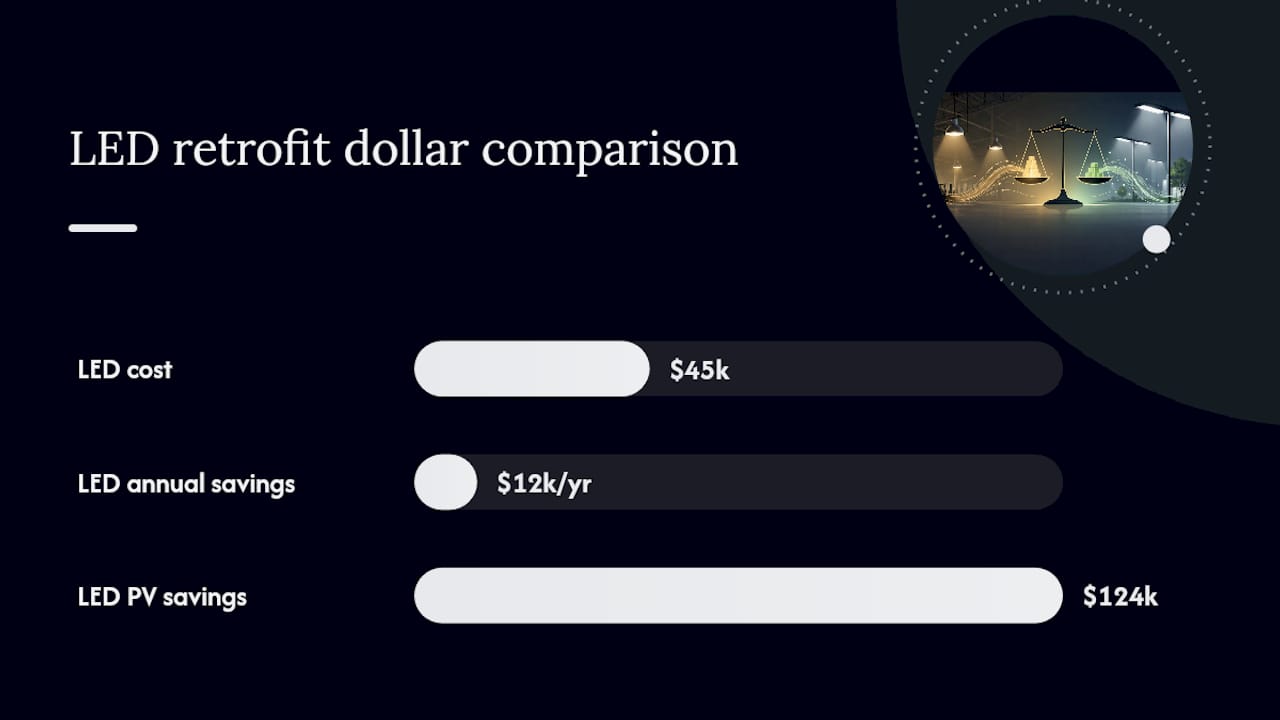
Auditors use three primary financial metrics to rank EEMs: simple payback, Savings-to-Investment Ratio (SIR), and Net Present Value (NPV).
Metric definitions and when each applies:
- Simple payback: Installed cost divided by annual savings. Useful for budget-minded owners evaluating quick wins. A payback under three years is generally considered low-risk.
- SIR: Lifetime savings (present value) divided by installed cost. An SIR above 1.0 means the measure pays back more than it costs over its life. Preferred for capital justification and life-cycle comparisons.
- NPV: Discounts all future cash flows at a chosen rate. Negative NPV means the measure destroys value at that discount rate; positive NPV confirms economic viability.
Sample calculation:
- LED retrofit installed cost: $45,000
- Estimated annual energy savings: $12,000
- Simple payback: $45,000 ÷ $12,000 = 3.75 years
- Assumed equipment life: 15 years; discount rate: 5%
- Present value of savings over 15 years: approximately $124,000
- SIR: $124,000 ÷ $45,000 = 2.76 (well above 1.0; strong justification)
A Level II audit presents these calculations for each EEM. Bundling a short-payback measure (LED retrofit, SIR 2.76) with a longer-payback measure (BAS upgrade, SIR 1.2) in a single capital request can improve overall portfolio SIR and make the combined project easier to approve. Value engineering approaches support this bundling analysis when capital budgets are constrained.
M&V: how auditors verify savings and what to expect post-installation
A credible audit includes a Measurement and Verification (M&V) plan that specifies how savings will be confirmed after implementation. Without it, owners have no way to validate that projected savings materialized.
Common M&V approaches:
- Utility bill analysis (normalized): Compares pre- and post-retrofit bills adjusted for weather (heating and cooling degree days) and occupancy changes. Suitable for whole-building measures.
- Sub-metering: Dedicated meters on specific systems (lighting circuits, chiller plant) isolate savings to individual EEMs.
- Spot measurements: Short-duration power measurements on motors, lighting panels, or plug loads to verify operating conditions.
- Calibrated simulation: Energy model calibrated to actual utility data, then re-run with retrofits applied. Used for complex Level III projects.
A plan that lacks these three elements cannot produce defensible results.*
Short case examples of audit findings and realized savings
A regional convention center case documented in PNNL’s audit guide achieved significant annual savings with a payback period under one year by correcting equipment scheduling, control setpoints, and system faults identified during the audit, with additional savings projected from longer-term capital replacements.

The no-cost and low-cost measures were implemented within 60 days of report delivery. Capital measures were sequenced in the following budget cycle, with sub-metering installed on the lighting circuits and AHU panels to support M&V. Post-installation utility analysis confirmed savings within the projected range.
How to read your audit report and convert findings to action
Use a structured checklist to move from report receipt to implemented savings. Owners who schedule a formal findings meeting within two weeks of delivery consistently capture more no-cost savings than those who defer.
Recommended action sequence:
- Schedule the findings meeting within 10 business days of report delivery. Bring facilities staff, the energy manager, and the finance lead.
- Extract no-cost measures into a work-order list. Assign each to a responsible technician with a completion date within 30 days.
- Implement low-cost measures within 60–90 days. Obtain two contractor quotes for any measure above $5,000.
- Submit capital measures to the budget cycle with SIR and NPV documentation from the audit. Bundle measures where the combined SIR exceeds 1.5.
- Activate the M&V plan at the same time as the first retrofit. Baseline data collection must begin before installation, not after.
- Review M&V results at 90 days and 12 months post-installation. Compare normalized utility consumption against the audit projection.
Sample timeline:
- Days 1–30: No-cost operational fixes (scheduling, setpoints, controls)
- Days 30–90: Low-cost retrofits (sensors, damper repairs, plug-load management)
- Months 3–12: Capital project design, bidding, and contractor selection
- Months 12–18: Capital installation and M&V baseline confirmation
Refer to design safety guidance when capital retrofits involve structural or mechanical modifications that require professional review.
Why audit reports sit on shelves and how to prevent it
Owners frequently commission audits and then fail to act on them. Three structural barriers account for most of this implementation gap, and each has a direct governance fix.
Barrier 1: Report shelfing. The audit arrives as a PDF, circulates briefly, and gets filed. Fix: assign a named implementation owner at the findings meeting and tie at least one no-cost measure to a 30-day completion deadline before the meeting ends.
Barrier 2: Fragmented decision-making. Facilities staff can implement operational fixes, but capital measures require finance approval that never gets formally requested. Fix: prepare a one-page capital summary using the audit’s SIR and NPV data and submit it as a budget line item within 45 days of report delivery.
Barrier 3: No M&V follow-through. Without verified savings data, the next audit cycle starts without credible baselines. Fix: require the auditor to include a written M&V plan as a deliverable, not an optional add-on, and assign a staff member to collect baseline meter readings before any retrofit begins.
The pattern across well-managed portfolios is consistent: owners who treat the audit report as a project initiation document rather than a reference document capture the savings. Those who treat it as a compliance exercise rarely do.
Aectechnicalsg supports your energy retrofit and compliance work

Building owners who have an audit report in hand but need qualified engineering support to implement capital measures, manage authority submissions, or coordinate M&E system upgrades will find that Aectechnicalsg’s engineering consultancy services cover the full scope from design through regulatory approval. Where capital retrofits involve structural modifications, mechanical system replacements, or changes requiring professional endorsement, Aectechnicalsg provides the qualified person supervision and PE endorsement and authority submission management that owners need to move from audit recommendation to completed, compliant installation. Contact Aectechnicalsg directly to discuss the engineering scope your audit findings require.
Sources
The following sources underpin the methods, metrics, and examples in this article:
- 74 Mount Auburn Street Energy Audit Report 12.09.11
- A Guide to Energy Audits (PNNL-20956)
- Building EQ energy-audit narrative report sample pages (ASHRAE)
- What to Expect from Your Energy Audit Report – Vital Communities
- StopWaste / ASHRAE Level 1 Audit sample (LEEDUser)
When evaluating capital measures, request that your auditor provide RSMeans-referenced cost estimates and a written M&V plan as standard deliverables, not optional additions.