
Your building must meet façade testing requirements under BCA’s Periodic Façade Inspection regime if it falls within the eligibility criteria, typically triggered by building age and height. The core mandated tests cover air permeability, water-tightness, and structural performance under Singapore Standard SS 654:2020. If you haven’t confirmed your building’s PFI status or appointed a Competent Person, that is your immediate next step.
TL;DR:
- Buildings must undergo façade testing every seven years if they meet age and height thresholds, with out-of-cycle tests triggered by visible damage or safety incidents.
- Tests for air permeability, water-tightness, and structural performance must follow SS 654:2020 standards, with proper sequencing to ensure accurate results.
- Mock-up specimens should replicate high-risk details, and drone surveys complement manual inspections but cannot replace pressure gauges or drainage checks.
- Engaging a qualified Competent Person ensures proper coordination, testing, and report submission via approved templates to avoid delays.
- Costs depend on mock-up fabrication, testing, and remedial work, with early planning and a full inspection checklist reducing the risk of rejection or project delays.
Table of Contents
- Who Must Comply and What Triggers an Inspection Cycle
- What Tests Are Required Under SS 654 and Related Standards
- How Mock-Ups, Field Tests, and Drone Surveys Fit Together
- Who Does What: Competent Person and Facade Inspector Roles
- Submitting Your PFI Report Without Delays
- Budgeting for Costs, Lead Times, and Sample Sizes
- A Practical Sequence for Getting Through PFI Compliance
- Why Testing Should Be Treated as Risk Management, Not Paperwork
- Getting Compliant Without the Guesswork
- Sources
- FAQ
Who Must Comply and What Triggers an Inspection Cycle
Building and Construction Authority (BCA) rules place façades on a recurring inspection clock, and missing that clock carries real legal exposure. The Periodic Facade Inspection (PFI) framework applies based on building age and height thresholds specified in BCA notices, and confirming your building’s status starts with checking the official notice sent to the owner or management corporation, not with guesswork.
Once a building qualifies, the standard cycle repeats every seven years. That interval is not negotiable simply because a façade “looks fine” from ground level.
Several conditions force testing outside the normal schedule:
- Visible spalling, cracking, or staining reported by occupants or passersby
- Major addition and alteration works that disturb façade cladding or curtain wall systems
- A safety incident, such as debris fall, anywhere on the building envelope
- A prior PFI report flagging deferred remedial items now due for follow-up
Owners should verify their standing directly against BCA’s published eligibility notices and the official list of accredited Competent Persons rather than relying on a contractor’s informal assessment.
What Tests Are Required Under SS 654 and Related Standards
Three performance tests anchor façade testing requirements in Singapore, and all three trace back to SS 654:2020 (incorporating Amendment 1:2023), the code of practice for metal-framed curtain walls.
- Air permeability measures how much air leaks through a wall assembly under a defined pressure differential, and it flags gaps in gasket seating or frame joints before they become water paths.
- Water-tightness covers both static and dynamic testing, often including field spray-rack methods that mirror wind-driven rain, with reference clauses aligned to methods adopted from ASTM and AAMA where SS 654 points to them.
- Structural performance applies proof loads to check deflection limits, confirming the frame and anchors survive design wind pressure without permanent distortion.
Statistic Callout: SS 654:2020 recommends full-scale or representative specimen testing before fabrication proceeds at scale, catching design flaws while correction is still cheap.
The order matters. Air testing typically runs first because a leaky joint will corrupt water-tightness results, and structural loading comes last since it can permanently deform a specimen you still need intact for the earlier tests. Skipping straight to structural testing, or testing a specimen that doesn’t match approved shop drawings, produces results that satisfy nobody during BCA review. Building Envelope Services from UL Solutions describes this same sequencing logic across commercial façade programs, not just Singapore projects.
How Mock-Ups, Field Tests, and Drone Surveys Fit Together
A laboratory mock-up exists to expose weaknesses before they reach the building, and a flat, defect-free panel tells you almost nothing useful. The specimen needs corners, slab edge conditions, parapets, and movement joints, since these high-risk details are where real façades actually fail.
The testing program generally follows this sequence:
- Build the mock-up with workmanship matching expected site conditions, not upgraded shop-quality assembly.
- Run air, then water, then structural tests in that order on the same specimen.
- Select field test locations, with roughly 10% close-range inspection as a common sampling benchmark, increasing where visible distress or prior repairs exist.
- Witness each test with a qualified reviewer confirming specimen fidelity, instrument calibration, and correct sequence.
- Deploy drones for broad visual screening, reserving manual close-range checks for anything the drone flags.
Drones speed up large-façade visual surveys, and accredited providers can cover elevations that would otherwise need rope access or a swing stage. But a drone camera can’t detect drainage failures or read a pressure gauge, so drone inspection work still needs manual verification wherever anomalies show up.
Pro Tip: Insist that your witnessing team includes someone who understands the project’s actual risk profile, not just a checklist auditor. A witness who knows the difference between a calibration certificate that’s current and one that expired last quarter is the difference between a clean report and a rejected submission.
Who Does What: Competent Person and Facade Inspector Roles
The Competent Person (CP) holds overall responsibility for the PFI submission, coordinating the inspection program and signing off on findings to BCA. The Facade Inspector (FI) handles the hands-on inspection work, including close-range checks and coordinating specimen testing where required.
Confirm any CP you engage against the official PFI resources, which list accredited professionals and clarify submission expectations. Look for these accreditation signals before signing an engagement letter:
- Registration as a Professional Engineer with relevant structural or façade experience
- Current listing on BCA’s published Competent Person register
- Testing labs referencing SAC accreditation for the specific test methods being run
- A scope letter that names the exact tests, standards, and specimen count, not vague language like “façade assessment as required”
Red flags that should prompt a second opinion include missing calibration records for test instruments, witness statements with no named individual attached, and reports that skip structural test data entirely while still claiming full SS 654 compliance. Owners can also cross-check unfamiliar contractors against ScamShield before releasing payment for testing services.
Submitting Your PFI Report Without Delays
BCA requires specific templates, not free-form reports. The PFI template and supporting guidance in the PFI Guidelines PDF spell out exactly what BCA expects attached: test certificates, signed witness statements, and dated photographic logs tied to specific façade zones.
Most straightforward PFI cycles move from inspection completion to submission within a few weeks, assuming no remedial works are flagged. A report identifying defects adds time for remedial planning and a follow-up approval round.
| Common pitfall | Why it delays approval |
|---|---|
| Specimen traceability gaps | Reviewers can’t confirm the tested unit matches installed units |
| Missing calibration records | Test validity can’t be verified against instrument accuracy |
| Insufficient sample size | BCA may request expanded close-range inspection before accepting the report |
| Incomplete witness statements | No independent confirmation the test sequence was followed correctly |
Building a short pre-submission checklist, matching every attachment against the official template before sending, catches most of these issues before BCA ever sees the file.
Budgeting for Costs, Lead Times, and Sample Sizes
Cost drivers break down predictably: lab mock-up fabrication and testing, field test mobilization, witness fees, and remedial works if the façade fails any criterion. Lab bookings often need several weeks of lead time, and witness scheduling should be locked in early since qualified reviewers run tight calendars during peak inspection seasons.
Statistic Callout: The close-range inspection benchmark referenced in PFI guidance serves as a starting point, and actual inspection coverage may need to be higher depending on visible deterioration or complexity. Any elevation with visible staining, prior repairs, or complex geometry justifies expanding beyond that minimum.
- Fold testing costs into a lifecycle maintenance plan rather than treating each PFI cycle as an isolated expense.
- Post-occupancy field testing catches leakage early, often at a fraction of what deferred water damage eventually costs.
- Partners like Haio offer complementary façade maintenance services worth folding into that same planning window.
A Practical Sequence for Getting Through PFI Compliance
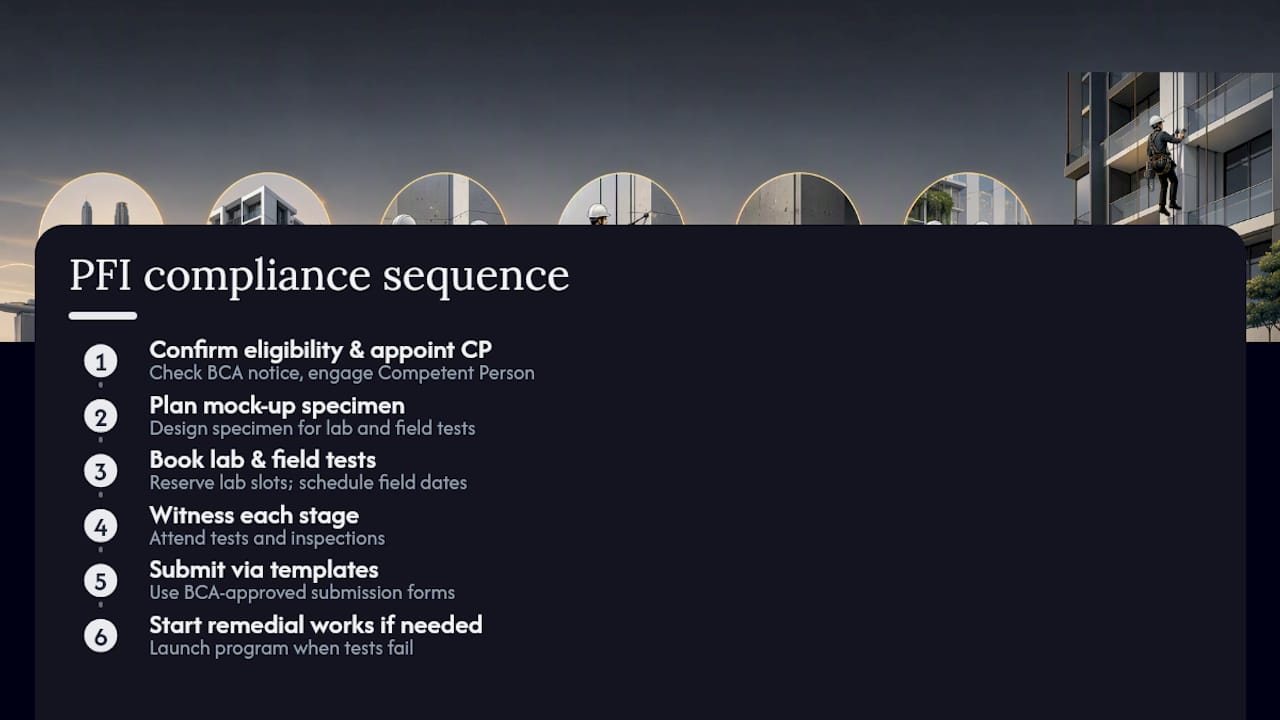
Run the process in order: confirm eligibility against BCA’s notice, appoint a Competent Person, plan the mock-up specimen, book lab and field tests, witness every stage, submit using the correct templates, and launch a remedial program if results demand it.
Real buildings rarely cooperate with a clean schedule. Phased testing around tenant access, coordinating façade contractors with other ongoing trades, and sequencing drone surveys before scaffold mobilization all keep the program moving without gridlock.
Why Testing Should Be Treated as Risk Management, Not Paperwork
Façade testing tells you something a visual walk-through never will: whether the assembly actually performs under load and weather, not just whether it looks intact. Owners who treat test records as handover assets, not filing-cabinet paperwork, get faster, cheaper PFI cycles down the road. Appoint a capable Competent Person early, document everything, and treat the next inspection as planned maintenance rather than a deadline to dread.
— Aman
Getting Compliant Without the Guesswork
Coordinating a full PFI cycle, from CP appointment through witnessed testing to a clean BCA submission, takes more moving parts than most facility teams manage day to day. A competent engineering consultancy can support coordination by appointing qualified Competent Persons, scheduling laboratory and field testing against SS 654 requirements, arranging independent witnessing, and preparing PFI reports using the correct official templates.
An engagement typically covers eligibility confirmation, specimen planning that accounts for your building’s actual high-risk details, full test documentation including calibration certificates and photographic logs, and submission support that avoids the common pitfalls that stall BCA review. If your building’s PFI window is approaching or a notice has already arrived, explore PE endorsement and authority submission support to see how the submission side of a compliant façade program actually comes together.
Sources
- Periodic Facade Inspection (PFI)
- SS 654:2020 (incorporating Amendment 1:2023)
- PFI template
- Building Envelope Services | UL Solutions
FAQ
What Are BCA’s Guidelines for Façade Inspections?
BCA’s PFI guidance sets eligibility by building age and height, requires appointment of a Competent Person, and mandates testing against SS 654 on a seven-year cycle unless out-of-cycle triggers apply.
What Should a Façade Inspection Checklist Include?
A complete checklist covers specimen traceability records, calibration certificates for test instruments, signed witness statements, dated photographic logs by façade zone, and confirmation that sample size meets or exceeds the close-range inspection benchmark.
How Do You Become a Façade Inspector in Singapore?
Facade Inspectors typically work under a registered Competent Person and build credibility through documented testing experience, accredited lab familiarity, and inclusion on recognized professional registers; Aectechnicalsg’s PFI guidance outlines how these roles are structured in practice.
How Much Does a Façade Inspection Cost?
Costs vary with building size, specimen complexity, and whether remedial works are needed, driven primarily by lab mock-up fabrication, field test mobilization, and witness fees rather than a fixed per-building rate.